
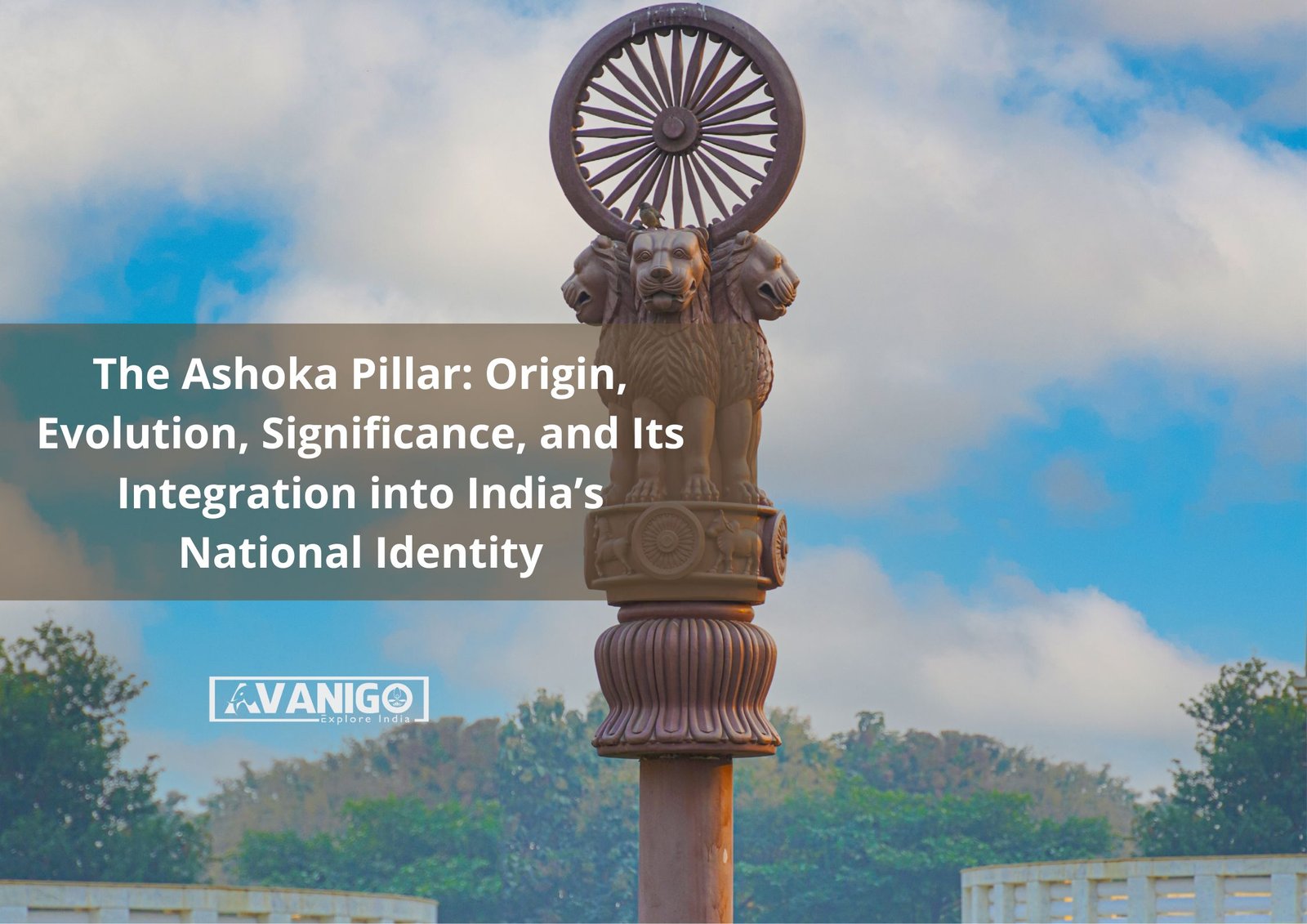
The Ashoka Pillar stands as one of the most authoritative visual markers of the Republic of India. Today’s adaptation, formally known as the State Emblem of India, is rooted in a two-thousand-year-old tradition of political governance, public communication, and cultural integration. More than a carved stone structure, the Ashoka Pillar represents a system of administrative ethics built on transparency, fairness, and moral responsibility. When the Government of India adopted the Lion Capital of Ashoka as the national emblem, it was not merely selecting an aesthetic symbol. It was choosing a historical foundation aligned with the country’s long-term nation-building objectives in the post-Indian independence period.
To understand why the Ashoka Pillar became one of the most important national symbols of India, it is necessary to analyse its origin, archaeological relevance, political messaging, and the administrative processes that led to its official adoption. Similarly, understanding the compliance framework, usage rules, and restrictions around the emblem is important because—like the national anthem Jana Gana Mana, the national bird (Peacock), the national flower (Lotus), the national flag, or the Parliament itself—the emblem operates within a governance-driven legal framework, not merely a cultural one.
This article covers the Ashoka Pillar comprehensively: the historical background of the Mauryan period, Emperor Ashoka’s governance model, the pillar’s architectural and symbolic elements, the transformation into the modern State Emblem, and the guidelines governing its usage by the public and government institutions.
Quick Navigation
Historical Origins of the Ashoka Pillars
The Ashoka Pillars were created during the third century BCE, under the rule of Emperor Ashoka (Ashoka the Great), the third ruler of the Mauryan Empire. After the destructive Kalinga War, Ashoka moved toward a governance model built on dharma, ethical responsibility, non-violence, administrative discipline, and welfare-oriented policies. To reinforce this shift, he commissioned a communication system across his empire using pillars, rocks, and inscriptions.
These pillars served multiple functions:
- Public Policy Communication: Ashoka used the pillars as channels to deliver imperial directives. They communicated rules of conduct, welfare practices, and justice procedures in simple language.
- Administrative Visibility: The pillars ensured that the Mauryan governance system was present in all key regions of the empire. Areas with pillars often overlapped with trade routes, urban centres, and border zones.
- Cultural Integration: The empire was large and multicultural, stretching across various linguistic and cultural zones. The pillars created a unified communication architecture.
- Moral Governance Promotion: Ashoka emphasised compassion, non-violence, and dispute resolution. The pillars advocated these principles openly.
Archaeologically, these pillars were crafted from single pieces of sandstone transported from specific quarries, often Chunar sandstone. Their polish, engineering precision, and uniform height demonstrate advanced craftsmanship.
The Lion Capital at Sarnath
Among all Ashoka Pillars, the most significant is the Lion Capital at Sarnath, which later became the State Emblem of India. Installed around 250 BCE, this pillar marked the location where the Buddha delivered his first sermon. The capital is structurally composed of:
- Four Asiatic Lions standing back-to-back, representing power, confidence, vigilance, and universal sovereignty.
- Abacus with Sculptures, including:
- A bull
- A horse
- An elephant
- A lion
These figures are separated by spoked wheels (Dharmachakra).
- The Wheel (Ashoka Chakra) itself, later adopted on the national flag.
The lions face four cardinal directions, symbolising the outward projection of ethical governance. The Dharma Chakra represents rule of law, continuity, balance, and disciplined power.
Rediscovery and Historical Research
During the colonial period, the remains of Ashokan monuments garnered attention from historians and archaeologists. The Lion Capital was excavated by F. O. Oertel in 1904–05. It became an important reference point for understanding the Mauryan Empire, early Indian stone art, and India’s administrative history.
Scholars studying polity, governance, and heritage emphasised its relevance not merely as a Buddhist symbol but as part of a larger Indian administrative system that predated many global governance traditions.
Transition from Archaeological Artifact to National Emblem
-
The Context of Indian Independence
After India achieved independence in 1947, leaders understood that the country needed a set of national symbols of India that reflected continuity, unity, and a long heritage of governance. The Constituent Assembly, responsible for drafting the Constitution, also had the responsibility of selecting appropriate national symbols to represent the Republic.
Symbols chosen included:
- National Flag
- National Anthem: Jana Gana Mana
- National Bird: Peacock
- National Flower: Lotus
- National Emblem (based on Ashoka Pillar)
The emblem needed to represent credibility, sovereignty, structural power, and civilisational depth. The Lion Capital at Sarnath was an obvious choice because it had no association with monarchy or religious exclusivity and was rooted in ethical governance.
-
Decision-Making by the Constituent Assembly
The adaptation process was supervised by:
- B. N. Rau
- Dr. Rajendra Prasad
- Other senior members of the Assembly
While discussions were ongoing, artists from Santiniketan—including Nandalal Bose and Dinanath Bhargava—worked on translating the sculpture into a two-dimensional format suitable for use on government documents.
The emblem was officially adopted on 26 January 1950, Republic Day, the day the Constitution came into force and Dr. Rajendra Prasad became the first President of India.
-
Adaptation Features
The modern emblem includes:
- The three visible lions (the fourth is hidden from view in 2D representation)
- The Ashoka Chakra
- The Bull
- The Galloping Horse
The inscription Satyameva Jayate, sourced from the Mundaka Upanishad, was added at the base. It means “Truth alone triumphs” and reinforces the administrative ethos of the Indian state.

Symbolic Significance in Modern Governance
The emblem operates on multiple levels within the Government of India’s administrative ecosystem.
-
Representation of Sovereignty
Just as the national flag, the national anthem Jana Gana Mana, and other national symbols serve as instruments of sovereign identity, the Ashoka Pillar emblem signals the authority of the Republic. It is used by:
- The Prime Minister’s Office
- The President of India
- The Parliament (Lok Sabha and Rajya Sabha)
- Ministries, departments, and constitutional authorities
- The Supreme Court and High Courts
- Law enforcement agencies
-
Representation of Rule of Law
The Ashoka Chakra embedded in the emblem aligns with:
- Transparent governance
- Continuity of lawful conduct
- Ethical responsibility
-
Cultural and Historical Continuity
By linking modern governance to the Mauryan administrative system, the emblem ensures that the Republic is not seen as a new construct but as a continuation of centuries of statecraft.
How the Ashoka Pillar Became the State Emblem of India
The process involved four stages:
Stage 1: Selection of a historically neutral yet culturally grounded symbol
The leadership sought a symbol free from colonial influence, royal messaging, or authoritarian overtones. The Ashoka Pillar met all criteria.
Stage 2: Review of archaeological evidence and artistic suitability
Experts analysed the original sculpture for representational clarity. The 2D adaptation required precision to reflect the same authority as the stone artifact.
Stage 3: Approval by the Constituent Assembly
After internal evaluations and design submissions, the Constituent Assembly formally approved the Lion Capital as the national emblem.
Stage 4: Legalisation and codification
The adoption became official on 26 January 1950. Since then, several acts regulate its usage, including:
- State Emblem of India (Prohibition of Improper Use) Act, 2005
- State Emblem of India Rules under the Ministry of Home Affairs
Frequently Asked Questions (FAQs) on the Ashoka Pillar
1. What is the Ashoka Pillar?
The Ashoka Pillar refers to a series of stone pillars erected during the reign of Emperor Ashoka in the 3rd century BCE. These pillars were used to communicate laws, moral principles, and administrative instructions across the Mauryan Empire.
2. Which Ashoka Pillar is India’s national emblem?
India’s national emblem is adapted from the Lion Capital of Ashoka, which originally stood on an Ashoka Pillar at Sarnath. It features four Asiatic lions standing back to back.
3. Why did Ashoka build the pillars?
Ashoka built the pillars to spread his policy of Dhamma, which focused on ethical conduct, non-violence, justice, social welfare, and respect for all communities. The pillars functioned as official public notices.
4. How many Ashoka Pillars exist today?
Archaeologists have identified around 40 Ashoka Pillars, though many are fragmented or damaged. About 20 pillars with inscriptions have survived in varying conditions across India and neighbouring regions.
5. What is written on Ashoka Pillars?
The inscriptions, known as Ashokan Edicts, are written mainly in Prakrit using the Brahmi script. Some edicts also appear in Kharosthi, Greek, and Aramaic. They discuss governance, justice, public welfare, and moral duties.
6. What do the four lions on the Ashoka Pillar represent?
The four lions represent power, courage, pride, and confidence. Facing all four directions, they symbolise vigilance and the authority of the state in every direction.
7. What is the Ashoka Chakra on the pillar?
The Ashoka Chakra is a wheel with 24 spokes symbolising law, movement, and progress. It later became part of the national flag of India, reinforcing continuity between ancient and modern governance.
8. When was the Ashoka Pillar adopted as India’s national emblem?
The Lion Capital of Ashoka was adopted as the State Emblem of India on 26 January 1950, the day the Constitution of India came into force.
9. What does “Satyameva Jayate” mean?
“Satyameva Jayate” means “Truth alone triumphs.” It is inscribed below the national emblem and reflects the ethical foundation of Indian governance.
10. Is it legal for individuals or companies to use the Ashoka Pillar emblem?
No. The use of the State Emblem is restricted by law. Unauthorized use by individuals, private companies, or organizations is prohibited under the State Emblem of India (Prohibition of Improper Use) Act, 2005.
11. Where can Ashoka Pillars be found in India?
Ashoka Pillars are found in locations such as Sarnath, Vaishali, Lauriya Nandangarh, Rampurva, Sanchi, and Allahabad. Many are preserved at their original sites or in museums.
12. Why is the Ashoka Pillar important in Indian history?
The Ashoka Pillar represents one of the earliest examples of organised governance, public administration, and ethical state communication in Indian history. Its adoption as the national emblem links ancient Indian statecraft with the modern Republic.
Essay on Ashoka Pillar for Students (100 Words)
The Ashoka Pillar is an important historical monument from ancient India. It was built by Emperor Ashoka in the 3rd century BCE to spread messages of good governance, peace, and moral values. The most famous Ashoka Pillar is at Sarnath, which has four lions standing back to back. This Lion Capital was adopted as the national emblem of India in 1950. The pillar shows the importance of truth, justice, and law. It reminds citizens that India’s governance is based on strong ethical and historical foundations.

Ashoka Chakra Usage Guidelines, Rules, and Restrictions
The emblem’s use is restricted and regulated. Misuse is a punishable offence. Key guidelines include:
- Who can legally use the emblem
Only authorised government institutions may use the emblem. These include:
- Ministries of the Government of India
- Constitutional bodies
- Central and State legislatures
- Government departments
- Indian embassies
- Law enforcement agencies
Private entities, NGOs, startups, and individuals cannot use it on:
- Products
- Business cards
- Websites
- Marketing material
- Event backdrops
- Use in official documentation
The emblem appears on:
- Passports
- Currency notes
- Government certificates
- Official stationery
- Gazettes
- Identity cards of authorised officials
- Prohibited uses
Misuse includes:
- Commercial endorsement
- Use in advertisements
- Use on private event branding
- Use for political promotion
- Use by non-government organisations without approval
Violations can lead to:
- Fines
- Seizure of material
- Legal action under the 2005 Act
- Design guidelines
The government mandates:
- No distortion of proportions
- No colour modification except permitted versions
- No alteration of text
- No artistic reinterpretations for commercial use
- Digital usage compliance
With increasing reliance on digital government services, the Ministry of Home Affairs has issued specifications for:
- DPI standards
- Minimum size
- Background colour compatibility
- Vector formats for print and screen
The Ashoka Pillar in Public Education and Awareness
Apart from governance, the emblem forms part of school-level civic learning alongside other national symbols such as:
- National Anthem: Jana Gana Mana
- National Bird: Peacock
- National Flower: Lotus
- National Song: Vande Mataram
- National Flag
Students learn:
- The history of the emblem
- Its ethical meaning
- Rules around correct usage
- Respect protocols
This aligns with nation-building priorities.
The Emblem and Its Role in Modern National Identity
In a diversified nation, the emblem works as a unifying factor, just as the Parliament, the Constitution, and the office of the Prime Minister serve as institutions of collective identity. Its presence on passports and currency reinforces India’s identity in global contexts.
The emblem is not limited to ceremonial representation; it is embedded in strategic communication, security, and diplomatic relations. It serves as the definitive visual assurance of authority when used by government agencies.

Architectural Influence and Replication
Many government buildings replicate the Ashoka Pillar aesthetically in:
- Columns
- Entrance gateways
- Interior motifs
The Parliament Complex, state assemblies, and judicial buildings frequently incorporate the motif as a representation of continuity and authority.
Public Perception and Modern Interpretations
Unlike symbols such as the national anthem or national flag, which have public-facing rules for participation (e.g., standing during the anthem), the emblem is not associated with citizen rituals. Its perception is administrative rather than ceremonial.
Digital public platforms often feature the emblem, but unofficial reproduction remains prohibited. Citizens understand it as a marker of government legitimacy rather than personal affiliation.
The Ashoka Pillar in International Diplomacy
The emblem appears on:
- Diplomatic mission signage
- Seals of Indian embassies
- Treaties and international agreements
It reinforces India’s sovereign status and historical depth.
Conclusion
The Ashoka Pillar is not merely an archaeological artifact or a decorative heritage piece. Through its transformation into the State Emblem of India, it has become a cornerstone of the Republic’s identity. It links modern India to an ancient governance system rooted in ethical leadership and public welfare. Like the national anthem Jana Gana Mana, the national bird, or the national flower, it is one of the key national symbols of India. Its presence across the offices of the President, Prime Minister, and Parliament signifies authority and continuity. Its usage is tightly regulated to maintain the sanctity and credibility associated with state power.
As India moves forward in the global arena, the Ashoka Pillar continues to represent a structured, historically grounded national identity built on truth, justice, and accountable governance.

Swetha is a Content Specialist, LinkedIn Branding and B2B Marketing Consultant. When she is not in the world of B2B, she researches the roots and beauty of Indian Culture and Traditions. She is the author of the book: 365 Days 365 Posts – The Guide to LinkedIn Personal Branding, available exclusively on Amazon. Connect with her on LinkedIn.