
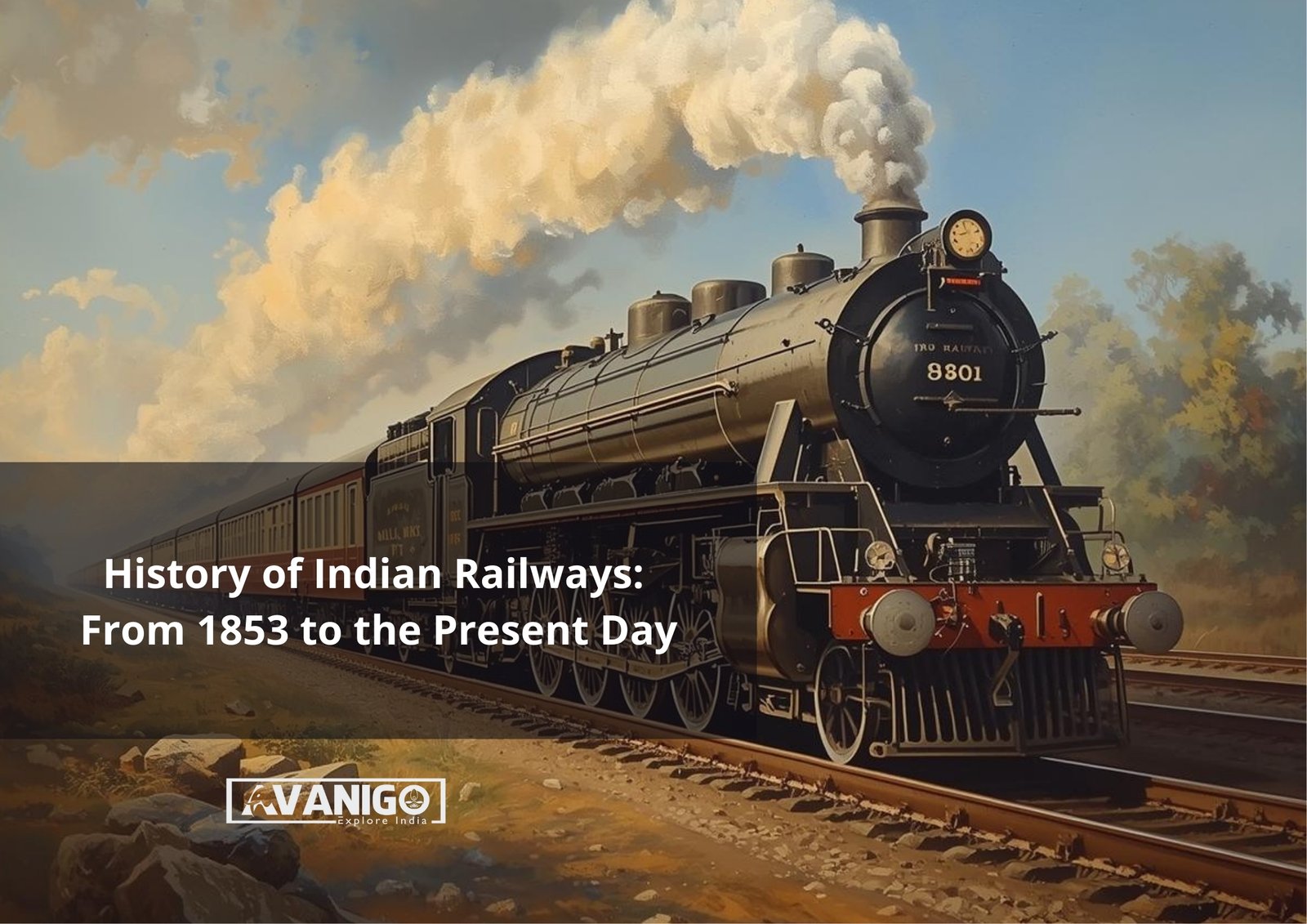
Indian Railways is one of the largest railway systems in the world. It connects almost every part of India and carries millions of passengers every day. Trains are used by students, workers, farmers, tourists, and businesspeople. Because of this, Indian Railways plays a very important role in daily life.
The history of Indian Railways is closely connected with the history of modern India. It began during British rule, expanded during the freedom movement, and grew rapidly after independence. Over time, it has changed from steam engines to electric trains and from paper tickets to online booking.
Quick Navigation
The First Train in India (1853)
The story of Indian Railways began on 16 April 1853. On this day, the first passenger train ran from Bombay (now Mumbai) to Thane, covering a distance of about 34 kilometers.
The train had:
- 14 passenger coaches
- About 400 passengers
- Three steam engines named Sahib, Sindh, and Sultan
This journey marked the beginning of railway transport in India.
The British introduced railways mainly to:
- Transport raw materials like cotton and coal
- Move soldiers quickly
- Connect ports with inland areas
At that time, railways were not built mainly for Indian passengers, but they slowly became useful for the general public.
Expansion of Railways During British Rule
After the first train, railway lines started expanding rapidly across India.
By the late 1800s:
- Major cities such as Calcutta (Kolkata), Madras (Chennai), Delhi, and Bombay were connected
- Railways helped move goods like grain, coal, and textiles
- Many private British companies operated different railway lines
However, this system had problems:
- Different companies used different rules
- Railways were not planned for Indian needs
- Safety and passenger comfort were limited
Even with these issues, railways changed how people traveled and communicated across regions.
Railways and Indian Society
Railways brought big changes to Indian society.
Important social impacts:
- People from different regions met each other
- Travel became faster and cheaper than before
- Farmers could sell their crops in distant markets
- Newspapers and ideas spread more easily
Railways helped people feel that they were part of one country rather than separate regions.
Role of Railways in the Freedom Movement
Indian Railways played an important role in India’s freedom struggle.
- Freedom fighters traveled by train to attend meetings
- Leaders like Mahatma Gandhi used trains to reach people across India
- Protest messages and newspapers spread faster
Although railways were built by the British, they became a tool for national unity and awareness among Indians.
Indian Railways at the Time of Independence (1947)
When India became independent in 1947, the railway system faced many challenges.
Problems after independence:
- The railway network was divided due to Partition
- Many trains and tracks were damaged
- A large number of skilled workers had migrated
The Indian government took control of the railways and decided to run them as a single national system. This helped improve planning and coordination.
Formation of Indian Railways as a National System
After independence:
- Railways were nationalized
- Different railway companies were merged
- Indian Railways became a government-owned organization
The main goals were:
- Rebuild damaged infrastructure
- Connect remote and rural areas
- Support economic growth and national integration
Railways were seen as a public service, not just a business.
Zonal System and Administration
To manage such a large network, Indian Railways was divided into zones and divisions.
Each zone:
- Manages trains, tracks, and stations in its area
- Looks after safety, maintenance, and staff
- Reports to the Ministry of Railways
This system made administration more organized and efficient.
Change from Steam to Diesel and Electric Trains
In the early years, trains ran on steam engines, which used coal and water. These engines:
- Produced a lot of smoke
- Needed frequent maintenance
- Were slow and costly
Later, Indian Railways introduced:
- Diesel engines, which were cleaner and more powerful
- Electric trains, which were faster and more energy-efficient
Today, most major routes are electrified. Electrification reduces fuel costs and pollution.
Growth of Passenger and Freight Services
Indian Railways is not only about passenger trains.
It also plays a major role in:
- Transporting coal to power plants
- Moving food grains across states
- Carrying cement, steel, and fuel
Freight trains support industries and help keep prices stable.
Passenger services also expanded with:
- Express and mail trains
- Suburban trains in big cities
- Long-distance and short-distance routes
Introduction of IRCTC and Online Booking
In 1999, the government created IRCTC.
IRCTC manages:
- Online ticket booking
- Catering services on trains
- Railway tourism packages
Online ticket booking started in 2002. This made it easier for people to:
- Book tickets from home
- Check train schedules
- Avoid long queues at stations
Today, millions of tickets are booked online every day.
Safety Improvements and New Technology
Safety has always been an important concern.
Indian Railways has introduced:
- Better signaling systems
- Automatic train protection technologies
- Improved tracks and bridges
Modern coaches in Indian Railways such as LHB coaches are safer and more stable than older designs.
New technology helps reduce accidents and improve passenger confidence.
Indian Railways in the 21st Century
In recent years, Indian Railways has focused on modernization.
Key areas include:
- Faster trains such as Vande Bharat Express
- Clean energy and electrification
- Better stations and passenger facilities
- Digital services and apps
Railways are also working towards sustainability by reducing carbon emissions.
Importance of Indian Railways Today
Today, Indian Railways:
- Connects remote villages to big cities
- Supports trade and industry
- Provides affordable travel for all income groups
- Employs a large workforce
It is often called the lifeline of the nation because of its role in daily life and development.
Conclusion
From a short steam-powered journey in 1853 to one of the world’s largest railway networks, Indian Railways has grown along with India. It has survived wars, Partition, economic changes, and technological shifts. Even today, it continues to evolve to meet the needs of a growing country.
Indian Railways is not just a transport system. It is a symbol of connection, progress, and national unity.
FAQs: History of Indian Railways
- When did Indian Railways start?
Indian Railways started on 16 April 1853 with the first train from Bombay to Thane. - Who introduced railways in India?
Railways were introduced by the British during colonial rule. - Why were railways built in India originally?
They were built mainly for trade, transport of goods, and military movement. - How did railways help the freedom movement?
They helped leaders travel, spread ideas, and unite people from different regions. - What happened to railways after independence?
They were nationalized and reorganized by the Indian government. - What is IRCTC?
IRCTC manages online ticket booking, catering, and railway tourism. - Are all trains in India electric?
No, but most major routes are electrified, and electrification is expanding. - Why are railways important for India?
They support travel, trade, employment, and national integration. - What were steam engines replaced with?
Steam engines were replaced by diesel and electric engines. - Is Indian Railways one of the largest in the world?
Yes, it is among the largest railway networks globally.