
Quick Navigation
Kerala Is Now ‘Keralam’: Cultural Identity and Political Significance of the State’s Name Change
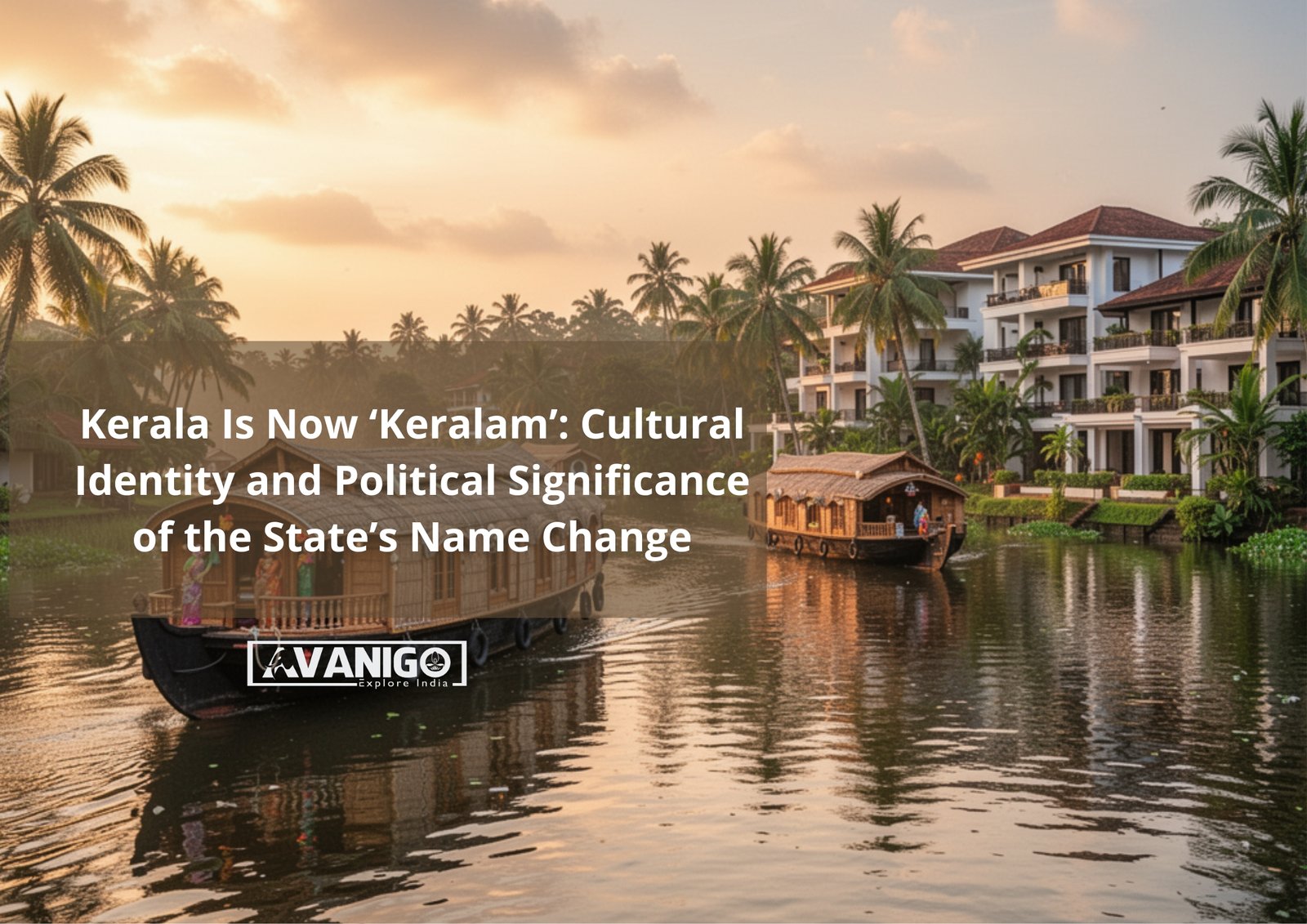
The Union Cabinet has approved the proposal to rename the state of Kerala as Keralam.
The decision marks a significant moment in India’s ongoing effort to align official nomenclature with linguistic and cultural realities. While the change may appear administrative on the surface, its implications extend into history, identity, and federal policy.
For a state deeply rooted in literary tradition, maritime trade history, and linguistic pride, the shift from “Kerala” to “Keralam” is not merely cosmetic. Kerala is now Keralam. It is symbolic.
A Name Rooted in Antiquity
The origins of the word “Kerala” trace back over two millennia.
Historical references appear in:
- Sangam literature of ancient Tamilakam
- Ashokan edicts referring to southern polities
- Classical Greco Roman trade accounts
- Early inscriptions connected to the Chera dynasty
The Cheras were among the three major Tamil dynasties of early South India. Their territory is widely associated with the region that later evolved into present day Kerala.
Over centuries, the pronunciation and usage of the region’s name varied. In Malayalam, the native language of the state, the land has long been called “Keralam.” The anglicized “Kerala” became standard during colonial administration and later entered official usage in independent India.
The Cabinet’s approval effectively restores the phonetic integrity of the Malayalam form.
Quick Facts
New Name: Keralam
Old Official Name: Kerala
Reason for Change: Linguistic and cultural alignment
Language Basis: Malayalam
Meaning: Land of coconuts
Approval Status: Union Cabinet approved
What Does “Keralam” Mean?
The word “Keralam” carries layered interpretations.
Scholars commonly associate it with:
- “Kera,” meaning coconut tree
- “Alam,” meaning land
Together, it suggests “the land of coconuts,” an apt description of the state’s coastal ecology and agrarian landscape.
More importantly, “Keralam” reflects how the people of the state refer to their homeland in their own language. The suffix “am” is linguistically natural in Malayalam. Its omission in English usage was a product of transliteration conventions rather than local preference.
The renaming aligns the official designation with lived linguistic identity.
Administrative Context of the Kerala Renaming
The proposal to rename Kerala as Keralam was passed earlier by the state legislature. The Union Cabinet has now approved the change, moving the process forward at the national level.
Renaming a state in India requires:
- A resolution from the state legislature
- Consideration by the Union government
- Parliamentary approval for formal constitutional amendment
India has witnessed similar city name changes before.
Examples include:
- Bombay to Mumbai
- Madras to Chennai
- Orissa to Odisha
- Pondicherry to Puducherry
These changes were typically driven by linguistic authenticity and decolonization of official names.
The Keralam decision follows this established precedent.
Cultural Assertion in a Federal Framework
Names function as markers of identity.
In multilingual federal systems like India, linguistic recognition carries political and cultural weight. The Constitution recognizes multiple official languages and allows states to preserve their regional identity within the Union.
The renaming can be viewed as:
- An affirmation of Malayalam linguistic heritage
- A move toward phonetic accuracy
- A continuation of postcolonial cultural alignment
For many residents, the state has always been Keralam in speech and literature. The formal recognition brings official terminology in line with cultural usage.

Historical Continuity and Civilizational Memory
Kerala’s history includes:
- Ancient spice trade with Rome and the Arab world
- Early Christian and Jewish settlements
- Maritime exchanges across the Indian Ocean
- A strong tradition of literature and performing arts
Through these centuries, the regional identity remained anchored in language and geography.
By adopting “Keralam,” the state reinforces continuity between:
- Ancient Chera territory
- Medieval maritime Kerala
- Modern linguistic state formation in 1956
- Contemporary federal India
The change underscores that history is not static. It evolves through reinterpretation and reclamation.
Economic and Global Considerations
Kerala has built a global brand associated with:
- Backwater tourism
- Ayurveda and wellness
- Literacy and human development indicators
- Diaspora presence in the Gulf region
One question raised in public discourse concerns international recognition. Will “Keralam” affect tourism branding or global familiarity?
Experience from other Indian name changes suggests:
- Transitional adjustment in documentation
- Minimal long term economic disruption
- Gradual normalization in international usage
Mumbai, Chennai, and Odisha today face no confusion in global trade or tourism markets. The same trajectory is expected for Keralam.
Public and Political Perspectives
Reactions to the renaming have been varied but measured.
Supporters argue that:
- The change corrects a colonial era anglicization
- It strengthens linguistic pride
- It reflects the will of the state legislature
Critics question:
- Administrative costs of updating records
- Practical challenges in documentation
- Whether the move is symbolic rather than structural
However, such debates are not new in India’s renaming history. Similar concerns accompanied earlier transitions, most of which stabilized quickly.
Part of a Broader National Pattern
Across India, the past three decades have seen efforts to revisit place names.
These changes often aim to:
- Reflect indigenous pronunciation
- Restore historical references
- Remove colonial imprints
- Align official language with local usage
The renaming of Kerala to Keralam fits within this broader pattern of linguistic recalibration.
It signals an ongoing conversation about how India chooses to represent itself, both domestically and internationally.
Why This Change Matters
At its core, the shift from Kerala to Keralam is about coherence between identity and nomenclature.
It represents:
- Alignment of state name with Malayalam linguistic structure
- Recognition of historical continuity
- Assertion of regional heritage within a federal system
Names are more than labels. They carry historical memory, cultural identity, and political meaning.
For residents of the state, “Keralam” is not new. It is familiar. It is spoken daily. The Cabinet approval simply formalizes what has long existed in language and literature.
Conclusion
The Union Cabinet’s approval to rename Kerala as Keralam marks an important moment in India’s cultural and administrative evolution.
The decision does not alter geography or governance. It does not redefine policy or economy.
What it does is align official identity with linguistic authenticity.
In a nation defined by diversity and layered histories, such recalibrations are part of an ongoing process of self definition.
Keralam, as it has long been called in Malayalam, now moves closer to becoming its formal name in the constitutional record.
For a state whose history stretches from ancient maritime trade to modern global connectivity, the change represents continuity rather than rupture.
It is, in essence, a return to its own voice.
Frequently Asked Questions About Kerala’s Renaming to Keralam
Why is Kerala being renamed to Keralam?
Kerala is being renamed to Keralam to align the state’s official name with its Malayalam linguistic form. “Keralam” is how the name is pronounced and written in the state’s native language. The change reflects cultural authenticity and corrects the anglicized version used during colonial and postcolonial administrative practice.
Has the Union Cabinet approved the name change?
Yes. The Union Cabinet has approved the proposal to rename Kerala as Keralam. The proposal was earlier passed by the state legislature. The change now proceeds through the formal constitutional process required for renaming an Indian state.
What does the word “Keralam” mean?
“Keralam” is commonly interpreted as:
- Kera meaning coconut tree
- Alam meaning land
Together, it translates to “land of coconuts.” The term reflects the state’s geography and agricultural landscape. More importantly, it represents the original Malayalam linguistic form of the name.
Is Keralam a new name?
No. “Keralam” is not a new name. It has been used in Malayalam language, literature, and cultural references for centuries. The change formalizes existing linguistic usage rather than creating a new identity.
Will the name change affect tourism or branding?
Based on previous Indian state and city name changes, long term impact on tourism or branding is expected to be minimal. Transitional updates in documentation and communication may occur, but international recognition typically stabilizes over time.
Does renaming a state require constitutional changes?
Yes. Renaming a state in India requires:
- A resolution passed by the state legislature
- Approval from the Union Cabinet
- Parliamentary approval to amend relevant constitutional references
This ensures federal and legal consistency.
How is this different from earlier state name changes?
The Kerala to Keralam change follows a pattern seen in:
- Bombay to Mumbai
- Madras to Chennai
- Orissa to Odisha
- Pondicherry to Puducherry
Like those transitions, this change emphasizes linguistic authenticity and regional identity rather than administrative restructuring.
Is Kerala officially Keralam now?
The Union Cabinet has approved the proposal. Final implementation depends on completion of the parliamentary and constitutional process. Once notified, Keralam will become the official name in all central records.

Swetha is a Content Specialist, LinkedIn Branding and B2B Marketing Consultant. When she is not in the world of B2B, she researches the roots and beauty of Indian Culture and Traditions. She is the author of the book: 365 Days 365 Posts – The Guide to LinkedIn Personal Branding, available exclusively on Amazon. Connect with her on LinkedIn.