
Vedic astrology and Western astrology are two distinct astrological traditions that interpret the positions of celestial bodies through different systems of calculation and interpretation. Although both use birth charts, zodiac signs, and planetary positions, they differ in their zodiac reference points, treatment of lunar constellations, timing techniques, and interpretive traditions.
Vedic astrology, commonly known as Jyotisha or Indian astrology, is associated with the Indian subcontinent and its historical calendar, astronomical, and astrological traditions. Western astrology developed through ancient Mesopotamian, Greek, and Roman traditions and subsequently evolved into several different schools of practice.
One of the most widely discussed differences is the zodiac system. Most contemporary Vedic astrology practitioners use the sidereal zodiac, while mainstream Western astrology generally uses the tropical zodiac. This distinction can result in different zodiac sign placements for the same birth details.
Understanding these differences provides a clearer picture of how the two systems developed and why their interpretations are not always interchangeable.
Quick Navigation
What Is Vedic Astrology?
Vedic astrology, widely referred to as Jyotisha, is an Indian astrological tradition with historical connections to astronomical calculations, calendrical practices, and religious observances.
The Sanskrit term Jyotisha is associated with celestial bodies and the study of heavenly phenomena. Early Indian Jyotisha included calendrical calculations used to determine appropriate dates for ritual observances. Over subsequent centuries, Indian astrological traditions developed more elaborate methods for interpreting planetary positions and preparing individual birth charts.
A central element of contemporary Vedic astrology is the Janma Kundali, or birth chart. It represents the calculated positions of celestial bodies at a person’s birth and is interpreted according to established astrological conventions.
Several concepts are particularly important in this system:
- Rashis: The twelve divisions of the zodiac, commonly associated with the zodiac signs.
- Grahas: Nine traditionally recognised astrological entities comprising the Sun, Moon, Mars, Mercury, Jupiter, Venus, Saturn, Rahu, and Ketu.
- Nakshatras: Twenty-seven lunar mansions used to describe divisions of the zodiac associated with the Moon’s position.
- Dashas: Planetary periods used in many Vedic astrological traditions to organise interpretations of different phases of life.
- Muhurta: The traditional practice of selecting a time considered suitable for a particular activity.
- Panchang: A traditional Hindu almanac based on five calendrical elements: Tithi, Nakshatra, Yoga, Vara, and Karana.
These concepts form part of a broader tradition that includes different interpretive schools and calculation methods. The term Vedic astrology is widely used today, although the historical development of Indian astrology extends across multiple periods and textual traditions.
What Is Western Astrology?
Western astrology developed through several historical stages, drawing on Mesopotamian astronomical and astrological traditions and the Hellenistic world of ancient Greece and Rome.
During the Hellenistic period, astrologers developed systematic approaches to interpreting celestial positions in relation to individuals and events. Greek-language astrological texts subsequently influenced the transmission and development of astrology across other regions.
Western astrology today encompasses multiple schools. Popular Sun-sign astrology is one familiar form, but professional astrological practice may involve a much more detailed interpretation of the natal chart.
A Western natal chart typically represents the positions of celestial bodies for a particular date, time, and location. Depending on the tradition, its interpretation may consider:
- Zodiac signs: The twelve divisions of the zodiac used to interpret planetary placements.
- The Sun and Moon: Two central components of natal chart interpretation.
- Planets: Their positions within signs and houses.
- Houses: Twelve chart divisions associated with different areas of life in astrological interpretation.
- Aspects: Angular relationships between celestial bodies within the chart.
- Transits: The movements of celestial bodies in relation to positions in a natal chart.
Modern Western astrologers may also use Uranus, Neptune, Pluto, and additional calculated points, depending on their approach.
Unlike the popular image of Western astrology as a system based exclusively on Sun signs, detailed natal astrology considers several interacting chart components.
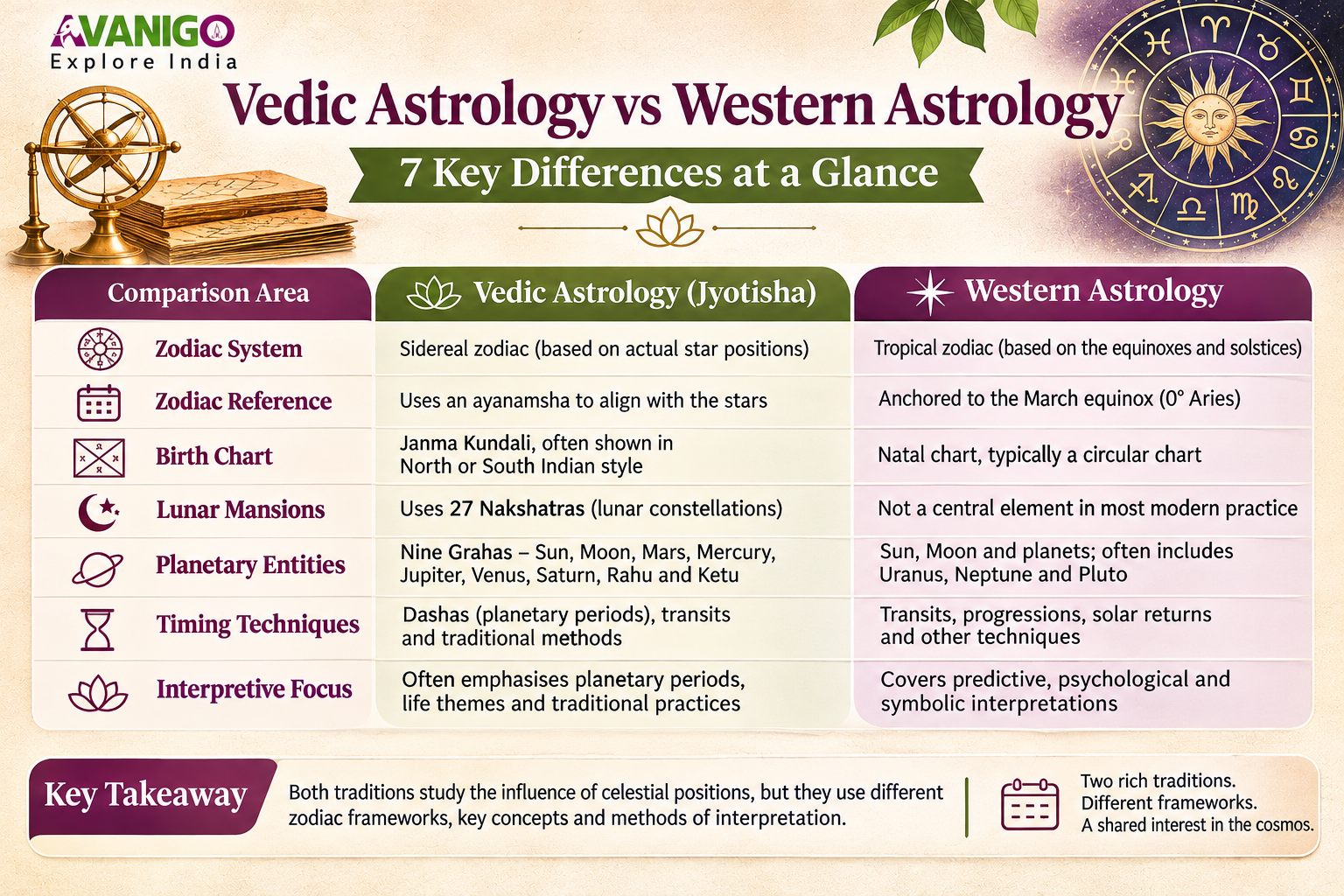
Vedic Astrology vs Western Astrology: 7 Key Differences
Although the two traditions share some terminology and concepts, their methods and interpretations can differ considerably.
| Feature | Vedic Astrology | Western Astrology |
| Common zodiac system | Sidereal zodiac | Tropical zodiac in most mainstream practice |
| Zodiac reference | Uses a stellar reference framework and an ayanamsha convention | Anchors the zodiac to the equinoxes and solstices |
| Birth chart | Commonly called a Janma Kundali | Commonly called a natal chart |
| Lunar mansions | Nakshatras are a major component | Not central to most mainstream modern Western astrology |
| Planetary entities | Traditionally works with nine Grahas, including Rahu and Ketu | Commonly uses the Sun, Moon, and planets; modern schools may include Uranus, Neptune, and Pluto |
| Timing techniques | Dashas, transits, and other traditional methods | Transits, progressions, solar returns, and other techniques, depending on the school |
| Interpretive emphasis | Many schools emphasise planetary periods, traditional predictive techniques, and life themes | Approaches range from predictive astrology to psychological and symbolic interpretations |
These are general distinctions rather than absolute rules. Both traditions contain multiple schools, and practitioners may use different methods within the same broad framework.
1. Sidereal Zodiac vs Tropical Zodiac
The zodiac reference system is one of the most significant differences between Vedic astrology and mainstream Western astrology.
The sidereal zodiac, commonly used in Vedic astrology, uses a reference framework linked to the stars. Indian astrological calculations commonly incorporate an ayanamsha, an adjustment representing the angular difference between the sidereal and tropical reference systems.
The tropical zodiac, commonly used in Western astrology, is anchored to the equinoxes and solstices. Its first degree of Aries is defined by the March equinox rather than by the current position of a particular star.
Earth’s rotational axis slowly changes orientation through a phenomenon known as axial precession. Consequently, the equinoxes shift relative to the background stars over long periods.
Because the two zodiac systems use different reference points, the same celestial longitude can be assigned to different zodiac signs in the two systems.
This difference concerns the framework used to define the zodiac. It does not mean that the planets themselves occupy different physical positions.
2. Why Zodiac Signs Can Differ
A person who identifies as an Aries in Western astrology may receive a different Sun-sign placement under a Vedic astrology calculation.
The reason is that the two systems commonly use different zodiac reference points.
A tropical chart calculates the Sun’s zodiac position relative to the equinox-based zodiac. A sidereal chart calculates it using a sidereal framework and the selected ayanamsha.
The resulting sign placements may therefore differ, particularly for births near a sign boundary. The exact result depends on the birth details and calculation conventions.
It is also important to distinguish the Sun sign from the Moon sign and Ascendant. These are separate chart components, and their placements need to be calculated individually.
A meaningful comparison should therefore use the same birth date, recorded birth time, and birthplace, while clearly identifying the zodiac system and calculation method used.
3. Nakshatras and Lunar Mansions
Nakshatras are a distinctive and important feature of Vedic astrology.
The commonly used system divides the zodiacal circle into twenty-seven lunar mansions. Each occupies 13 degrees and 20 minutes of the zodiac, creating a framework for describing the Moon’s position.
Nakshatras feature in several aspects of Vedic astrological interpretation, including birth-chart analysis and the calculation of certain planetary periods.
Mainstream modern Western astrology generally places greater emphasis on the twelve zodiac signs, planetary placements, houses, and aspects. Lunar mansions are not a central feature of most contemporary Western natal astrology, although some Western practitioners use related systems.
The difference reflects the distinct methods and historical developments of the two traditions.
4. Different Approaches to Planetary Entities
Vedic astrology traditionally recognises nine Grahas: the Sun, Moon, Mars, Mercury, Jupiter, Venus, Saturn, Rahu, and Ketu.
Rahu and Ketu are associated with the lunar nodes, the points where the Moon’s orbital path intersects the ecliptic. They are calculated astronomical points rather than physical planets.
Western astrology also recognises the Sun and Moon as central chart components. Its planetary framework commonly includes Mercury, Venus, Mars, Jupiter, and Saturn, while modern practitioners often include Uranus, Neptune, and Pluto.
These choices influence chart interpretation.
For example, Rahu and Ketu have established roles in Vedic astrology, whereas Uranus, Neptune, and Pluto feature prominently in many modern Western astrological interpretations.
This distinction should not be overstated. Western astrology includes different schools, and the planets and points considered important depend on the practitioner’s chosen approach.
5. Birth Charts and Their Interpretation
Both traditions use charts calculated from birth details, but they organise and interpret chart information through different conventions.
A Vedic birth chart commonly uses a twelve-house framework alongside Rashis, Grahas, Nakshatras, and other traditional elements. North Indian and South Indian chart formats are two familiar ways of displaying the chart.
Western astrology also uses twelve houses, zodiac signs, and planetary positions. Its chart is frequently displayed as a circular wheel, with signs, houses, and planetary aspects represented around the circle.
The visual difference is easy to recognise, but chart appearance is not the main distinction. The more important differences concern the zodiac reference system, calculation conventions, and rules used to interpret placements.
Neither the shape of the chart nor its visual format, by itself, determines how an astrologer interprets it.
6. Different Timing Techniques
Timing techniques are another area where the two traditions often differ.
In Vedic astrology, Dashas are planetary periods used by many practitioners to structure interpretations of different life phases. The Vimshottari Dasha system is particularly well known. Its calculations depend on the Moon’s position within a Nakshatra at birth.
Vedic practitioners may also consider planetary transits and other timing methods.
Western astrology uses several techniques, including transits, secondary progressions, solar returns, and other methods that vary by school.
A transit compares current planetary positions with positions in a natal chart. Secondary progressions use a symbolic relationship between days after birth and years of life. A solar return chart is calculated for the time when the Sun returns to its natal zodiacal position.
These techniques have different calculation rules and interpretive traditions. They should not be treated as equivalent simply because both systems use planetary positions to discuss timing.
7. Cultural Context and Contemporary Practice
Vedic astrology and Western astrology have developed within different historical and cultural settings.
In India, Jyotisha has connections with traditional calendars, Hindu religious observances, Panchang, and the selection of auspicious times for certain activities. Contemporary practice varies by region, community, and practitioner.
Western astrology has also evolved considerably. Its modern forms include traditional approaches that draw on historical texts as well as psychological and symbolic interpretations developed in more recent periods.
Today, people may encounter either tradition through books, websites, consultations, software, and mobile applications. Some explore astrology as part of cultural heritage, while others approach it as a system of symbolic interpretation.
These contemporary uses do not erase the differences in the traditions’ historical development or technical methods.
Is Vedic Astrology Older Than Western Astrology?
This question requires a careful distinction between early Indian calendrical astronomy, Indian astrological traditions, and the development of horoscopic astrology.
Early Indian Jyotisha included calendrical calculations and methods for tracking lunar and solar cycles. Over time, Indian astrology developed additional systems for interpreting birth charts.
Western astrology also has a long history, with roots in ancient Mesopotamian traditions and subsequent development in the Hellenistic world.
Historical research indicates that Indian horoscopic astrology incorporated elements from Hellenistic astrology while developing distinctive methods and interpretive traditions of its own.
It is therefore misleading to compare the two as if either had developed in complete isolation or had remained unchanged since antiquity.
A more accurate approach is to examine particular practices, texts, and historical periods rather than assigning a single origin date to everything now associated with either tradition.
Can You Use Both Vedic and Western Astrology?
Yes. A person can study both traditions to understand their different concepts, calculation methods, and cultural contexts.
For an informative comparison, begin with the same recorded birth details and identify the calculation conventions used for each chart. Compare the zodiac reference points, planetary placements, houses, and interpretive techniques without assuming that similarly named concepts have identical meanings.
Readers interested in Indian traditions may wish to explore Nakshatras, Dashas, and Panchang alongside the broader history of Jyotisha.
Those interested in Western astrology may wish to study the tropical zodiac, natal chart interpretation, planetary aspects, and transits.
Studying both traditions can provide a broader understanding of how different cultures have interpreted celestial observations and incorporated them into systems of meaning.
Conclusion: Understanding Two Distinct Astrological Traditions
Vedic astrology and Western astrology share some broad concepts, including zodiac signs, planetary positions, and birth charts. Their differences lie in the frameworks and methods through which these concepts are organised and interpreted.
The sidereal and tropical zodiacs provide the clearest starting point for understanding why sign placements can differ. Nakshatras, Dashas, planetary conventions, chart formats, and timing techniques offer further points of comparison.
Both traditions have changed over time, and neither should be treated as a single, uniform system. Understanding their historical development and technical differences makes the comparison more meaningful than simply asking which system is better.
For readers exploring Indian culture and traditional knowledge, Vedic astrology offers an opportunity to learn about Jyotisha and its connections with calendars and cultural practices. Western astrology provides a separate historical and interpretive tradition worth understanding on its own terms.
Disclaimer
This article is intended for educational and cultural information only. It describes historical traditions and astrological practices without endorsing their predictive claims. Astrology is not scientifically established as a reliable method for predicting personality, relationships, health outcomes, financial results, or future events. Readers should not use astrological interpretations as a substitute for evidence-based medical, financial, legal, or other professional advice.