
Quick Navigation
Why Do Hindus Fast? Understanding Upvas, Vrat and the Significance of Ekadashi
Fasting is one of the most familiar practices in Hindu life.
For some, it may mean going without food for an entire day. For others, it may mean eating only fruits, drinking milk, avoiding grains, having one simple meal or giving up a particular food for a period of time.
There is no single Hindu method of fasting.
The practice varies according to the occasion, family tradition, region, religious tradition and the individual’s own capacity.
At its heart, however, Hindu fasting is less about simply going without food and more about discipline, devotion and conscious restraint.
The Sanskrit word Upavasa is commonly associated with fasting. It is often understood in the sense of drawing closer to the divine. Vrat, or vrata, refers more broadly to a religious vow or observance undertaken with a particular intention.
This distinction is useful because a vrat does not necessarily mean complete abstinence from food.
A person observing a vrat may restrict certain foods, eat only once, consume fruits and milk, or undertake a complete fast depending on the tradition.
So why do Hindus fast?
The answer lies in several interconnected ideas.
What Does Fasting Mean in Hinduism?
In many Hindu traditions, fasting is a form of self-discipline.
Food is one of the most basic human desires. Choosing to temporarily regulate that desire creates an opportunity to practise restraint.
The purpose is therefore not simply to endure hunger.
It is to consciously step away from ordinary indulgence and devote greater attention to prayer, contemplation, worship or a particular spiritual intention.
This is why fasting is often accompanied by other practices such as:
- Puja
- Japa or repetition of a divine name or mantra
- Meditation
- Reading sacred texts
- Visiting a temple
- Charity
- Maintaining a calm and disciplined state of mind
The emphasis is on the whole observance, rather than the absence of food alone.
Upvas and Vrat: Are They the Same Thing?
The words Upvas and Vrat are often used interchangeably in everyday conversation, but they carry slightly different meanings.
Upvas
Upvas is generally associated with fasting or abstinence undertaken as a religious practice. The word is traditionally interpreted as being associated with drawing oneself closer to the divine.
Vrat
Vrat, or vrata, is a broader religious vow or observance.
A vrat may involve fasting, but it can also include prayer, specific rituals, dietary restrictions, charitable acts or other forms of discipline.
For example, someone observing a particular vrat may avoid certain foods rather than abstain from food altogether.
This is why it is more accurate to think of fasting as one part of a larger tradition of religious observance.
Why Do Hindus Fast?
There isn’t one universal answer. Different Hindu traditions give different emphasis to fasting, but several ideas recur.
1. Fasting Encourages Self-Control
One of the simplest explanations for fasting is restraint.
Instead of automatically satisfying hunger or other cravings, the person deliberately chooses to regulate them.
This makes fasting a practical exercise in self-discipline.
The idea is not that food itself is undesirable. Rather, the temporary restraint is intended to cultivate greater control over one’s impulses.
2. Fasting Creates Space for Spiritual Practice
Hindu fasting is frequently associated with prayer and worship.
A person may spend more time chanting, reading scripture, performing puja or contemplating a chosen deity while observing a vrat.
The fast therefore changes the rhythm of an ordinary day.
Instead of focusing exclusively on meals and routine activities, the devotee consciously sets aside time for spiritual practice.
3. Fasting Is an Expression of Devotion
A vrat can also be an act of bhakti, or devotion.
The person undertakes a discipline as an expression of commitment to a deity or spiritual ideal.
This is particularly evident in fasts associated with deities such as Vishnu, Shiva, Durga, Lakshmi and others.
The act of giving something up becomes part of the offering.
4. Fasting Encourages Simplicity
Many forms of Hindu fasting involve eating very simple foods or limiting the variety of food consumed.
This creates a temporary break from ordinary habits of consumption.
The emphasis shifts from eating for pleasure or routine towards eating only as much as the particular observance permits.
In this sense, fasting can be understood as a practice of simplicity and moderation.
5. Fasting Can Mark a Sacred Day
Certain days in the Hindu calendar are traditionally associated with fasting.
These include Ekadashi, Maha Shivaratri, Navratri, Janmashtami and several other observances.
The fast becomes a way of distinguishing a sacred day from an ordinary one.
The dietary restriction is therefore part of a larger calendar of worship and remembrance.
Is Hindu Fasting Always Complete Abstinence From Food?
No.
This is one of the most important things to understand about fasting in Hinduism.
There are many forms of fasting.
Depending on the tradition, an observance may involve:
- Complete abstinence from food
- Abstaining from both food and water
- Eating only fruits
- Drinking milk or other permitted liquids
- Eating once during the day
- Avoiding grains or particular ingredients
- Eating a simple meal
- Giving up a particular food for a specified period
The precise rules can vary considerably.
For example, some devotees observe a nirjala fast, meaning a fast without water. Others follow a much less restrictive form.
There is therefore no single dietary rule that applies to every Hindu fast.
What Is Ekadashi?
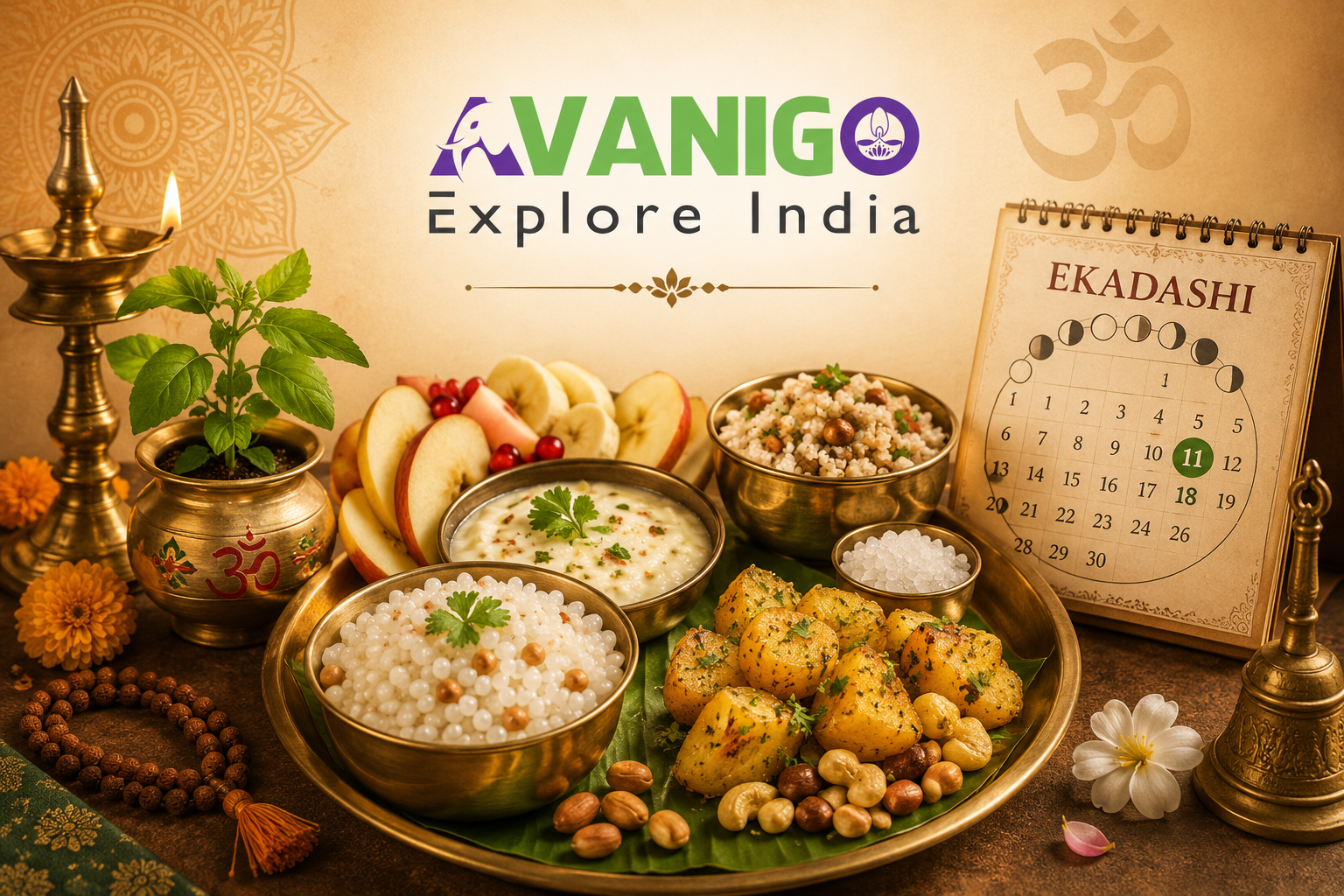
Among Hindu fasting traditions, Ekadashi is particularly significant.
The word Ekadashi refers to the 11th lunar day, or tithi, of each fortnight in the Hindu lunar calendar.
Because there are two lunar fortnights in each lunar month, Ekadashi occurs twice a month: once during the waxing phase of the Moon, known as Shukla Paksha, and once during the waning phase, known as Krishna Paksha.
This means that an ordinary lunar year contains approximately 24 Ekadashi observances, with additional observances possible in years containing an intercalary month.
Ekadashi is particularly associated with Lord Vishnu and Vaishnava traditions, although its observance and interpretation can vary across Hindu communities.
Why Do Hindus Fast on Ekadashi?
The significance of Ekadashi goes beyond simply avoiding food.
For devotees, it is traditionally a day for turning attention towards Vishnu, practising restraint and deepening spiritual discipline.
Fasting is often combined with:
- Vishnu puja
- Chanting
- Japa
- Reading or listening to sacred texts
- Meditation
- Devotional singing
- Charity
- Staying awake for part or all of the night in some traditions
The underlying idea is that a day ordinarily structured around food, work and routine can instead become a day consciously dedicated to spiritual practice.
The practice is particularly prominent within Vaishnavism, where Ekadashi is regarded as an important recurring vrata dedicated to Vishnu.
Why Is Ekadashi the 11th Day?
The significance of Ekadashi comes from its place in the Hindu lunar calendar.
Each lunar fortnight, or paksha, contains fifteen tithis. The eleventh tithi is Ekadashi.
There is a further symbolic interpretation within Hindu traditions that connects the day with the regulation of the senses and the mind. The religious significance, however, should not be confused with claims that modern science has established a special physiological effect of the Moon on the body on Ekadashi.
The important point from the traditional perspective is that Ekadashi is a recurring sacred time set aside for restraint and devotion.
The Story Behind Ekadashi
Hindu traditions contain several stories associated with Ekadashi.
One widely known account describes a battle between Lord Vishnu and the demon Mura.
According to the traditional story, while Vishnu was resting, a divine feminine power emerged and defeated Mura. Vishnu named this manifestation Ekadashi and granted a boon associated with the observance of the day.
The story helps explain why Ekadashi came to be regarded as a sacred day for fasting and devotion to Vishnu.
Different texts and traditions narrate the story with variations, so it is best understood as part of the rich body of Hindu sacred storytelling rather than as a single historical account. The Government of India’s Ministry of Tourism also records this traditional narrative in its description of Vaikuntha Ekadashi.
Why Are Grains Often Avoided on Ekadashi?
One of the distinctive features of Ekadashi fasting is the traditional avoidance of grains and cereals, particularly rice.
This is not universal in exactly the same form across every Hindu community, but it is a widely recognised practice within Ekadashi observance.
Depending on the tradition, devotees may instead eat fruits, milk, certain vegetables, nuts or specially prepared fasting foods.
Some devotees undertake a complete fast, while others observe a partial fast.
The rules are therefore best understood as tradition-specific rather than universal Hindu dietary laws.
What Is Nirjala Ekadashi?
Nirjala Ekadashi is one of the most austere forms of Ekadashi observance.
Nirjala literally refers to being without water.
Devotees who undertake this form of the vrat abstain from both food and water for the prescribed period.
The Ministry of Tourism 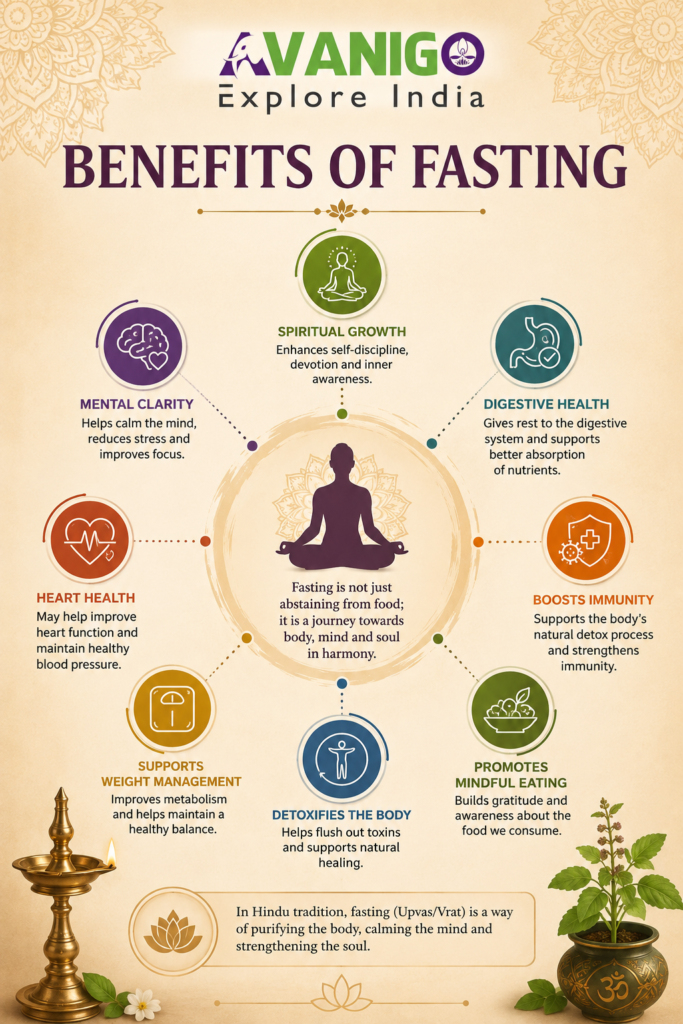 describes Nirjala Ekadashi as an especially significant Ekadashi associated with a complete abstinence from food and water.
Because this is an extremely demanding form of fasting, it should not be presented as the standard way to observe Ekadashi. Different devotees follow different forms of the vrat according to their tradition and personal circumstances.
What Is Vaikuntha Ekadashi?
Vaikuntha Ekadashi is one of the best-known Ekadashi observances, particularly among Vaishnava communities.
It falls on the Ekadashi of the bright fortnight in the Hindu month associated with Margashirsha/Dhanurmasam, generally around December or January depending on the calendar.
The day is associated with the belief that the gates of Vaikuntha, the abode of Lord Vishnu, are opened to devotees.
Special observances, prayers and temple rituals are held on the occasion, particularly in South India. The Ministry of Tourism notes its importance at major Vaishnava centres and describes the traditional belief surrounding the opening of the Vaikuntha Dwar.
Ekadashi and Gita Jayanti
There is another interesting connection within the Hindu calendar.
Gita Jayanti, commemorating the revelation of the Bhagavad Gita to Arjuna by Krishna, is traditionally observed on Shukla Ekadashi in the month of Margashirsha.
The Ministry of Tourism’s cultural documentation also identifies Gita Jayanti with this Ekadashi and notes the tradition of fasting and devotional observance on the day.
This connection illustrates how different strands of Hindu religious practice often intersect through the lunar calendar.
Is Fasting About the Body or the Mind?
Traditionally, it is about both, but with greater emphasis on the mind and discipline.
Food is the visible part of a fast.
The deeper purpose of a vrat is often expressed through what happens alongside it: prayer, restraint, concentration, devotion and conscious withdrawal from ordinary indulgence.
This is why simply going hungry does not necessarily capture the meaning of Hindu fasting.
A fast undertaken without any sense of discipline or spiritual intention can miss the purpose of the practice.
The observance is not merely:
“I am not eating.”
It is closer to:
“For this period, I am choosing restraint so that I can direct my attention towards something higher.”
Do All Hindus Fast?
No.
Hinduism encompasses numerous traditions, schools of thought, regional practices and family customs.
Some Hindus observe several vrats throughout the year. Some observe particular festival fasts. Some observe Ekadashi regularly. Others may rarely or never fast.
Even among people observing the same vrat, the rules can differ.
That diversity is an important part of understanding Hindu religious practice.
There is no single fasting practice that can accurately represent every Hindu.
Does Fasting Have to Be Difficult?
Not necessarily.
The spiritual value traditionally associated with a vrat is not simply measured by how extreme the deprivation is.
A person may choose a form of fasting that is appropriate to their tradition and circumstances.
For some, that may mean a complete fast. For others, it may mean giving up particular foods, eating once, or following a fruit-based diet.
The principle is discipline with intention, rather than suffering for its own sake.
The Deeper Meaning of Hindu Fasting
Hindu fasting can appear, from the outside, to be primarily about food.
But food is only the most visible part of the practice.
At a deeper level, fasting brings together several recurring Hindu ideas:
Self-control.
Learning not to respond automatically to every desire.
Devotion.
Using personal discipline as an expression of faith.
Mindfulness.
Becoming more conscious of everyday habits and impulses.
Simplicity.
Temporarily reducing ordinary consumption.
Spiritual focus.
Creating time and mental space for prayer, contemplation and worship.
Ekadashi expresses these ideas particularly clearly because it returns twice every lunar month, creating a recurring opportunity for devotees to practise them.
Frequently Asked Questions
Why do Hindus fast?
Hindus fast for several reasons, including devotion, self-discipline, spiritual focus, religious observance and the practice of restraint. The exact purpose varies according to the vrat and the tradition of the person observing it.
What is Upvas in Hinduism?
Upvas is a Hindu practice of fasting or abstinence undertaken as a religious observance. It is traditionally associated with drawing closer to the divine and practising restraint.
What is a Vrat?
A vrat, or vrata, is a religious vow or observance. It may involve fasting, dietary restrictions, prayer, worship, charity or other forms of discipline.
How many times does Ekadashi occur?
Ekadashi occurs twice during each lunar month, once during the waxing fortnight and once during the waning fortnight. In a regular year, this generally results in 24 Ekadashis.
Why is Ekadashi important in Hinduism?
Ekadashi is especially important in Vaishnava traditions and is associated with devotion to Lord Vishnu. Fasting, prayer and spiritual discipline are central to its observance.
Can Hindus drink water while fasting?
It depends on the type of fast. Some Hindu fasts permit water and other foods or liquids, while a Nirjala fast traditionally involves abstaining from water as well.
Why do people avoid rice on Ekadashi?
Avoiding rice and other grains is a traditional feature of many Ekadashi observances, particularly in Vaishnava practice. The precise dietary rules vary between traditions.
What is Nirjala Ekadashi?
Nirjala Ekadashi is an especially austere form of Ekadashi fasting in which devotees abstain from both food and water for the prescribed period.
What is Vaikuntha Ekadashi?
Vaikuntha Ekadashi is an important Ekadashi associated with Lord Vishnu. It is particularly prominent in Vaishnava traditions and is associated with the traditional belief that the gates of Vaikuntha are opened to devotees on this day.
Conclusion
Fasting in Hinduism is not simply a practice of going without food.
It is a form of intentional restraint.
Sometimes it marks a festival. Sometimes it accompanies worship of a particular deity. Sometimes it is a personal vow. And in traditions such as Ekadashi, it becomes a recurring practice of devotion and self-discipline.
The forms may differ, but the underlying idea remains remarkably consistent: temporarily stepping away from ordinary consumption to create greater space for discipline, reflection and devotion.
That is why, for many Hindus, a fast is not defined only by what is left off the plate.
It is defined by what one chooses to focus on instead.