
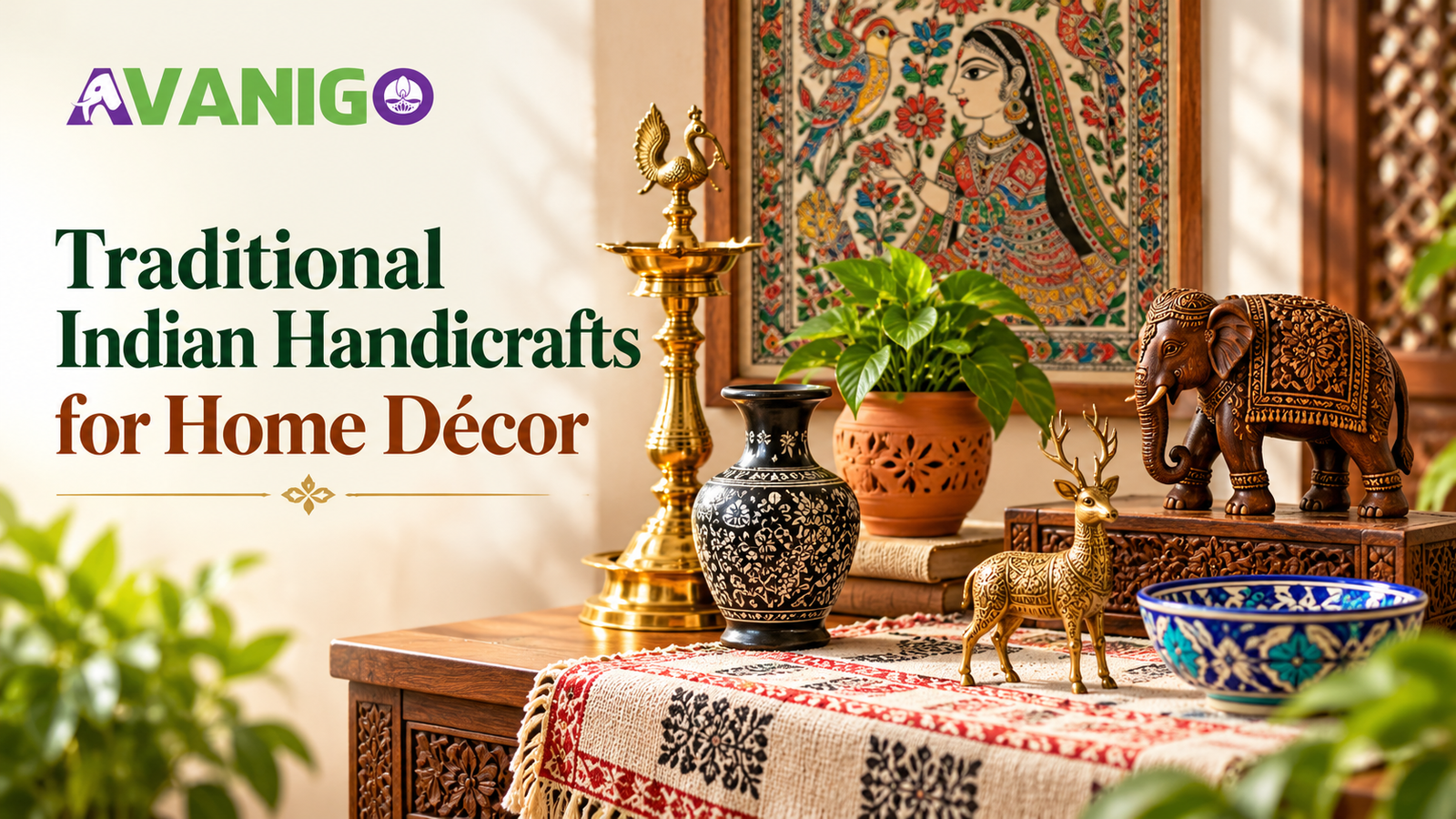
A brass lamp on a wooden console, a Madhubani painting above a reading chair, or a handwoven rug beneath a dining table can change the character of a room without requiring an entirely new interior. Traditional Indian handicrafts offer something beyond decoration: they bring regional materials, inherited techniques and cultural histories into contemporary living spaces.
India’s craft traditions developed around local resources, occupational communities, religious practices, trade networks and royal patronage. Terracotta, wood, metal, stone, cotton and silk were shaped into objects that served practical, ceremonial and artistic purposes. Some became symbols of regional identity; others travelled across the subcontinent through merchants, pilgrims and royal workshops.
Today, these traditions are finding new contexts in modern apartments, boutique hotels, restaurants, multiplexes and design-led homes. The challenge is not simply to collect traditional objects. It is to understand what makes them distinctive, how they were made, and how they can be incorporated into a contemporary interior without reducing their cultural significance to a decorative trend.
Quick Navigation
How Indian Handicrafts Became Part of Domestic Life
Craftsmanship has long been connected to everyday life in the Indian subcontinent. Archaeological discoveries from the Indus Valley Civilisation include beads, terracotta objects, pottery and other crafted artefacts. These finds demonstrate the importance of specialised making in ancient settlements, although individual objects do not always reveal the precise meanings their makers intended.
Over subsequent centuries, craft production developed through village industries, temple economies, merchant networks and royal workshops. Textiles, metal objects, brass items, carved furniture, pottery and decorative arts served households as well as religious institutions and courts.
Literature and historical records also preserve evidence of the importance of materials and skilled production. Kautilya’s Arthashastra, for example, discusses economic administration, manufacturing and the regulation of various occupations. It is not a catalogue of modern home décor, but it illustrates how production and skilled work formed part of organised economic life.
Royal patronage later helped certain techniques flourish. Mughal and regional courts supported metalworkers, painters, weavers, stone carvers and woodworkers. Meanwhile, craft traditions continued outside courtly settings, shaped by local materials, community knowledge and practical needs.
The contemporary Indian home brings these different histories together. A handwoven textile may function as a cushion cover, a carved wooden panel may become a wall feature, and a traditional metal vessel may serve as a centrepiece. The object may have a new use, but its value lies partly in the knowledge and labour that produced it.
The Government of India’s handicrafts resources document a broad range of Indian craft traditions, including weaving, embroidery, metalwork, terracotta and decorative arts. These crafts remain connected to regional identity while adapting to changing design preferences.
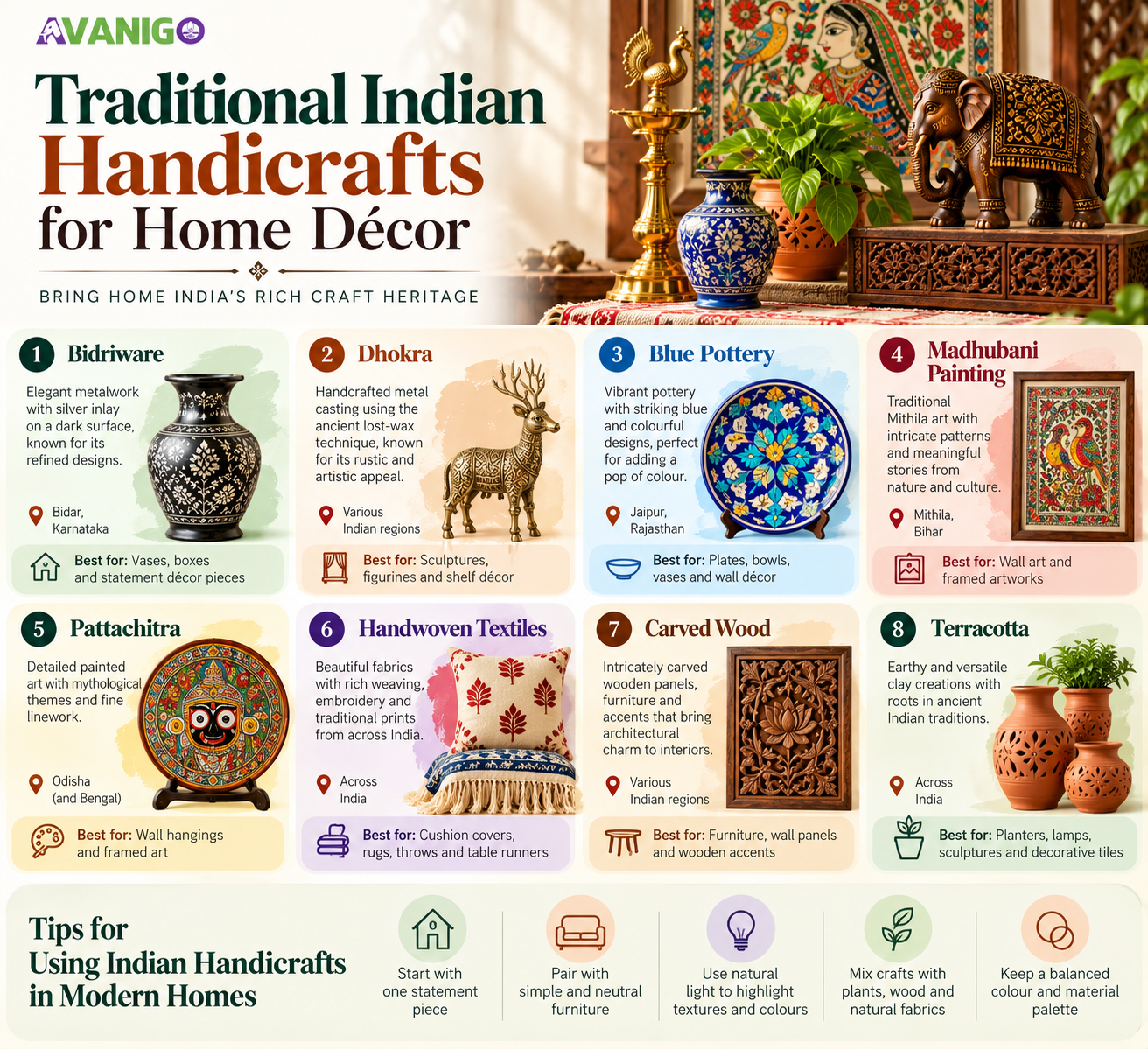
1. Bidriware from Bidar: Metalwork with a Distinctive Surface
Bidriware is a metalcraft tradition associated with Bidar in Karnataka. Its characteristic appearance comes from the contrast between a dark metal surface and silver-coloured inlay.
The craft is closely associated with the Deccan’s artistic history. Bidar’s position within the Deccan Sultanates helped create an environment in which courtly tastes, regional workmanship and wider artistic influences interacted. The precise history of the craft’s development is complex, but its identity is strongly connected to the region.
For contemporary interiors, Bidriware works particularly well as a small accent rather than a dominant decorative element. Consider a vase on a bookshelf, a box on a desk, or a carefully placed decorative plate on a console. The dark finish can complement neutral walls, natural wood and restrained metallic details.
How to use it at home
- Place a Bidriware vase against a light-coloured wall.
- Use a small box as a decorative object on a work desk.
- Pair one statement piece with understated furniture rather than grouping several competing metallic finishes.
When purchasing, ask about the maker, the materials used and the item’s origin. A product described as Bidri-style is not necessarily made using the traditional technique.
2. Dhokra: The Appeal of Handcrafted Metal
Dhokra metal casting is associated with several artisan communities and regions in India. It uses the lost-wax casting method, in which a wax model helps create a mould for casting metal. Designs and production methods vary across communities, so Dhokra should not be treated as one completely uniform tradition.
The resulting objects often feature textured surfaces and stylised forms. Figures, animals, ritual objects and decorative pieces can all be produced through related casting practices.
For home décor, Dhokra pieces work well in spaces that benefit from texture and visual contrast. A small figurine can add interest to an open shelf, while a larger sculpture can serve as a focal point on a console. Their irregular surfaces also pair well with linen, timber and stone.
How to use it at home
- Place a Dhokra sculpture on a low wooden shelf.
- Use a single piece to introduce texture into a minimalist room.
- Combine it with pottery or handwoven textiles, leaving enough space for each object to be seen.
Dhokra is a useful reminder that a handmade object does not need an elaborate finish to be visually distinctive. Its character comes from form, surface and the casting process itself.
3. Blue Pottery: Colour Without Visual Clutter
Jaipur blue pottery is recognised for its decorative surface, commonly featuring blue and other colours against light backgrounds. It is a distinctive craft associated with Rajasthan’s capital, although the history and material composition of the tradition differ from conventional clay pottery.
Its visual appeal makes it suitable for contemporary interiors that need colour without a large commitment to patterned furniture or painted walls.
Small bowls, tiles, plates and decorative vessels can introduce blue accents into kitchens, dining areas and living rooms. A single object may be sufficient in a neutral interior; a group of pieces can work when the colours and patterns are coordinated.
How to use it at home
- Display a decorative plate on a wall or open shelf.
- Use a small vessel as a centrepiece on a side table.
- Repeat blue accents through cushions or artwork rather than introducing several unrelated colours.
Before buying a piece for practical use, check whether its glaze, finish and intended use make it suitable for food contact. Decorative pottery should not automatically be treated as functional tableware.
4. Madhubani Painting: A Narrative on the Wall
Madhubani, also known as Mithila painting, is associated with the Mithila region of Bihar and neighbouring areas. It is known for expressive linework, patterned surfaces and subjects that can include religious narratives, nature, community life and social themes.
Historically, painting traditions in the region were associated with domestic and ceremonial settings. In the modern period, artists have also worked on paper, canvas and other formats, allowing the art to reach collectors and households beyond its original contexts.
Madhubani painting offers more than a colour scheme. Its figures, symbols and dense compositions can convey stories and cultural ideas. This makes it particularly suitable for an interior where the owner wants artwork with a recognisable visual language.
How to use it at home
- Choose one substantial painting for a living-room wall.
- Use smaller works in a hallway or reading corner.
- Keep nearby furniture relatively simple if the painting has a dense pattern.
- Ask about the artist, the materials and whether the work is handmade or printed.
A printed reproduction may be an affordable decorative option, but it should not be represented as an original painting. Clear product descriptions help buyers understand what they are supporting.
5. Pattachitra: Fine Detail and Storytelling
Pattachitra refers to traditional painting practices associated particularly with Odisha and, in a related but distinct tradition, Bengal. The subject matter, materials and methods vary by region.
Odisha’s Pattachitra tradition is closely connected to religious narratives and the cultural world surrounding Jagannath in Puri. Painted works have historically represented deities and episodes from religious stories, while contemporary artists also explore new subjects.
In an interior, Pattachitra can function as a narrative artwork. It suits a reading room, a study or a carefully curated gallery wall where visitors can spend time examining the details.
How to use it at home
- Display one piece at eye level.
- Use appropriate framing to protect the work from dust and handling.
- Avoid placing sensitive works in direct sunlight or humid locations.
- Learn the story or tradition represented rather than treating the painting only as a colour accent.
6. Indian Handwoven Textiles: Craft That Changes a Room
Textiles are among the most adaptable forms of traditional Indian craftsmanship. Weaving, embroidery, dyeing and printing techniques differ across regions, communities and materials.
A handwoven cotton throw, an embroidered cushion cover or a block-printed table runner can introduce pattern without changing the structure of a room. Textiles also allow people to engage with traditional craft at different price points.
The history of Indian textile production is extensive, with weaving and spinning appearing in literary and economic records. Textiles also moved through domestic, religious and commercial settings, connecting skilled makers with local and distant markets. India’s textile heritage continues to evolve through new designs, digital sales and changing consumer preferences.
How to use textiles
- Layer a handwoven throw over a plain sofa.
- Use a block-printed runner to add pattern to a dining table.
- Choose cushion covers that share a colour family but differ in texture.
- Use embroidered wall hangings where framed artwork would feel too formal.
When buying handloom or handmade textiles, check the fibre, care instructions, production technique and maker information. A traditional-looking print is not necessarily hand-printed, and a woven design is not necessarily handloom.
7. Carved Wood and Traditional Furniture
Wood carving has produced architectural details, doors, panels, furniture and decorative objects across many Indian regions. The styles differ according to local materials, religious traditions, historical influences and the intended function of the object.
A carved wooden panel can introduce architectural character into a modern home. Smaller objects, including boxes and frames, can provide a more restrained way to incorporate the craft.
The key is proportion. A heavily carved object may become visually overwhelming when placed beside ornate furniture, patterned upholstery and elaborate wall treatments. In a simpler room, the same piece can become a focal point.
Practical considerations
- Check whether the wood is reclaimed, new or from a documented source.
- Ask how the item should be protected from moisture and pests.
- Verify the dimensions before buying large panels or furniture.
- Be cautious about products described as antique without credible provenance.
For contemporary interiors, a well-made object with a clear history is generally more meaningful than a mass-produced item marketed with vague claims of antiquity.
8. Terracotta: A Material with Everyday Roots
Terracotta is fired clay used for vessels, figures, tiles and architectural elements. Its use in the subcontinent extends back to ancient settlements, including the Indus Valley Civilisation, where archaeological evidence includes terracotta objects.
The material remains relevant because it is versatile and visually direct. Its warm, earthy colour works with plants, natural fibres, wood and stone.
Terracotta pots are a familiar choice, but the material can also appear in sculptural objects, lampshades, wall pieces and decorative tiles. These products offer a way to introduce craft into a room without relying on elaborate ornament.
How to use it at home
- Group planters of different heights near a window or balcony.
- Place a sculptural terracotta object on an open shelf.
- Combine terracotta with green plants and natural textiles.
- Check whether a lamp or vessel is designed for its intended functional use.
How Traditional Indian Handicrafts Are Entering Modern Homes
Contemporary interest in handmade objects reflects several overlapping preferences: people want distinctive interiors, locally meaningful products and alternatives to identical mass-produced décor. Social media and online marketplaces have also made regional crafts easier to discover.
Designers increasingly combine traditional objects with contemporary furniture rather than recreating an entire historical interior. A carved panel can sit beside a clean-lined sofa; a handwoven textile can soften a modern bedroom; and a traditional painting can become the centre of a restrained gallery wall.
This approach does not require every object to be expensive or museum-quality. It requires informed selection. A small, well-made piece from an identifiable maker may offer more cultural and aesthetic value than a large decorative object with no reliable information about its origin.
There is also an economic dimension. Purchasing directly from credible artisan groups, craft organisations or established sellers can help support skilled production. However, buyers should check how products are sourced and represented rather than assuming that every item labelled handmade provides the same benefit.
How to Choose Authentic Indian Handicrafts
Use these questions before purchasing:
- Who made the object? Look for a named artist, artisan group, cooperative or verifiable seller.
- What technique was used? Ask whether the item is handwoven, hand-painted, cast, carved, printed or machine-produced.
- Where was it made? Regional attribution should be specific rather than based on a broad label such as “Indian style.”
- What materials are used? Check wood species, metals, fibres, finishes and care requirements.
- Is the price plausible? Very low prices for labour-intensive work may warrant questions about materials and production.
- How will it be used? Decorative items may not be suitable for food service, outdoor exposure or daily handling.
- Is the historical claim credible? A traditional technique does not make every contemporary product an antique.
Geographical indication (GI) registration can help identify goods associated with a particular region and recognised production characteristics. It is useful evidence, but it does not replace checking the seller, the item’s specific claim or the conditions of purchase.
Frequently Asked Questions
Which Indian handicrafts are best for home décor?
Bidriware, Dhokra metalwork, Madhubani paintings, Pattachitra, blue pottery, handwoven textiles, carved wood and terracotta can all work well. The best choice depends on the room, the intended use and the style of the object.
Are traditional Indian handicrafts suitable for modern interiors?
Yes. A single handmade object can introduce texture, colour or cultural context into a contemporary space. Pair intricate crafts with simpler furniture and avoid crowding the room with too many competing patterns.
How can I identify authentic Indian handicrafts?
Ask about the maker, region, materials and production method. Buy from sellers who provide specific product information, and verify GI or artisan-group claims when relevant.
Are handmade décor products sustainable?
Not automatically. Sustainability depends on material sourcing, production practices, durability, packaging and transport. A well-made product that lasts can be a sensible choice, but buyers should examine specific claims rather than assume that all handmade products have the same environmental impact.
Bringing India’s Craft Heritage into Everyday Life
Traditional Indian handicrafts are not relics that belong only in museums or heritage homes. They remain part of a living design culture, adapted by artisans, designers and households to changing needs.
A painting can bring a regional story into a living room. A handwoven textile can connect a contemporary home with a long tradition of skilled making. A metal object can demonstrate the precision and material knowledge that a decorative surface alone cannot explain.
The most considered approach is to buy fewer objects, understand their origins and give them room to be appreciated. That turns home decoration into a more informed engagement with India’s craft heritage.