
Vastu for office spaces is a consideration for some business owners when selecting commercial property, planning a new workplace or renovating an existing office. Common areas of interest include the entrance, reception, leadership cabins, employee seating, meeting rooms and the location of important business functions.
For modern businesses, these preferences need to be considered alongside the factors that determine whether a workplace functions effectively: employee comfort, accessibility, technology infrastructure, acoustics, lighting, ventilation, safety and the nature of the work being performed.
The practical question is not simply whether an office follows a particular Vastu layout. It is whether the proposed arrangement accommodates the client’s cultural preferences while supporting the operational requirements of the organisation.
Quick Navigation
What Is Vastu for Office Spaces?
Vastu for office spaces refers to the application of traditional Vastu Shastra principles to workplaces, shops and commercial buildings.
Depending on the tradition or practitioner, recommendations may cover the direction of the entrance, the placement of leadership cabins, the arrangement of employee desks, meeting rooms, reception areas and storage.
These recommendations are not uniform across every school of Vastu. Businesses should clarify which principles they want to follow before making property or renovation decisions.
It is also important to distinguish traditional beliefs from evidence-based workplace design. There is no established scientific evidence that a specific office direction or desk position guarantees revenue growth, business success or employee productivity.
However, many workplace considerations discussed alongside Vastu, including lighting, circulation, organisation and the relationship between different functions, can be evaluated through established design principles.
Why Vastu Matters to Some Business Owners
A workplace represents more than a physical location. It is where employees collaborate, customers interact with the business and leadership makes operational decisions.
For some business owners, Vastu preferences are connected to family traditions, cultural beliefs or a sense of confidence in the workplace. These preferences may influence the selection of commercial property or the brief given to an architect or interior designer.
The most effective approach is to identify these preferences early. Retrofitting a completed office to accommodate a new set of requirements can be expensive, particularly when the proposed changes affect partitions, electrical systems, plumbing or structural elements.
A design brief should therefore separate three categories:
- Cultural preferences: Direction-based or symbolic arrangements that the business wants to accommodate.
- Operational requirements: The layout needed for employees, customers, equipment, collaboration and business processes.
- Technical requirements: Building regulations, fire safety, accessibility, electrical infrastructure, ventilation and other compliance obligations.
A workable office plan considers all three without allowing a symbolic preference to override safety or functionality.
Vastu for Office: Common Areas of Consideration
1. Main entrance and reception
The entrance is often treated as an important feature in Vastu-based commercial planning. Businesses may have preferences regarding the entrance direction, its position and the relationship between the entrance and the reception area.
From a workplace-design perspective, the entrance should also be easy to identify, accessible to visitors and suitable for the volume of people using it.
Reception areas need sufficient circulation space, clear wayfinding, appropriate lighting and a layout that protects confidential conversations where necessary. The entrance should not obstruct emergency routes or create accessibility barriers.
For offices that receive clients, suppliers or interview candidates, the reception is also part of the organisation’s first impression. Its design should reflect the company’s identity and the practical needs of visitors.
2. Leadership cabins and management offices
Some Vastu interpretations provide guidance on the location of an owner’s or senior executive’s cabin and the orientation of the desk.
The operational requirements of a leadership office are broader. Senior staff may need confidential calls, video meetings, private discussions, access to teams and visibility into shared work areas.
The layout should support those activities while maintaining appropriate acoustic privacy. Desk placement should also account for screen glare, natural light, cable management and the movement of people through the room.
If a business wishes to incorporate a preferred desk orientation, the design team can assess the available options without compromising these practical requirements.
3. Employee seating and workstations
Office Vastu guidance may include recommendations on the orientation and arrangement of employee desks.
A modern workstation plan should also consider the type of work employees perform. A team that spends most of the day on focused tasks has different needs from a sales team, a customer-support function or a group that collaborates frequently.
Spacing, ergonomic furniture, monitor positioning, lighting, ventilation and access to power and data connections all affect workstation usability.
A layout that places every desk in a preferred direction but creates glare, noise or congestion may be less suitable than an alternative that balances the stated preference with workplace requirements.
4. Meeting rooms and collaboration areas
Meeting rooms need to support a range of activities, including client presentations, team discussions, interviews and video conferences.
The room’s size, acoustic treatment, display placement, connectivity and ventilation should match its intended use. Small meeting rooms may require effective sound insulation, while larger spaces need suitable sightlines and audiovisual coverage.
Businesses can consider Vastu preferences during room planning, but these should not prevent the room from meeting its functional requirements.
5. Finance, records and storage
Some Vastu recommendations address the placement of safes, cash storage, financial records or important documents.
In a modern office, access control, information security, document retention, fire protection and ease of retrieval should determine how sensitive materials are stored.
Financial records and confidential files should be protected through appropriate physical and digital controls. Their location should be selected according to operational and security needs rather than relying on directional beliefs alone.
Office Vastu Tips: Traditional Preferences and Practical Requirements
The following table summarises common areas of interest. It does not present one definitive Vastu prescription because recommendations vary across traditions and practitioners.
| Office area | Common Vastu consideration | Practical design requirement |
| Main entrance | Direction and placement of the entrance | Accessibility, clear access, security and wayfinding |
| Reception | Position relative to the entrance and other rooms | Visitor flow, privacy, visibility and adequate circulation |
| Leadership cabin | Location and desk orientation | Confidentiality, lighting, acoustics and access to teams |
| Employee workstations | Seating direction and arrangement | Ergonomics, glare control, power access and collaboration |
| Meeting rooms | Location within the office layout | Acoustic privacy, audiovisual systems and ventilation |
| Finance and records | Placement of cash or important documents | Access control, fire protection and secure storage |
| Pantry | Kitchenette or pantry location | Plumbing, hygiene, ventilation and electrical safety |
| Toilets | Location within the commercial layout | Plumbing, accessibility, ventilation and compliance |
| Work-from-home desk | Desk direction and room placement | Lighting, posture, concentration and separation from household activity |
The table is intended to help business owners structure a design discussion. Specific Vastu recommendations should be checked against the tradition they intend to follow.
What Does Current Research Say About Office Design in India?
Modern workplace design is increasingly connected to organisational identity, employee experience, technology and flexible working arrangements.
CBRE’s September 2026 announcement on its India Office Occupier Survey reported that 65% of respondents identified brand and culture-led design as a key priority for improving workplace experience. The survey also found that 50% prioritised accommodating hybrid work and 40% identified holistic well-being as a focus.
The same survey reported that 52% of firms were adding enclosed, soundproof spaces for video calls, while 50% expected to allocate more capital to workplace technology such as seat and room booking applications and occupancy sensors.
These findings do not establish the effectiveness of Vastu. They show that businesses are evaluating office design against practical organisational needs, including collaboration, technology and workplace experience.
A separate 2026 outlook from Colliers projected Grade A office demand in India at 70–75 million square feet for the year, with new supply projected at 60–65 million square feet. The forecast reflects continued demand for commercial space, with global capability centres, flexible workspaces, technology and sustainability among the drivers discussed in the report.
For businesses selecting an office, the implication is straightforward: the layout should serve the organisation’s operating model, not merely satisfy an abstract design checklist.
Vastu for Shops and Retail Businesses
Retail spaces have requirements that differ from those of conventional offices. The layout must support product discovery, customer circulation, staff operations, inventory handling and transactions.
Vastu preferences may influence the entrance, billing counter, product displays, storage area or the owner’s desk. These preferences can be considered during planning, provided they do not compromise the customer journey or store operations.
A retail layout should address several practical questions:
- Can customers identify the entrance and navigate the store easily?
- Are high-demand products placed where customers can find them?
- Is the billing counter positioned for efficient transactions and suitable security?
- Can staff replenish shelves without obstructing customer movement?
- Are emergency exits and access routes unobstructed?
- Does the lighting allow customers to assess products accurately?
- Is the storage area sufficient for the inventory the business needs to hold?
For shops with limited floor area, every square metre matters. A design decision that reduces usable display space or creates congestion should be reviewed carefully, even if it is intended to accommodate a traditional preference.
Claims that a specific counter direction guarantees higher sales should not be treated as established fact. Sales performance depends on a combination of location, demand, pricing, merchandising, service, competition and operational execution.
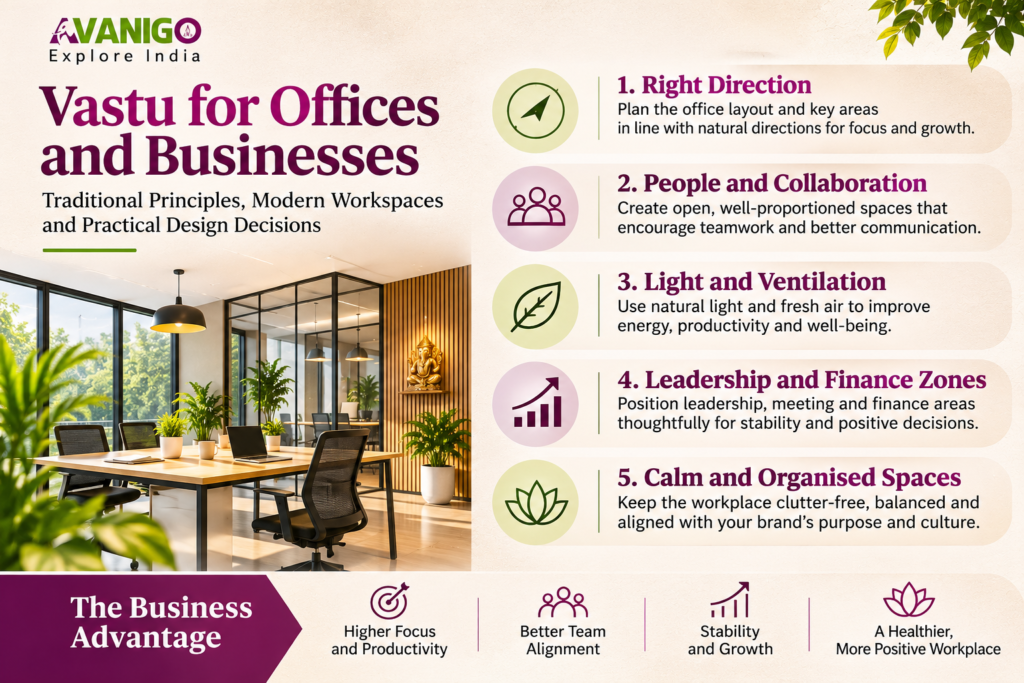
Vastu for Commercial Buildings and Large Offices
Large commercial buildings introduce additional constraints. A tenant may control the furniture and internal fit-out but have little influence over the building’s core, external orientation, lifts, staircases, fire systems, shared toilets or service shafts.
The building’s approved plans, landlord requirements and applicable regulations define what can be changed. Some modifications may require formal approvals, technical assessments or coordination with building management.
For this reason, Vastu preferences should be discussed before signing a lease or finalising a fit-out plan whenever possible.
A pre-lease assessment can compare the property against the business’s requirements for:
- Employee capacity and future expansion.
- Meeting rooms and confidential spaces.
- Network, power and audiovisual infrastructure.
- Ventilation, daylight and thermal comfort.
- Accessibility and emergency egress.
- Pantry, storage and support facilities.
- The Vastu preferences the business considers important.
This approach helps decision-makers identify potential conflicts before they become expensive fit-out changes.
Vastu for a Home Office or Work-from-Home Setup
Home offices have become an important part of workplace planning for employees, consultants, founders and small business owners.
In a home environment, the workspace may need to coexist with family activities, limited floor area and shared rooms. Vastu preferences can be considered, but the desk and chair should still support a comfortable working posture.
A practical home-office setup should provide:
- A desk with sufficient working surface.
- A chair suitable for the duration and nature of the work.
- Lighting that reduces screen glare.
- Reliable power and internet access.
- A background suitable for video calls.
- Storage for work materials and equipment.
- Reasonable separation between work and household activity.
If the available room is small, a compact workstation or a designated corner may be more practical than trying to create a separate office. The most suitable arrangement is one that supports consistent work without creating unnecessary discomfort or disruption.
Can an Existing Office Be Adjusted According to Vastu?
In many cases, selected preferences can be accommodated without major construction. Furniture placement, storage, lighting, room use and non-structural partitions may offer some flexibility.
However, the feasibility of any change depends on the existing building and the type of adjustment proposed.
| Proposed adjustment | What to check before proceeding |
| Moving desks | Power and data access, circulation, ergonomics and glare |
| Relocating a cabin | Partitions, ventilation, acoustic privacy and team access |
| Changing the reception layout | Visitor flow, security and accessibility |
| Moving storage units | Fire exits, load limits and access to equipment |
| Changing room functions | Ventilation, occupancy, privacy and building rules |
| Altering walls or services | Structural assessment, approvals and qualified professional advice |
Structural alterations should never be undertaken solely to satisfy a Vastu recommendation without the appropriate technical assessment.
Businesses should also consider the cost of downtime, employee disruption, changes to IT infrastructure and any approvals needed from the landlord or building management.
Does Vastu Improve Business Success or Employee Productivity?
There is no established scientific evidence that following a particular Vastu direction guarantees higher revenue, greater profits, business growth or improved employee productivity.
That does not mean every design consideration associated with Vastu is irrelevant to a workplace. Some preferences overlap with broader concerns about spatial organisation, circulation or how people experience a building. These aspects can be evaluated through practical design assessment.
Employee productivity is influenced by multiple factors, including management practices, workload, tools, compensation, workplace culture, role clarity and the physical environment. A well-designed office can help employees perform their work, but no single room direction can replace effective business management.
Businesses should therefore assess workplace changes through observable outcomes, such as employee feedback, space utilisation, meeting-room availability, comfort, operational efficiency and maintenance costs.
A Practical Checklist Before Finalising an Office
Before purchasing, leasing or renovating an office, use the following checklist to align Vastu preferences with business requirements.
Before selecting the property
- Identify the Vastu principles that matter to the owner or leadership team.
- Assess the entrance, internal layout and location of major service areas.
- Review the approved building plans and permitted alterations.
- Check the property’s suitability for the required headcount and business functions.
- Evaluate access, connectivity, ventilation, daylight and safety.
Before approving the layout
- Confirm the position of workstations, meeting rooms and leadership cabins.
- Review lighting, acoustics, power and data infrastructure.
- Ensure accessible routes and emergency exits remain unobstructed.
- Assess pantry, storage and document-security requirements.
- Obtain the necessary technical approvals for proposed changes.
Before moving in
- Test lighting, ventilation, connectivity and audiovisual systems.
- Confirm that furniture supports the intended working activities.
- Check signage, visitor access and security procedures.
- Gather employee feedback after occupation.
- Record any practical issues that require adjustment.
This checklist does not replace professional architectural or engineering advice. It provides a structured way to discuss traditional preferences alongside the requirements of a functioning workplace.
Frequently Asked Questions About Vastu for Office and Business
Which direction is best for an office according to Vastu?
Recommendations vary across Vastu traditions and practitioners. Businesses should identify the specific guidance they intend to follow and assess it against the property’s physical constraints, intended use and applicable building requirements.
Is Vastu necessary for a successful business?
Vastu is a cultural or traditional consideration for some business owners, but it is not a scientifically established requirement for commercial success. Business performance depends on factors such as demand, product quality, pricing, execution, customer relationships and financial management.
What should business owners consider when applying Vastu to an office?
Common areas of interest include the entrance, reception, leadership cabin, employee workstations, meeting rooms and storage. These should be evaluated alongside ergonomics, lighting, ventilation, accessibility, security and operational requirements.
Can Vastu be applied to a rented office?
Some preferences may be accommodated through furniture arrangement or non-structural changes. Larger modifications may require landlord approval, building-management coordination and technical assessment. Review these constraints before committing to a lease.
Does office desk direction affect productivity?
There is no established scientific evidence that a specific compass direction for a desk directly guarantees productivity. Workstation comfort, lighting, ergonomics, acoustics, task suitability and management practices are more appropriate factors to assess.
How is Vastu for a shop different from Vastu for an office?
A shop must accommodate customer circulation, product displays, transactions, inventory and staff operations. An office typically places greater emphasis on workstations, collaboration, meetings, privacy and technology. Both need to meet safety and accessibility requirements.
Conclusion: Design the Workplace Around People and Operations
Vastu for offices and businesses is best approached as one part of a wider design discussion. For business owners who value the tradition, selected preferences can be incorporated into property selection, space planning or interior design.
Those preferences should be assessed alongside the practical requirements of the workplace: employee comfort, customer access, technology, privacy, safety and compliance.
For a new office, these discussions should happen before the fit-out is approved. For an existing workplace, the first step is to identify adjustments that are feasible, proportionate and operationally useful.
A successful office layout cannot guarantee business success. It can, however, provide a safer, more functional environment in which people can work and customers can engage with the organisation.