
India’s traditional calendar is more than a way to track dates. It connects lunar and solar movements with religious observances, festivals, seasonal traditions, and important events in everyday life. For generations, Indian households have consulted the Panchang to understand festival dates, observe vratas, and determine auspicious times for ceremonies.
Despite its continued use, the Panchang can be difficult to interpret for someone unfamiliar with its terminology. What is a tithi? How is a nakshatra different from a zodiac sign? Why can a Hindu festival fall on a different Gregorian date each year? And what do the five elements of the Panchang actually represent?
The answers begin with understanding the five components of this traditional Indian calendar: tithi, vara, nakshatra, yoga, and karana.
This guide explains how each component works, how the five elements are used together, and why the Panchang remains relevant in contemporary Indian life.
Quick Navigation
What Is a Panchang?
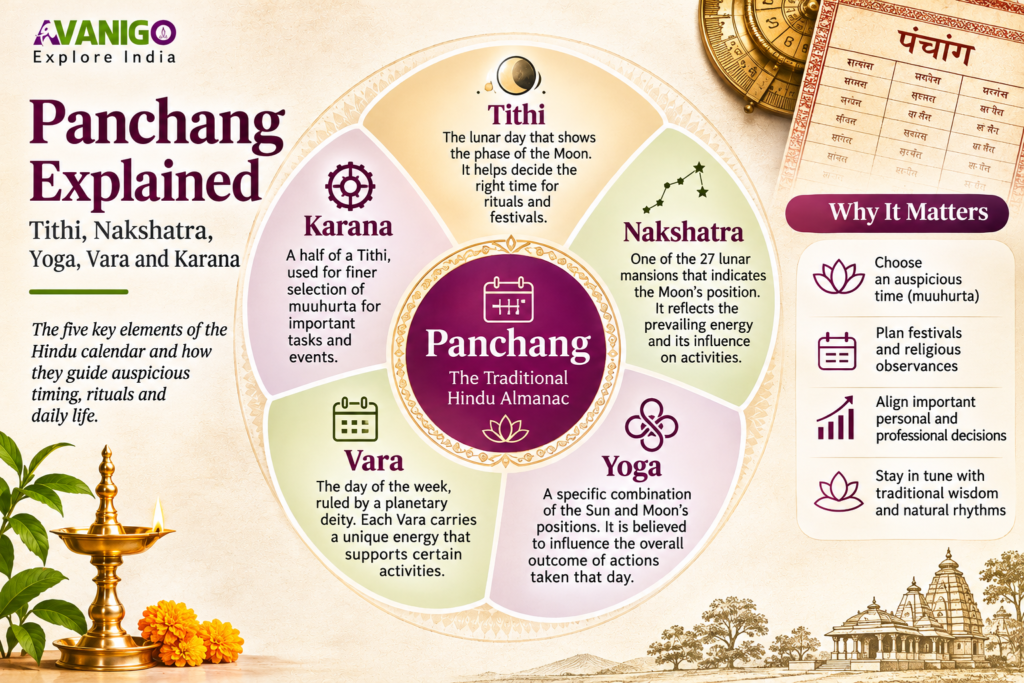
A Panchang, also called Panchangam in several Indian languages, is a traditional Hindu calendrical almanac used to track time through five principal elements. The word comes from two Sanskrit terms: pancha, meaning five, and anga, meaning limb or component.
The five elements are:
- Tithi: The lunar day, calculated from the angular relationship between the Sun and Moon.
- Vara: The day of the week.
- Nakshatra: The lunar mansion or section of the zodiac occupied by the Moon.
- Yoga: A calendrical element calculated using the longitudes of the Sun and Moon.
- Karana: Half of a tithi, based on the angular relationship between the Sun and Moon.
Together, these elements form the basis of daily Panchang calculations. Traditional almanacs may also include sunrise and sunset times, moonrise and moonset, lunar phases, planetary positions, festival dates, and other calendrical information.
The Government of India‘s India Meteorological Department publishes the Rashtriya Panchang through its Positional Astronomy Centre. It provides calculated astronomical and calendrical information, including tithis, nakshatras, yogas, and other data, in multiple Indian languages. This demonstrates how traditional calendrical systems can be documented using modern astronomical calculations.
1. Tithi: Understanding the Hindu Lunar Day
A tithi is a lunar day determined by the changing angular separation between the Sun and Moon. Unlike a Gregorian calendar day, which runs from midnight to midnight, a tithi does not have a fixed duration.
The angular separation between the Moon and Sun increases by approximately 12 degrees during one tithi. Because the Moon’s apparent motion varies, a tithi may last longer or shorter than 24 hours.
This distinction is important when understanding Hindu festivals and religious observances. A festival may be associated with a particular tithi rather than a fixed Gregorian date.
The two lunar fortnights
A traditional lunar month is divided into two pakshas, or fortnights:
- Shukla Paksha: The waxing phase of the Moon, extending from the period after the new moon towards the full moon.
- Krishna Paksha: The waning phase of the Moon, extending from the period after the full moon towards the next new moon.
Each fortnight contains 15 tithi positions, with the full-moon and new-moon tithis marking the ends of the respective phases.
Common tithi names include:
| Tithi | Common transliteration | General position in the fortnight |
| Pratipada | Pratipat | First |
| Dwitiya | Dvitiya | Second |
| Tritiya | Tritiya | Third |
| Chaturthi | Chaturthi | Fourth |
| Panchami | Panchami | Fifth |
| Shashthi | Shashthi | Sixth |
| Saptami | Saptami | Seventh |
| Ashtami | Ashtami | Eighth |
| Navami | Navami | Ninth |
| Dashami | Dashami | Tenth |
| Ekadashi | Ekadasi | Eleventh |
| Dwadashi | Dvadasi | Twelfth |
| Trayodashi | Trayodasi | Thirteenth |
| Chaturdashi | Chaturdasi | Fourteenth |
| Purnima or Amavasya | Full moon or new moon | Fifteenth lunar position |
The names and transliterations can vary across regional traditions and publications.
Why is tithi important?
Tithis help determine the observance of several Hindu festivals and vratas. Ekadashi, for example, is associated with the eleventh lunar day of each fortnight. Purnima marks the full-moon observance, while Amavasya is associated with the new moon.
Other festivals are connected to specific tithis, sometimes with additional rules governing when the relevant tithi must prevail.
An important distinction: A festival’s traditional date is not always determined simply by checking which tithi is present at midnight. The applicable rule may depend on the tithi at sunrise, a specified period of the day or night, or a tradition-specific calculation.
For this reason, two calendars may occasionally list an observance differently, particularly when they follow different regional conventions.
2. Vara: The Seven Days of the Week
Vara refers to the day of the week. The seven-day cycle is familiar to modern readers, but the traditional Indian names preserve linguistic and cultural associations with celestial bodies.
| Vara | Sanskrit-derived name | Common English equivalent |
| Ravivara | Sunday | Sunday |
| Somavara | Monday | Monday |
| Mangalavara | Tuesday | Tuesday |
| Budhavara | Wednesday | Wednesday |
| Guruvara or Brihaspativara | Thursday | Thursday |
| Shukravara | Friday | Friday |
| Shanivara | Saturday | Saturday |
The names are associated respectively with the Sun, Moon, Mars, Mercury, Jupiter, Venus, and Saturn in traditional Indian astronomical and astrological terminology.
How is vara used in Indian traditions?
In many Hindu households, particular weekdays are associated with devotional practices. Monday is commonly associated with Shiva worship, Tuesday with traditions involving Hanuman or other deities depending on the region, and Thursday with worship connected to Brihaspati or other regional traditions.
These associations are not uniform across India. Household customs, temple traditions, sampradayas, and regional practices can influence how a particular weekday is observed.
Vara is also considered when selecting a muhurta, or traditionally auspicious time, for a ceremony. In such cases, it is assessed alongside the other Panchang elements rather than treated as the only deciding factor.
For everyday readers, vara is the most straightforward Panchang component because it corresponds to the familiar seven-day week. Its traditional significance, however, extends beyond simply naming the day.
3. Nakshatra: The Moon’s Position in the Zodiac
A nakshatra is one of the 27 divisions of the zodiac used in the traditional Indian sidereal system. Each division spans 13 degrees and 20 minutes of celestial longitude, together covering the full 360-degree zodiac.
The Moon’s position is used to identify the nakshatra prevailing at a particular time. Since the Moon moves through these divisions during its monthly cycle, the nakshatra generally changes approximately once a day, although the exact duration varies.
The 27 commonly recognised nakshatras are:
- Ashwini
- Bharani
- Krittika
- Rohini
- Mrigashira
- Ardra
- Punarvasu
- Pushya
- Ashlesha
- Magha
- Purva Phalguni
- Uttara Phalguni
- Hasta
- Chitra
- Swati
- Vishakha
- Anuradha
- Jyeshtha
- Mula
- Purva Ashadha
- Uttara Ashadha
- Shravana
- Dhanishta
- Shatabhisha
- Purva Bhadrapada
- Uttara Bhadrapada
- Revati
Spellings may differ between Sanskrit transliteration systems and regional languages. Some traditional systems also recognise Abhijit as an additional nakshatra for particular purposes, but the standard 27-division system is widely used in Panchang calculations.
Nakshatra and rashi: What is the difference?
Nakshatra and rashi are related concepts, but they describe different divisions of the zodiac.
A rashi divides the zodiac into 12 signs of 30 degrees each. A nakshatra divides it into 27 sections of 13 degrees and 20 minutes each.
A rashi therefore covers a larger segment of the zodiac than a nakshatra. Each rashi contains portions corresponding to multiple nakshatras, while each nakshatra can extend across more than one rashi.
This distinction is useful when reading a Hindu Panchang or understanding traditional horoscope terminology. The nakshatra listed for a particular day describes the Moon’s position within the nakshatra system at the specified time, while the rashi identifies its position within the 12-sign framework.
Why do nakshatras matter?
Nakshatras play a role in several Indian cultural and astrological traditions. They are used in traditional horoscope calculations, and some families consult them when selecting dates for naming ceremonies, weddings, or other important events.
The nakshatra associated with a person’s birth is also used in certain naming customs. In these traditions, syllables associated with particular nakshatra divisions may be considered when choosing a child’s name.
Practices differ by region and family. These are cultural and astrological conventions, not scientifically established methods for predicting a person’s character or future.
For readers exploring Indian heritage, nakshatras provide an example of how celestial observations became integrated into language, rituals, calendars, and family customs.
-
Yoga: A Calculation Based on the Sun and Moon
In Panchang terminology, yoga is a calendrical element calculated from the combined celestial longitudes of the Sun and Moon. It is different from yoga as a physical, philosophical, or spiritual discipline.
The sum of the Sun’s and Moon’s longitudes is divided into 27 equal sections, each measuring 13 degrees and 20 minutes. The section corresponding to the combined position determines the yoga recorded in the Panchang.
The 27 traditional yogas are:
- Vishkambha
- Priti
- Ayushman
- Saubhagya
- Shobhana
- Atiganda
- Sukarma
- Dhriti
- Shula
- Ganda
- Vriddhi
- Dhruva
- Vyaghata
- Harshana
- Vajra
- Siddhi
- Vyatipata
- Variyan
- Parigha
- Shiva
- Siddha
- Sadhya
- Shubha
- Shukla
- Brahma
- Indra
- Vaidhriti
As with the names of other Panchang elements, spelling and transliteration may vary between publications. The Rashtriya Panchang lists the traditional yoga names and explains the underlying calculation.
What does yoga signify in a Panchang?
In traditional Hindu astrology, yogas are interpreted according to established rules and may be considered when assessing a date for a religious ceremony or other important activity.
The precise interpretation depends on the astrological tradition being followed. A yoga is not the same as a yoga posture or breathing practice, and the presence of a particular yoga does not establish a scientifically verified outcome for an event.
For practical use, readers should first understand what the yoga entry represents and when it begins or ends. Its traditional interpretation is a separate question from the astronomical calculation used to identify it.
5. Karana: Half of a Tithi
A karana is half of a tithi, corresponding to an angular change of six degrees in the separation between the Sun and Moon.
Because a tithi covers 12 degrees of angular separation, two karanas occur within each tithi. Their start and end times are calculated from the same underlying lunar-solar relationship used to determine tithis.
The traditional system identifies 11 karanas: seven recurring karanas and four fixed or non-recurring karanas.
The seven recurring karanas
- Bava
- Balava
- Kaulava
- Taitila
- Gara
- Vanija
- Vishti
These recur in a prescribed sequence through the lunar cycle.
The four fixed karanas
- Shakuni
- Chatushpada
- Naga
- Kimstughna
These occur at specific positions in the traditional sequence rather than following the same recurring cycle.
The Rashtriya Panchang explains that the seven recurring karanas follow a cycle, while the four fixed karanas occur during designated portions of the lunar cycle.
Why is karana included in the Panchang?
Karana is one of the five elements consulted in traditional muhurta calculations. Some astrological traditions assign different interpretations to different karanas when evaluating the suitability of a time for a particular activity.
For readers unfamiliar with the terminology, the most useful point is that karana offers a finer division of the lunar day. It helps distinguish time periods within a tithi rather than simply repeating the information supplied by the tithi itself.
As with other astrological interpretations, the cultural role of karana should be distinguished from scientific evidence. Its calculation is based on the angular relationship between celestial bodies; claims about the success or failure of an activity based on a karana belong to traditional belief systems.
How Do the Five Elements of Panchang Work Together?
The five elements are designed to be read together. Each describes a different aspect of the calendrical system, and none should be confused with the others.
Consider a hypothetical Panchang entry for a particular morning:
| Element | Example entry | What it tells you |
| Vara | Somavara | It is Monday |
| Tithi | Shukla Panchami | The fifth tithi of the waxing lunar fortnight is prevailing |
| Nakshatra | Rohini | The Moon is passing through Rohini |
| Yoga | Siddhi | The calculated Panchang yoga is Siddhi |
| Karana | Bava | Bava is the karana prevailing at that time |
This is an illustrative example, not a Panchang for a specific date.
A daily Panchang may show several transitions. A tithi, nakshatra, yoga, or karana that prevails in the morning may end later in the day, giving way to the next one. The time displayed alongside an entry often indicates when that element ends.
This is why consulting only the name of a tithi or nakshatra may not be enough when planning an observance that follows a specific timing rule.
The India Meteorological Department’s Rashtriya Panchang provides the relevant elements alongside astronomical information such as sunrise, sunset, moonrise, and moonset. It also explains the conventions used to present these calculations.
How Is a Panchang Used to Determine Hindu Festival Dates?
Many Hindu festivals follow the traditional lunar or lunisolar calendar rather than a fixed Gregorian date.
The Gregorian calendar is primarily solar, with dates progressing through a standard annual cycle. The Hindu calendrical traditions discussed here incorporate lunar phases and, in many systems, adjustments that maintain a relationship with the solar year and seasonal cycle.
As a result, the Gregorian date associated with a festival can change from year to year.
The Panchang helps establish the relevant tithi and other calendrical details used to determine when an observance should take place.
Examples of festivals and observances
- Ekadashi: Ekadashi observances are associated with the eleventh tithi of each lunar fortnight. The precise observance date can depend on the applicable calendrical rules and regional tradition.
- Purnima: Full-moon days are associated with various religious observances, festivals, and customary practices across India.
- Amavasya: The new-moon period is significant in several Hindu traditions, including certain ancestral rites and regional observances.
- Ganesh Chaturthi: The festival is associated with Bhadrapada Shukla Chaturthi in commonly followed Hindu calendar traditions. The applicable date is determined through calendrical rules rather than by a fixed Gregorian date.
- Janmashtami: The festival is associated with Krishna’s birth observance and is determined using traditional lunar-calendar criteria. The exact observance can vary depending on the rules followed by a temple, community, or regional calendar.
These examples show why the Panchang remains relevant to religious and cultural life. It helps communities coordinate observances using a shared calendrical framework, even when those observances fall on different Gregorian dates each year.
Panchangam in South India: Regional Traditions and Practices
Although the basic five elements are widely recognised, Panchang usage varies across India. Regional calendars, languages, religious traditions, and methods of reckoning can influence how the information is presented and interpreted.
- In Andhra Pradesh and Telangana, the Telugu Panchangam is familiar to many households. It is consulted during festivals, religious observances, marriage planning, housewarming ceremonies, and other significant occasions.
- Kannada, Tamil, and Malayalam-speaking communities also have their own established calendrical traditions and regional practices. The terminology may be similar, but the calendar’s presentation and certain rules can differ.
- The Government of India’s Rashtriya Panchang is published in multiple Indian languages, including Telugu, Tamil, Kannada, and Malayalam, among others. Its purpose includes providing standardised calendrical and astronomical information while documenting the relevant calculations.
Why can two Panchangs show different dates?
Differences may arise from the regional calendar system, the method used to define the lunar month, the rule applied to a festival, or the location for which timings are calculated.
For example, a traditional observance may be tied to a tithi prevailing at sunrise, while another may follow a specified period during the night. If a tithi begins or ends near the relevant boundary, different rules can produce different observance dates.
For location-sensitive events, sunrise and other local timings can also matter. A Panchang intended for one location should not automatically be assumed to provide every locally relevant detail for another.
When the date of an important observance is unclear, it is sensible to consult a trusted regional Panchang or the temple or religious institution conducting the observance.
How to Read a Panchang Today
Panchang information is available in printed almanacs, regional calendars, websites, and mobile applications. Digital tools make it easier to check daily details without needing to understand every calculation.
However, readers should know what they are looking at.
Use the following approach when consulting a Panchang:
- Check the date and location. Confirm that the calendar applies to the intended day and, where relevant, the location.
- Identify the tithi. Check which lunar day is prevailing and when it ends.
- Read the nakshatra and yoga. Note their names and transition times if they are relevant to the observance.
- Check the karana. Some Panchangs display multiple karanas for a single civil day because the underlying lunar day changes.
- Confirm the applicable festival rule. Do not assume that a festival is observed simply because its associated tithi appears somewhere on the calendar date.
- Consult a reliable regional source when necessary. This is particularly useful for weddings, religious ceremonies, and observances governed by specific traditions.
The Rashtriya Panchang is a useful reference for readers who want to understand how astronomical data is incorporated into a traditional Indian almanac. Its explanations cover tithi, nakshatra, yoga, karana, and the conventions used to present their timings.
Panchang and Horoscope: What Is the Difference?
A Panchang and a horoscope are related to traditional Indian astrological terminology, but they serve different purposes.
A Panchang is primarily a calendrical almanac. It records the five principal elements used to describe a particular time, alongside other information such as sunrise, sunset, lunar phases, and planetary positions.
A birth horoscope, or janma kundali, is a chart calculated for a particular person’s birth details. In traditional Jyotisha, it is interpreted using the positions of celestial bodies and other astrological factors at the time of birth.
A Panchang can therefore provide information that is relevant to horoscope calculations, but it is not itself a personal horoscope.
| Feature | Panchang | Birth horoscope |
| Primary purpose | Calendrical information and traditional timing | Traditional interpretation of a person’s birth chart |
| Information used | Tithi, vara, nakshatra, yoga, karana, and related data | Birth date, time, location, and calculated planetary positions |
| Common uses | Festival dates, observances, and muhurta calculations | Traditional readings concerning personality or life events |
| Time reference | A particular date and time | A particular person’s birth moment |
It is also important to distinguish traditional astrological interpretations from established scientific findings. The astronomical calculations used to describe celestial positions can be evaluated scientifically. Claims that these positions determine personality, relationships, or future events require separate evidence and should not be treated as scientifically established simply because they appear in a Panchang or horoscope.
Frequently Asked Questions About Panchang
What are the five elements of a Panchang?
The five elements are tithi, vara, nakshatra, yoga, and karana. They describe the lunar day, weekday, Moon’s nakshatra position, a calculated Sun-Moon yoga, and half of a tithi, respectively.
What is the difference between tithi and a calendar date?
A Gregorian calendar date follows a civil-day system, while a tithi is calculated from the angular separation between the Sun and Moon. A tithi does not necessarily begin or end at midnight and can span parts of two civil dates.
How many tithis are there in a Hindu lunar month?
A traditional lunar month has two fortnights, each containing 15 tithi positions. The waxing fortnight progresses towards Purnima, or the full moon, while the waning fortnight progresses towards Amavasya, or the new moon.
How many nakshatras are there?
The standard system used in most Panchang calculations recognises 27 nakshatras. Each covers 13 degrees and 20 minutes of the zodiac.
What is the difference between nakshatra and rashi?
Nakshatra and rashi are different divisions of the zodiac. The standard system has 27 nakshatras and 12 rashis. A rashi spans 30 degrees, while a nakshatra spans 13 degrees and 20 minutes.
Why does the Panchang change every day?
The Panchang reflects changing calendrical and astronomical conditions. The Moon moves relative to the Sun and through the nakshatra divisions, so tithis, nakshatras, yogas, and karanas change over time. The vara advances through the seven-day weekly cycle.
Why do Hindu festival dates change every year?
Many Hindu festivals follow lunar or lunisolar calendrical rules rather than fixed Gregorian dates. Their corresponding Gregorian dates therefore change from year to year. The precise observance date depends on the relevant tithi and the traditional rule followed.
Can I use an online Panchang?
Yes. Online Panchangs can make daily calendrical information accessible. For an important ceremony or religious observance, check the location, time zone, calculation conventions, and regional tradition. If the date is disputed, consult the relevant temple or a trusted regional calendar.
Is the Panchang scientifically accurate?
The astronomical quantities used to calculate tithis, nakshatras, and related timings can be computed using established astronomical methods. The accuracy of a particular entry depends on the data, calculation method, and conventions used. Traditional interpretations that assign auspiciousness or predict outcomes are separate from the astronomical calculations and are not thereby scientifically validated.
Conclusion: An Indian Calendar Tradition That Continues to Matter
The Panchang connects India’s calendrical heritage with the practical organisation of religious and cultural life. Its five elements offer a structured way to describe time using the relationship between the Sun, Moon, weekly cycle, and traditional divisions of the zodiac.
Understanding tithi, vara, nakshatra, yoga, and karana makes it easier to interpret a Hindu almanac, follow festival dates, and understand why traditional observances do not always align with fixed Gregorian dates.
The Panchang also illustrates the diversity of Indian traditions. Although the five elements are widely recognised, regional customs and calendrical conventions shape how communities use and interpret them.
For modern readers, the most useful approach is to understand the calculations, recognise their cultural significance, and consult reliable sources when exact timings matter.
The Panchang is not merely a list of auspicious dates. It is part of a broader Indian tradition of observing time, organising rituals, and maintaining cultural continuity across generations.