
Quick Navigation
Konkani Culture: How Konkani Connects Food, Festivals, Family and Cultural Identity
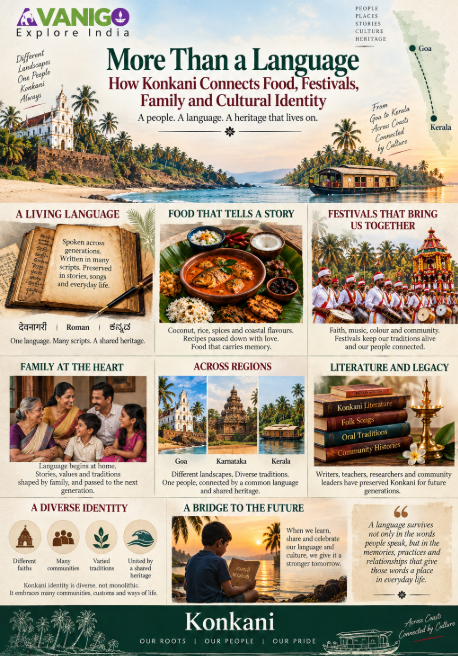
A language is often described through its vocabulary, grammar and literary history. Yet for communities that have carried their language across generations and geographical boundaries, language is also embedded in everyday life: the food prepared in family kitchens, the songs sung during celebrations, the rituals observed across generations and the stories passed down at home.
Konkani offers a compelling example of this relationship between language and cultural identity.
Spoken across communities in Goa, Karnataka, Kerala, Maharashtra and other parts of India, Konkani has developed within a complex landscape of migration, regional contact and cultural exchange. Its speakers do not represent a single uniform social or religious tradition. Instead, Konkani-speaking communities have developed diverse linguistic practices, culinary traditions and forms of cultural expression.
This diversity is central to understanding Konkani heritage. The language is not merely a means of communication. It is also a vehicle through which families remember, communities adapt and traditions acquire meaning.
Konkani culture cannot be understood through language alone. It must also be encountered through the food, festivals, family practices and collective memories in which the language continues to live.
1. Konkani: A Language Shaped by Geography and History
Konkani belongs to the Indo-Aryan language family and has a long history of development along the western coast of India. Its geographical spread is closely associated with communities living across the Konkan region and further south.
However, describing Konkani as a single, geographically uniform linguistic experience would overlook the variations that developed among its speakers.
The Census of India’s historical language documentation records the use of different scripts and regional forms of Konkani. Its survey material describes the adoption of Roman characters in Goa during the Portuguese period and the use of regional scripts in other areas. These developments demonstrate how historical circumstances and regional environments influenced the written representation of the language.
In Goa, Konkani in Devanagari script is the official language under the Goa, Daman and Diu Official Language Act, 1987. Konkani was included in the Eighth Schedule of the Constitution of India through the 71st Constitutional Amendment Act, 1992, which is sometimes incorrectly referred to as the 78th amendment in secondary sources.
The distinction between language, script and regional identity is important. Konkani-speaking communities may share linguistic connections while differing in religious practices, food customs, dialect features and cultural histories.
This is why Konkani heritage should be approached as a plural tradition rather than a single cultural template.
2. Konkani Food as a Record of Cultural Memory
Food is one of the most tangible ways in which culture is transmitted. Unlike a historical document that requires deliberate preservation, food traditions are often repeated through ordinary domestic routines: a recipe taught by a parent, a preparation made for a festival, or a dish associated with a particular season.
Within Konkani-speaking communities, food traditions reflect the interaction between regional ingredients, religious practices, family customs and local culinary environments.
Coastal ingredients and culinary adaptation
Coconut, rice, spices and locally available produce feature prominently in several coastal food traditions associated with Konkani communities. Yet culinary practices differ across regions and communities, so no single menu can represent Konkani food as a whole.
Goa’s official cultural documentation describes rice with fish curry as a staple of Goan cuisine and notes the use of coconut, coconut oil, spices and vinegar. It also records preparations associated with different religious and festive contexts, including khatkhate, sannas, bebinca and other regional foods.
In Kerala, Konkani culinary traditions have developed within a different regional environment. A study of heritage Konkani in Kerala documents the long-term interaction between Konkani and Malayalam, while cultural accounts of Kerala’s Konkani communities describe food as an important expression of community heritage. Culinary practices should nevertheless be understood in relation to the specific community being discussed rather than attributed universally to all Konkani speakers.
Food and the transmission of memory
A family recipe often contains more than instructions. It may preserve knowledge about ingredients, preparation methods, ritual occasions and household practices.
Consider the difference between recording the name of a traditional dish and documenting how a family prepares it. The first preserves a reference. The second preserves a practice.
This distinction matters because cultural continuity depends not only on retaining names, but also on sustaining the knowledge and contexts associated with them.
| Cultural dimension | How food contributes to continuity |
| Family | Recipes and cooking methods are passed between generations |
| Language | Food names, instructions and culinary vocabulary preserve linguistic usage |
| Festivals | Specific preparations may be associated with religious or seasonal observances |
| Regional identity | Ingredients and methods reflect local environments and historical contact |
| Memory | Dishes can evoke family occasions, places and inherited practices |
Food therefore becomes a form of cultural archive, particularly when culinary knowledge is shared through conversation and participation.
3. Festivals: Where Language Becomes Collective Experience
Festivals bring language and culture into public and communal settings. They connect religious observance, social participation, food, music and collective memory, although the form of celebration differs among Konkani-speaking communities.
A discussion of Konkani festivals must account for this diversity. Hindu and Christian communities in Goa, for example, observe different religious calendars and festive practices. Konkani-speaking communities elsewhere may follow distinct traditions shaped by their regional and religious histories.
The Government of Goa’s cultural documentation records folk performances, music, religious traditions and food practices as important elements of the state’s cultural life. Its account of Goan food also identifies preparations associated with celebrations among both Hindu and Christian communities.
The importance of participation
A festival’s cultural significance cannot be reduced to its visual spectacle. The deeper continuity often lies in participation:
- Preparing food together.
- Teaching children the meaning of a ritual.
- Singing traditional songs.
- Repeating customary greetings.
- Visiting relatives and community members.
- Sharing stories associated with the occasion.
These activities provide contexts in which language is used naturally. Children learn expressions, vocabulary and social conventions through interaction rather than formal instruction alone.
At the same time, traditions are not static. Families may modify food preparation, languages of conversation or the manner in which festivals are observed as circumstances change.
Cultural continuity, therefore, is not necessarily the exact repetition of every historical practice. It can also involve the transmission of meaning while forms of participation evolve.
4. Family: The First Institution of Language Preservation
The family is one of the primary environments in which children encounter a heritage language. It is where they may first hear stories about relatives, learn terms for food and relationships, and acquire expressions associated with everyday life.
The strength of this transmission depends on several factors, including whether the language is spoken at home, the linguistic environment of the community, intergenerational contact and opportunities to use the language beyond the household.
Research on heritage Konkani in Kerala provides a useful illustration of the complexity involved. A study published in Dialectologia examined language contact and phonetic change among heritage Konkani speakers in Kerala. The research included 20 Gowda Saraswat Brahmin youths aged 18 to 35 and identified changes associated with prolonged contact with Malayalam. Its findings concern a specific community and sample, not all Konkani speakers in Kerala.
This distinction is essential. Language change should not automatically be interpreted as cultural disappearance. Communities may retain cultural practices while their language changes in pronunciation, vocabulary, script use or frequency of everyday usage.
How families transmit cultural knowledge
Heritage language transmission can occur through:
- Everyday conversation: Using Konkani during routine family interactions.
- Storytelling: Sharing family histories, local memories and traditional narratives.
- Food preparation: Teaching culinary vocabulary and methods.
- Songs and prayers: Passing down language through cultural and religious practices.
- Intergenerational interaction: Creating opportunities for children to speak with older relatives.
The continuity of a language is influenced by whether younger generations have meaningful opportunities to use it. A language that exists only as a ceremonial reference may have a different social position from one used regularly in family and community life.
5. Konkani Identity Is Diverse, Not Monolithic
One of the most important considerations in writing about Konkani culture is avoiding the assumption that all Konkani-speaking people share the same customs.
Konkani communities have different religious affiliations, regional histories, caste backgrounds, dialect features and cultural practices. The academic study of heritage Konkani in Kerala explicitly examines linguistic variation across different caste communities, demonstrating that the language’s social and linguistic landscape is not uniform.
The diversity can be understood through several dimensions:
| Dimension | Why it matters |
| Region | Goa, coastal Karnataka, Kerala and Maharashtra have distinct historical environments |
| Religion | Religious observances influence festivals, food and community practices |
| Script | Devanagari, Roman and other regional writing traditions have historical significance |
| Dialect | Pronunciation, vocabulary and grammatical features may vary across communities |
| Migration | Settlement patterns have shaped language contact and cultural adaptation |
| Family history | Individual households preserve different traditions and memories |
This diversity does not weaken the idea of Konkani identity. It makes the identity more historically accurate and culturally substantive.
A responsible cultural article should identify the specific community, region or tradition it describes rather than presenting one group’s practices as representative of everyone.
6. The Role of Language in Preserving Cultural Vocabulary
Language carries categories of meaning that are not always easily translated into another language. Names of dishes, kinship terms, ritual expressions, proverbs and local references can contain cultural information beyond their dictionary definitions.
For Konkani, the preservation of vocabulary is connected to the continued use of the language in everyday and cultural settings.
Historical language documentation records Konkani folk songs, proverbs, idioms and phrases as part of its linguistic material. Such sources demonstrate the importance of studying the language not only through formal texts but also through spoken and traditional forms of expression.
A word connected to a family recipe, for example, may convey information about an ingredient, a preparation method or a customary occasion. Its significance can become less accessible when the associated practice is no longer familiar to younger generations.
This is why language preservation and cultural preservation often intersect.
Beyond translation
Translation can make cultural knowledge accessible to a wider audience, but it does not always reproduce every social and historical association carried by the original expression.
For this reason, documenting Konkani heritage may require a combination of:
- Original-language material.
- Transliterations where appropriate.
- Contextual explanations.
- Oral histories.
- Audio and visual documentation.
- Community-authored accounts.
These approaches can help preserve both the linguistic form and the cultural context in which the language is used.
7. Konkani Culture in a Changing World
Language communities evolve as their members move for education, employment, marriage and other reasons. Urbanisation, multilingual schooling, digital communication and changing household structures can alter how frequently a heritage language is used.
These changes are not unique to Konkani. They form part of the broader experience of multilingual communities in India.
The challenge is to understand how cultural practices are maintained, adapted or discontinued under changing conditions without assuming that all change produces the same outcome.
For Konkani-speaking families, possible approaches to cultural continuity include:
- Encouraging children to learn and use the heritage language.
- Recording family histories and oral narratives.
- Supporting regional literary and cultural institutions.
- Preserving traditional recipes with their cultural context.
- Documenting local festivals and community practices.
- Making heritage materials accessible through digital platforms.
The Goa Konkani Akademi, established in 1986, has an institutional mandate to support the development of Konkani language, literature and culture. Its work reflects the role that cultural institutions can play in language development and preservation.
Digital preservation can complement these efforts, but a digital archive is most valuable when its material is accurately documented, responsibly contextualised and connected to the communities whose heritage it represents.
8. From Goa to Kerala: A Shared Heritage with Regional Distinctions
The cultural relationship between Goa and Kerala is not adequately described as a simple transfer of one tradition from one place to another.
Konkani-speaking communities in Kerala have developed within their own historical and linguistic environment. Research on heritage Konkani in Kerala documents migration histories and language contact with Malayalam, including linguistic changes among particular communities.
This provides a useful framework for understanding cultural continuity: communities may carry elements of inherited language and practice while also adapting to new regional conditions.
Food, family traditions and religious observances may retain connections with earlier histories, but they can also acquire distinctive local forms.
The result is not a single, unchanging cultural identity. It is a network of related identities connected through language, memory and historical experience.
9. Why Cultural Memory Matters
Cultural memory is preserved through more than institutions and published histories. It also survives in personal accounts, family photographs, inherited objects, recipes, songs and recollections of individuals who contributed to community life.
These sources can reveal dimensions of heritage that are difficult to capture through broad historical summaries.
A memoir about a Konkani language contributor, such as N. Purushotham Mallya, can therefore serve as a starting point for a larger discussion of cultural preservation. However, the details of Mallya’s life, publications and specific contributions should be established through reliable biographical material, archival evidence or documented recollections before being presented as factual history.
The broader lesson is that cultural memory benefits from careful documentation. Personal testimony can provide valuable insight, while corroboration helps distinguish individual recollection from verifiable historical claims.
“A language survives not only in the words people speak, but in the memories, practices and relationships that give those words a place in everyday life.”
Frequently Asked Questions About Konkani Culture
What is the cultural significance of the Konkani language?
Konkani is a language associated with diverse communities across India’s western coast and beyond. Its cultural significance is expressed through literature, family communication, oral traditions, food practices and regional community histories.
What food is traditionally associated with Konkani culture?
Konkani food traditions vary by region, religion and community. Goan cuisine includes rice with fish curry, coconut-based preparations and a range of festive foods. Other Konkani-speaking communities have developed distinct culinary practices shaped by their regional environments and cultural traditions.
Is Konkani spoken in Kerala?
Yes. Konkani-speaking communities are present in Kerala, and research has documented heritage Konkani varieties and their interaction with Malayalam. The language’s usage and characteristics vary across communities.
Why does Konkani have different scripts?
Konkani has been written in different scripts in different regions and historical contexts. Historical documentation describes the use of Devanagari, Roman and regional scripts, reflecting linguistic and political developments.
How can families help preserve Konkani?
Families can create opportunities for children to hear and use Konkani, share oral histories, document family traditions, and participate in cultural activities. The appropriate approach depends on the family’s linguistic background and community context.
Is Konkani culture the same across Goa and Kerala?
No. Although there are linguistic and historical connections, Konkani-speaking communities in Goa and Kerala have developed distinct regional, religious and social practices. Cultural descriptions should identify the specific community being discussed.
Conclusion: A Heritage That Continues Through Practice
Konkani culture is not contained within a dictionary, a literary archive or a historical account. It is expressed through the everyday practices that connect people to their families, communities and places of origin.
Food preserves knowledge through preparation and sharing. Festivals bring communities together through ritual and participation. Families transmit language through conversation and memory. Migration introduces new environments in which inherited traditions are adapted and reinterpreted.
These dimensions of culture do not always develop at the same pace. Language use may change while food traditions endure. Festivals may evolve while family histories remain important. A community may retain a strong sense of cultural belonging even as its linguistic practices become more varied.
Understanding Konkani therefore requires attention to both continuity and change.
From Goa to Kerala and across other regions where Konkani-speaking communities have established roots, the language remains connected to a broader cultural history. Its preservation depends not only on recording the past, but also on creating meaningful opportunities for future generations to encounter, understand and use their heritage.