
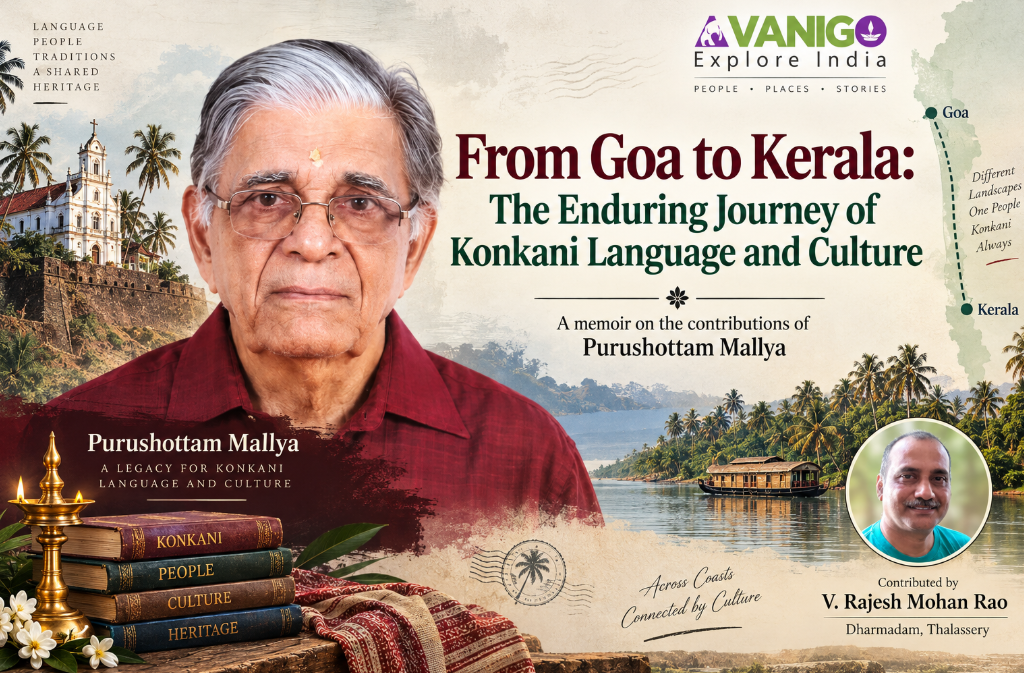
A language is much more than a means of communication. It carries the memories of generations, preserves traditions, connects communities and keeps alive the cultural experiences of people across time and distance. The history of Konkani beautifully illustrates this enduring relationship between language, people and place.
Goa occupies a central place in the cultural history of Konkani. Yet the story of Konkani does not end at the borders of Goa. Over generations, Konkani-speaking communities travelled and settled in different parts of the western and southern regions of India, particularly in Karnataka, Kerala and Maharashtra. Through these movements, Konkani became a language that connected people across geographical boundaries while adapting to different local environments.
Kerala has an important place in this wider Konkani story. The presence of Konkani-speaking communities in Kerala has a long history, and the Goud Saraswat Brahmin community, in particular, has contributed significantly to the preservation of Konkani language, traditions and cultural practices in the state. Kochi and several other parts of Kerala became important centres where language, religious traditions, family histories and community institutions continued to flourish.
It is in this broader history of Konkani that the life and work of N. Purushotham Mallya deserve special remembrance.
Mallya devoted a substantial part of his life to the study, preservation and promotion of Konkani language and culture. He was associated with scholarship, literature, poetry and historical research, and his deep attachment to Konkani reflected a larger commitment to preserving the cultural memory of a community.
For Mallya, language was not merely a medium through which people communicated. It represented history, identity, literature and collective memory. His work reminds us that the preservation of a language requires more than dictionaries and textbooks. It requires people who are willing to study its past, document its literature and encourage future generations to value it.
The recognition of Konkani in the Eighth Schedule of the Constitution of India in 1992 was an important milestone in the modern history of the language. The constitutional recognition that came through the 71st Amendment reflected decades of efforts by writers, scholars, cultural organisations and members of the Konkani-speaking community.
The achievement also demonstrated that India’s linguistic diversity is not a division but a cultural strength. Konkani’s recognition as a scheduled language gave its literary and cultural traditions a significant place within the country’s constitutional framework.
Mallya’s intellectual interests extended beyond the boundaries of a single language. His engagement with the Tirukkural, one of the great works of classical Tamil literature, is particularly significant in understanding his broader literary outlook. The study and appreciation of works from other Indian linguistic traditions demonstrate how India’s languages can enrich one another rather than exist in isolation.
His contribution was also recognised at the national level through the Padma Shri, one of India’s important civilian honours. Such recognition placed his literary and cultural contribution within a wider national context and drew attention to the importance of preserving India’s diverse linguistic traditions.
The relationship between Goa and Kerala therefore deserves to be viewed not simply as a story of migration, but as a continuing cultural conversation.
In Goa, Konkani has remained deeply connected with everyday life, literature, journalism and cultural expression. In Kerala, the language developed within a different social and geographical environment while retaining important elements of its heritage. The result is a fascinating cultural landscape in which the same language can carry different regional experiences while maintaining a shared historical foundation.
This diversity is one of the strengths of Konkani.
The Konkani-speaking world includes communities with different regional traditions, scripts, food cultures, social practices and literary experiences. Yet language continues to provide a common thread. From Goa to coastal Karnataka and Kerala, and from India to Konkani communities living abroad, the language has travelled with people and preserved links with their ancestral heritage.
The challenge before the present generation is to ensure that Konkani remains a living language.
Preserving a language cannot depend only on remembering its past. Children must be encouraged to speak it at home. Young people should have opportunities to read and write Konkani. Digital platforms should carry more Konkani content. Old books, manuscripts and historical records need to be preserved and made accessible. New writers, researchers and cultural activists must be encouraged.
This is where the role of contemporary media becomes important. Digital platforms based in Goa can help connect Konkani speakers across regions and generations. They can provide space not only for current news but also for literature, history, community stories and discussions about the future of the language.
The Konkani story is therefore not merely a Goan story or a Kerala story. It is a story of movement, memory and cultural continuity.
Remembering N. Purushotham Mallya provides an opportunity to reflect on this larger heritage.
His life demonstrates the importance of intellectual dedication to one’s language while remaining open to the wider cultural traditions of India. His interest in literature, history and other Indian languages offers a valuable example of how linguistic pride can coexist with cultural openness.
For the Konkani community, preserving this heritage is a responsibility shared across generations. Goa, Kerala, Karnataka, Maharashtra and Konkani communities elsewhere can each contribute to keeping the language vibrant.
The journey of Konkani from the Konkan coast to different parts of India has already crossed many geographical boundaries. Today, the digital age offers an opportunity to take that journey further.
A language survives not simply because it has a long history, but because each generation chooses to use it, learn it, write it and pass it on.
That is perhaps the most meaningful way to remember those who dedicated their lives to Konkani.
From Goa to Kerala, from one generation to another, Konkani continues to carry a remarkable story of language, culture, memory and human connection. Its past deserves to be preserved—and its future deserves to be written.
About The Author
V. Rajesh Mohan RaoDharmadam, Thalassery, Kerala, India.