
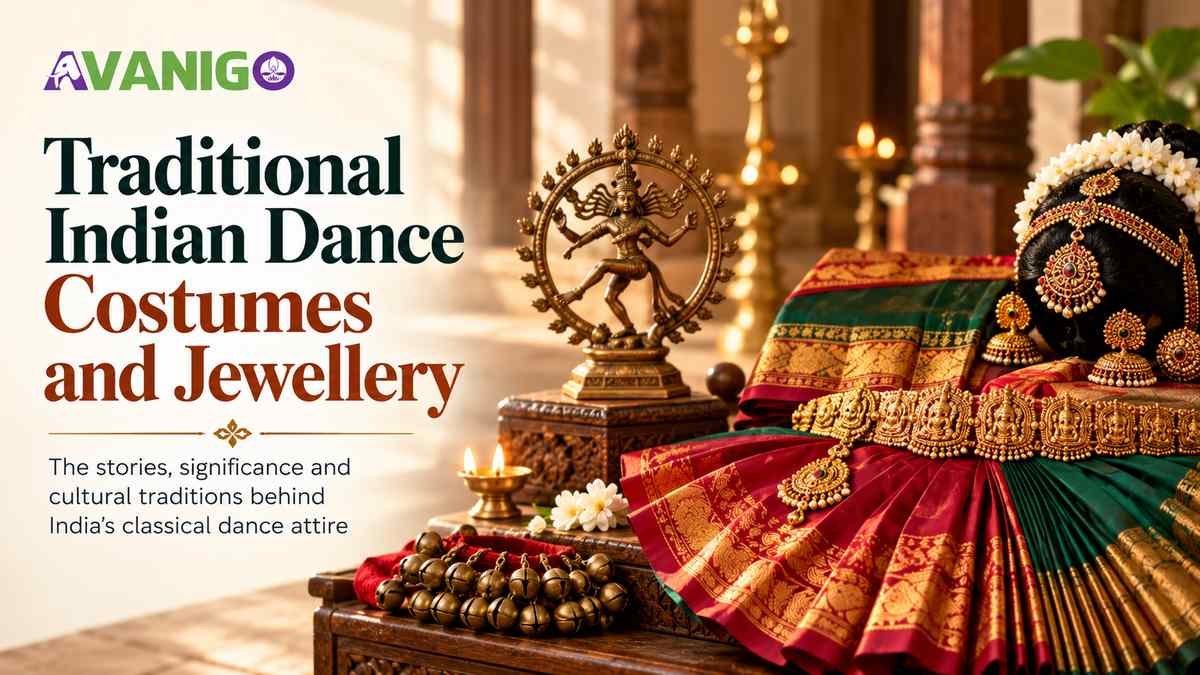
A classical Indian dancer’s costume is not simply an outfit chosen for a performance. The pleats of a Bharatanatyam costume, the silver ornaments of an Odissi dancer and the flowing garments worn for Kathak contribute to the visual language through which movement, character and emotion become legible to an audience.
These details developed within artistic traditions shaped by regional history, religious narratives, courtly patronage, textiles, metalwork and generations of teaching. They also continue to evolve. Contemporary dancers and costume designers must balance recognisable conventions with comfort, movement, stage lighting and the practical demands of performance.
Understanding traditional Indian dance costumes and jewellery therefore requires looking beyond appearance. The garments and ornaments make more sense when considered alongside the dance forms themselves, the stories they tell and the communities that have preserved and developed them.
Quick Navigation
How Costume Became Part of Indian Classical Dance
Indian performing arts have a long history of connecting movement, music, storytelling and visual presentation. The Natyashastra, an ancient Sanskrit treatise attributed to Bharata, discusses drama, dance, music, gesture, stagecraft and costume. Its framework includes aharya abhinaya, the aspect of performance associated with costume, makeup and visual presentation.
The text is an important source for understanding classical Indian performance theory. It should not, however, be treated as a complete record of the precise costumes worn by every dance community across every historical period. Regional traditions developed through their own practices, patronage systems, materials and performance contexts.
Indian classical dance also draws extensively on literature. Stories from the Ramayana, the Mahabharata and the Puranas appear in many dance repertoires. The Gita Govinda, composed by Jayadeva, has been especially influential in traditions that interpret the relationship between Krishna and Radha through music and dance.
The Sanskrit language resources of the Government of India identify the Natyashastra and Abhinayadarpana among the important texts associated with Indian classical dance. They also describe costume and makeup as components of abhinaya, alongside gesture, speech and the representation of emotion.
Costume matters because classical dance is a visual art. The audience must be able to read the dancer’s posture, hand gestures, facial expressions and rhythmic movement. Pleats, jewellery, fabric and ornaments contribute to that presentation, but they must work with the choreography rather than obstruct it.
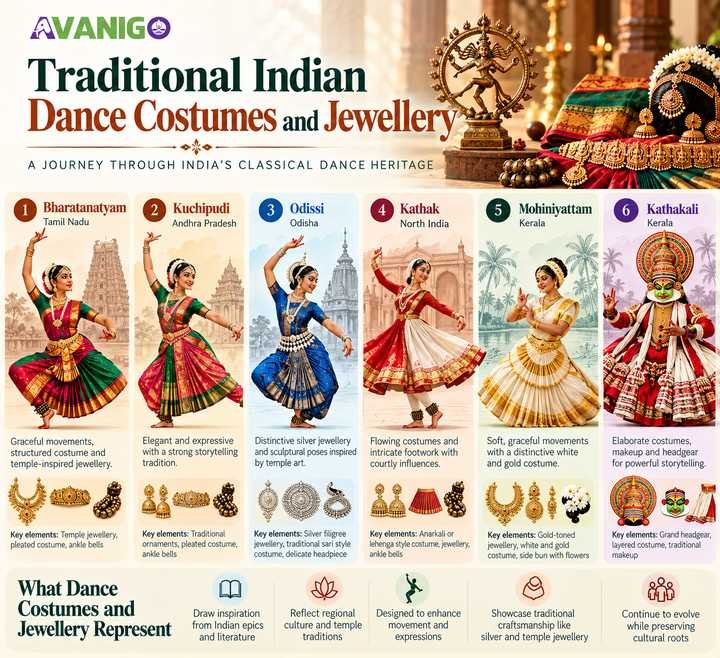
1. Bharatanatyam: Pleats, Temple Jewellery and Geometric Movement
Bharatanatyam is strongly associated with Tamil Nadu and is known for its structured vocabulary of movement, rhythmic precision, expressive storytelling and distinctive stage presentation.
The costume commonly includes a fitted blouse and a lower garment designed to accommodate the dancer’s movements. A fan-like pleated panel opens when the dancer bends the knees into a deep stance, making the geometry of the movement more visible to the audience.
Costume construction varies. Some outfits use stitched pleated trousers or a dhoti-style arrangement, while others combine a fitted upper garment with a pleated lower section. The essential consideration is freedom of movement and clear presentation of the dancer’s lines.
The role of Bharatanatyam jewellery
Traditional Bharatanatyam jewellery is often inspired by South Indian temple ornamentation. Sets may include a headpiece, earrings, necklaces, armlets, bangles, waist belts and ornaments worn around the ankles. A forehead ornament or central hair accessory may also form part of the complete look.
These pieces help frame the face, mark the lines of the body and create visual continuity across the costume. Ankle bells, known as salangai in Tamil, are particularly important to the performance because they articulate rhythmic footwork.
Temple-inspired jewellery should not be understood as a single unchanging set worn identically throughout history. Modern stage jewellery reflects a mixture of inherited conventions, contemporary manufacturing and practical requirements.
What dancers should consider
- Choose a costume with enough room for repeated deep knee bends.
- Check that pleats open cleanly during movement.
- Secure necklaces, earrings and head ornaments before performing.
- Ensure ankle bells are fitted comfortably and produce a clear, balanced sound.
- Select jewellery that complements the costume without distracting from the face or movement.
2. Kuchipudi: A Telugu Dance Tradition with Theatrical Roots
Kuchipudi is associated with Andhra Pradesh and has a particularly strong historical connection to Telugu-language dance-drama. Its repertoire includes expressive storytelling, rhythmic passages and characters drawn from literary and religious narratives.
The tradition is associated with Kuchipudi village in present-day Andhra Pradesh. Its development reflects the relationship between performance, community practice, devotional storytelling and the Telugu cultural world. Contemporary Kuchipudi includes solo performances as well as dance-drama traditions.
Costumes often share visual features with other South Indian classical dance styles, including pleated garments, fitted blouses, jewellery and ankle bells. Yet the details can vary with the production, the character portrayed and the dancer’s training tradition.
Costume and character
In a Kuchipudi performance, the costume must accommodate both rhythmic movement and dramatic expression. A solo dancer portraying a mythological character may require a different visual treatment from a dancer performing a pure rhythmic sequence.
Head ornaments, necklaces and waist belts help establish the stage appearance. Makeup may also be used to clarify facial expression under performance lighting.
The costume’s purpose is not to make every dancer look identical. It helps communicate the nature of the performance while allowing the audience to focus on the dancer’s technique and storytelling.
For students and parents: When purchasing a Kuchipudi costume, ask the teacher or institution about its preferred style, colour conventions, measurements and required accessories. A costume that looks correct in a photograph may still be unsuitable for the choreography or the dancer’s body.
3. Odissi: Silver Jewellery and the Visual Language of Odisha
Odissi, associated with Odisha, is recognised for its sculptural poses, lyrical movement and distinctive use of the torso. Its visual identity is also linked to the region’s artistic heritage, including temple sculpture, textile traditions and silver craftsmanship.
Odissi costumes commonly incorporate a sari or a garment constructed from traditional textiles, with pleats arranged to support movement. The exact arrangement varies across costume styles and performance requirements.
Why silver jewellery is prominent
Odissi jewellery is widely associated with silver filigree craftsmanship, particularly the tradition known as tarakasi in Cuttack. Fine silver wires are shaped into intricate patterns, producing ornaments with a delicate, detailed appearance.
A traditional Odissi ensemble may include a forehead ornament, earrings, necklaces, armlets, bangles and waist jewellery. The hair is often arranged in a distinctive style, sometimes incorporating a decorative headpiece inspired by temple imagery.
The combination of textile, jewellery and hair ornament creates a recognisable stage appearance. It also connects the dance to a wider regional tradition of metalwork and visual design.
Odissi’s repertoire includes works associated with devotional poetry and the Gita Govinda. The relationship between poetry, music, gesture and costume helps establish the atmosphere of a performance without requiring the audience to understand every word.
How to choose Odissi jewellery
- Ask whether the set is intended for stage performance or everyday wear.
- Check the weight of larger ornaments.
- Confirm how headpieces and hair ornaments are secured.
- Inspect delicate filigree work for bent wires or weak joints.
- Store silver ornaments carefully to reduce tarnishing and damage.
4. Kathak: Movement, Flow and Courtly Influence
Kathak developed through a complex history involving storytelling, devotional performance, courtly patronage and changing theatrical contexts across North India. Its contemporary forms include distinct gharana traditions, each with its own emphases in technique and presentation.
Unlike the structured pleated fan associated with Bharatanatyam, Kathak costumes often allow the skirt or lower garment to flare during turns. Women performers may wear an anarkali-style costume, a lehenga-style ensemble or a sari, depending on the repertoire and institution. Men may perform in an angarkha-style upper garment with a churidar or other suitable lower garment.
These are broad contemporary conventions, not fixed rules for every historical period or every Kathak performance.
Jewellery and movement
Kathak jewellery is often comparatively restrained when the choreography prioritises rapid footwork, turns and intricate rhythmic patterns. Earrings, necklaces, bangles and a forehead ornament may complete the ensemble.
Ankle bells are particularly important because the dancer uses footwork to articulate rhythmic patterns in coordination with the music. Their sound becomes part of the performance rather than merely a decorative addition.
Kathak’s history also illustrates why Indian classical costumes should not be reduced to one religious or regional origin. The form developed through multiple cultural settings, including devotional storytelling and courtly performance, and its contemporary practice reflects that layered history.
For performance use: The costume should allow full turns, prevent fabric from tangling around the feet and remain secure during fast footwork. Heavy jewellery or poorly fitted garments can interfere with movement.
5. Mohiniyattam: Kerala’s Soft Lines and White-and-Gold Palette
Mohiniyattam is a classical dance tradition associated with Kerala. Its stage presentation is often recognised by a white or off-white costume with gold borders, although contemporary interpretations and institutional conventions can differ.
The costume’s palette connects visually with Kerala’s textile traditions. Its restrained colours also complement the form’s emphasis on flowing movement and expressive gestures.
Jewellery may include gold-toned necklaces, earrings, bangles and hair ornaments. The hair is commonly arranged in a bun to one side, decorated with flowers in many traditional presentations.
The overall effect is created through the relationship between costume, movement and composition. It is not necessary to add elaborate ornament to make the dancer visually compelling; the design works because the fabric and jewellery support the movement.
Practical considerations
- Choose fabric that falls smoothly and does not restrict the feet.
- Ensure gold borders do not become excessively heavy.
- Secure flowers and hair accessories for the full duration of the performance.
- Follow the requirements of the dance school or production.
6. Kathakali: Costume as Character and Theatre
Kathakali, the classical dance-drama tradition associated with Keralam, demonstrates how costume can become an essential part of theatrical storytelling.
Its elaborate makeup, headgear, layered garments and facial conventions help audiences identify character types. The complete visual transformation is central to the dramatic experience.
Kathakali costumes are not simply embellished versions of everyday clothing. They belong to a performance system in which colour, makeup, facial expression, gesture and movement work together. The visual language may communicate character and dramatic function before a performer speaks or moves extensively.
The production requirements are substantial. Costumes can involve multiple layers and specialised makeup processes, and performers need training to work comfortably within them.
For cultural enthusiasts, Kathakali offers a useful contrast with styles whose costumes are more closely fitted to the body. Both approaches use costume to support performance, but they do so in different ways.
When attending a Kathakali performance, look at how costume, facial makeup and gesture work together. The visual details are not separate decorations; they form part of the dramatic vocabulary.
7. Manipuri: Devotional Performance and Distinctive Silhouettes
Manipuri, associated with Manipur, includes traditions shaped by regional history, devotional practice and the cultural importance of Vaishnavism. Raslila performances connected with Krishna and Radha are particularly significant within the tradition.
Costumes used in Manipuri Raslila can include the distinctive cylindrical skirt known as the potloi, paired with a fitted upper garment, veil and carefully arranged ornaments. This creates a silhouette very different from the pleated costumes of Bharatanatyam or the flowing garments used in many Kathak presentations.
Costumes vary according to the performance tradition and character. The potloi is especially associated with female roles in Raslila and should not be treated as a universal costume for every Manipuri dance form.
The costume helps establish the atmosphere of the performance, while movement and music create a sense of continuity and devotion. Its visual identity reflects the region’s own artistic conventions rather than a single national template for classical dance.
8. What Classical Dance Jewellery Communicates
Across Indian classical dance traditions, jewellery performs several functions. It frames the face, helps define the body’s lines, complements costume and contributes to a complete stage image.
Some ornaments are closely associated with regional craftsmanship. Odissi’s connection with silver filigree is one example; Bharatanatyam’s temple-inspired jewellery is another. These relationships can create opportunities for collaboration between dancers, costume makers, metalworkers and contemporary designers.
However, not every ornament has a single symbolic meaning, and meanings may differ between regions, institutions and performances. It is more accurate to discuss a particular tradition or use than to assign one universal interpretation to every necklace, anklet or headpiece.
The role of ankle bells
Ankle bells deserve particular attention because they have an audible as well as a visual function. They articulate rhythmic footwork and help the audience hear the relationship between movement and musical time.
The bells must be chosen and fitted according to the dancer’s training and the requirements of the form. Weight, sound, secure fastening and comfort all matter. They are performance equipment as much as costume accessories.
Materials and stage requirements
Classical dance jewellery may be made from precious metals, silver, alloys, plated materials or lightweight costume components. The right choice depends on budget, performance duration, durability and the institution’s expectations.
A set designed for a brief stage performance may differ from one intended for frequent rehearsals. Dancers should inspect fastenings, edges and weight distribution rather than judging a set only by appearance.
How Traditional Dance Costumes Are Evolving Today
Indian classical dance is not frozen in an earlier period. Dancers perform in traditional venues, cultural festivals, educational institutions and contemporary theatres. They also share performances through digital platforms, reaching audiences who may never have attended a live recital.
This has influenced costume design. Modern performers may use lighter materials, more secure fastenings and construction methods that make quick changes easier. Designers also experiment with colour, fabric and silhouette while working within the visual expectations of a particular dance form.
The continuity lies in the relationship between costume and technique. A modern costume still needs to support the movements, character and presentation of the dance. A design that looks attractive but obstructs footwork or hides essential gestures is not successful stagewear.
There is also renewed interest in regional craftsmanship. Dance jewellery can create a market for traditional metalwork, while costume makers maintain specialised skills in tailoring, pleating, embroidery and finishing. This commercial relationship is strongest when makers receive clear recognition and fair payment for their work.
For buyers, the important question is not whether a product is labelled traditional or modern. It is whether the design is appropriate for the performance, the maker’s work is accurately represented and the product is fit for purpose.
How to Choose a Classical Dance Costume and Jewellery Set
Before buying a complete set, consult the dancer’s teacher or institution. Costume expectations differ across forms and may vary by school, repertoire and performance context.
Use this checklist:
- Confirm the dance form and costume style. Do not assume that one South Indian classical costume will suit every form.
- Check measurements and movement. Test the costume while performing the movements required for the repertoire.
- Prioritise secure fastenings. Headpieces, necklaces, earrings and waist ornaments must remain in place.
- Consider weight. Heavy jewellery can cause discomfort during long rehearsals or performances.
- Inspect materials. Ask whether the jewellery is silver, gold, plated metal, an alloy or another material.
- Check care requirements. Textiles and metal ornaments need different storage and cleaning methods.
- Ask about repairs. Delicate ornaments may need specialist maintenance.
- Respect the performance context. Costume choices should suit the choreography, character and institution’s conventions.
Frequently Asked Questions
What is special about traditional Indian classical dance costumes?
They are designed to support movement, make gestures visible and establish the visual identity of a dance tradition. Their materials, silhouettes and ornaments differ across regions and forms.
Why does Bharatanatyam use pleated costumes?
Pleated panels open during deep stances and help make the dancer’s movements visible. Costume designs vary, but freedom of movement and clear presentation are essential.
What jewellery is used in Odissi dance?
Odissi costumes commonly feature silver jewellery associated with Odisha’s metalworking traditions, including earrings, necklaces, head ornaments and other pieces. The exact set depends on the dancer and performance.
Why are ankle bells important in classical dance?
Ankle bells articulate rhythmic footwork and create an audible connection between movement and music. Their fit and sound matter as much as their appearance.
Are modern dance costumes different from traditional ones?
Contemporary costumes may use lighter materials, updated construction and more secure fastenings. They still need to respect the dance form’s movement requirements and performance conventions.
More Than an Outfit: A Living Cultural Tradition
Traditional Indian dance costumes and jewellery make visible the relationship between performance and the wider cultural world. They reflect textiles, metalwork, regional aesthetics, literary narratives and the practical knowledge required to perform demanding choreography.
Bharatanatyam’s pleats, Odissi’s silver ornaments, Kathak’s flowing garments and Kathakali’s theatrical transformations are not interchangeable decorative styles. Each belongs to a particular performance tradition with its own history and conventions.
These traditions continue because dancers, teachers, costume makers, jewellers and audiences keep working with them. Their future depends not only on preserving familiar appearances, but also on understanding the skills and cultural knowledge behind them.