
Vedic astrology, commonly known as Jyotish Shastra, is an Indian astrological tradition that interprets celestial positions through a framework of planets, zodiac signs, lunar mansions and planetary periods. It has influenced several cultural practices in India, including the selection of auspicious dates for ceremonies, the preparation of birth charts and the interpretation of traditional calendars.
Its history is connected to a broader body of Indian knowledge that includes astronomy, mathematics, calendrical calculations, Sanskrit literature and religious practice. Over centuries, different schools developed their own methods and interpretations, making Jyotish a diverse tradition rather than a single, uniform system.
Today, Vedic astrology continues to appear in family customs, wedding planning, festival calendars and personal consultations. Understanding its historical development and core concepts helps explain its place in Indian culture while distinguishing traditional beliefs from scientifically established findings.
Quick Navigation
What Is Vedic Astrology?
Vedic astrology is the modern name commonly used for the Indian tradition of astrology known as Jyotisha or Jyotish Shastra. The term is associated with light and celestial knowledge, although the subject has evolved across different historical periods.
The tradition considers the positions and movements of celestial bodies within an interpretive framework used to prepare horoscopes, assess auspicious timings and offer astrological readings.
The term Jyotisha also has a broader historical meaning. In early Indian literature, Vedanga Jyotisha addressed the calculation of time and the astronomical observations needed to determine appropriate dates for Vedic rituals. This calendrical and astronomical tradition should not be treated as identical to every form of predictive astrology practised today.
The Indian government’s Vedic Heritage Portal identifies Jyotisha as one of the six Vedangas, or auxiliary disciplines associated with Vedic learning. Its early role included helping determine the timing of ritual observances. Later Indian traditions developed more elaborate systems of astronomical calculation and astrological interpretation.
The Historical Roots of Jyotish Shastra
The history of Indian astrology cannot be reduced to a single text or date. It developed through several bodies of literature, mathematical practices and cultural exchanges.
1. Vedanga Jyotisha and the calculation of time
Vedanga Jyotisha is an important early text associated with the calculation of time in Vedic ritual traditions. Attributed traditionally to Lagadha, it contains rules connected with lunar and solar cycles, seasons and the timing of ritual activities.
Its primary historical significance lies in calendrical calculation rather than the full horoscope-based predictive system that many people associate with Vedic astrology today.
This distinction matters. Indian astronomy and astrology share historical connections, but they are not interchangeable disciplines. Astronomical calculations concern the positions and movements of celestial bodies. Astrological interpretations assign traditional meanings to those positions.
2. Sanskrit literature and the development of astrology
Later Sanskrit literature contains works on astronomy, mathematical calculations, planetary movements and astrological interpretation.
Varahamihira, an influential scholar traditionally dated to the sixth century CE, is associated with works including Brihat Samhita and Brihat Jataka. These texts belong to different areas of the broader Jyotisha tradition. Brihat Samhita covers a wide range of subjects, including natural phenomena and cultural practices, while Brihat Jataka is associated with horoscopic astrology.
The historical development of Indian astrology also involved interaction with astronomical and astrological traditions beyond the Indian subcontinent. Academic research traces exchanges between Indian, Mesopotamian, Hellenistic and later Arabic traditions, showing that the history was complex rather than isolated.
For readers interested in Indian intellectual history, these texts provide a starting point for exploring how astronomical observations, mathematical methods and traditional interpretations developed over time.
3. Astrology in contemporary Indian culture
Astrology continues to have a place in many Indian households. Families may consult an astrologer when discussing marriage compatibility, selecting a ceremony date or interpreting a birth chart.
Its cultural significance varies by region, community, family tradition and individual belief. Some people treat astrology as an important part of decision-making; others engage with it primarily as a cultural inheritance.
Understanding these differences is essential when discussing astrology in modern India. It is a living tradition, but its practices are not uniform across all Hindu communities or Indian regions.
The Core Concepts of Vedic Astrology
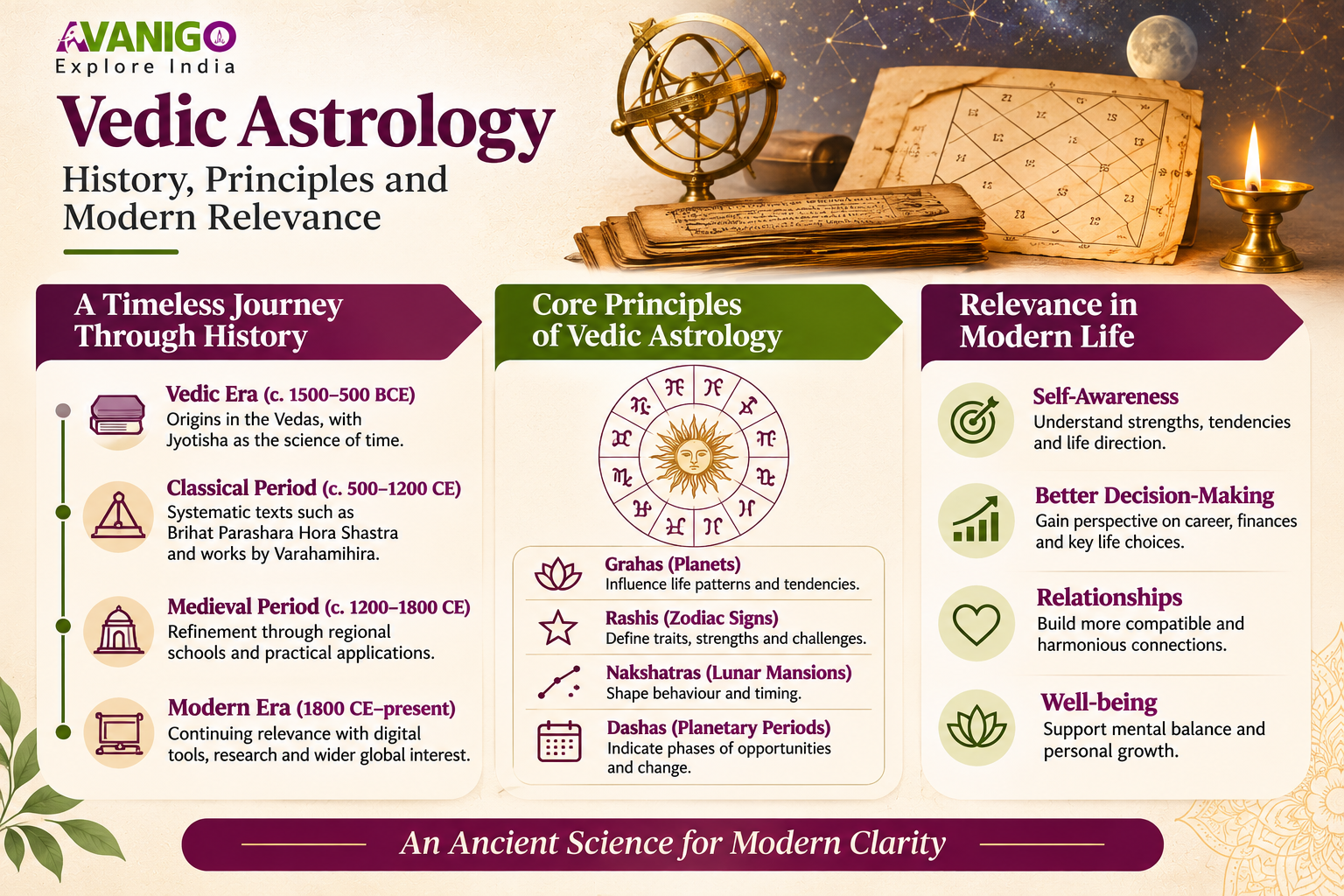
Vedic astrology uses several interconnected concepts. The following table introduces the main terms and their traditional roles.
| Concept | Meaning in Vedic astrology | Common context |
| Graha | A celestial body or astrological factor interpreted within the system | Birth charts and planetary readings |
| Rashi | One of the 12 zodiac signs | Horoscope interpretation |
| Nakshatra | A lunar mansion or division of the zodiac associated with the Moon’s position | Birth-chart analysis and traditional calendars |
| Lagna | The ascendant, calculated from the eastern horizon at a given time and place | Establishing the framework of a birth chart |
| Kundali | A horoscope or astrological chart | Personal astrological consultation |
| Dasha | A planetary-period system used in some schools of Vedic astrology | Traditional timing and interpretation |
| Gochar | The transit of a planet through a zodiac sign or other astrological position | Ongoing horoscope interpretation |
| Muhurta | Selection of a time considered auspicious for a particular activity | Ceremonies, weddings and other events |
Different schools may calculate or interpret these concepts differently. Birth-chart calculations also depend on the date, time and location used, along with the calculation conventions selected.
The Nine Grahas: Understanding the Navagraha Tradition
The Navagraha are the nine astrological grahas commonly used in Hindu astrological traditions: Surya, Chandra, Mangala, Budha, Brihaspati, Shukra, Shani, Rahu and Ketu.
In English, these are generally associated with the Sun, Moon, Mars, Mercury, Jupiter, Venus, Saturn, Rahu and Ketu.
Rahu and Ketu are lunar nodes rather than physical planets. Their inclusion illustrates that the grahas in Jyotish form an astrological classification, not simply a list of the planets recognised by modern astronomy.
| Sanskrit name | Common English name | Traditional astrological association |
| Surya | Sun | Authority, vitality and leadership |
| Chandra | Moon | Mind, emotions and mental disposition |
| Mangala | Mars | Energy, courage and action |
| Budha | Mercury | Communication, reasoning and learning |
| Brihaspati or Guru | Jupiter | Knowledge, guidance and wisdom |
| Shukra | Venus | Relationships, aesthetics and enjoyment |
| Shani | Saturn | Discipline, responsibility and consequences |
| Rahu | North lunar node | Ambition, unconventional pursuits and desire |
| Ketu | South lunar node | Detachment, introspection and spiritual themes |
These are traditional interpretive associations, not scientifically verified descriptions of how celestial bodies influence personality or life outcomes.
The Navagraha also occupy a place in Hindu religious practice, including temple iconography and devotional worship. A reader exploring the subject further may distinguish between Navagraha worship as a religious practice and the interpretation of planetary placements in an individual horoscope.
The 12 Rashis and Their Place in a Birth Chart
The zodiac in Vedic astrology is divided into 12 rashis. Each covers a section of the zodiac, and the signs are used in conjunction with the positions of the grahas and the houses of a horoscope.
The traditional Sanskrit names are Mesha, Vrishabha, Mithuna, Karka, Simha, Kanya, Tula, Vrischika, Dhanu, Makara, Kumbha and Meena.
| Rashi | Common English name |
| Mesha | Aries |
| Vrishabha | Taurus |
| Mithuna | Gemini |
| Karka | Cancer |
| Simha | Leo |
| Kanya | Virgo |
| Tula | Libra |
| Vrischika | Scorpio |
| Dhanu | Sagittarius |
| Makara | Capricorn |
| Kumbha | Aquarius |
| Meena | Pisces |
A Vedic birth chart does not depend on the Sun sign alone. Depending on the school and the type of reading, the ascendant, Moon’s position, planetary placements, houses and planetary periods may all be considered.
This is one reason a short newspaper horoscope and a full birth-chart consultation can differ considerably in scope.
What Are the 27 Nakshatras?
Nakshatras are lunar mansions used in Indian calendrical and astrological traditions. In a widely used system, the zodiac is divided into 27 nakshatras, each covering 13 degrees and 20 minutes of the zodiac.
The Moon’s position is central to many traditional uses of nakshatras. They may be consulted in birth-chart interpretation, the selection of auspicious timings and the calculation of traditional calendars.
The Government of India’s Rashtriya Panchanga explains the use of 27 nakshatras and their relationship to the zodiac.
The nakshatra system also creates opportunities to explore the relationship between astronomy, Sanskrit terminology and cultural practice. However, interpretations of individual nakshatras vary between astrological schools and should be attributed to the relevant tradition rather than presented as universal conclusions.
Vedic Astrology in Modern Indian Life
The continued use of astrology in contemporary India is best understood through the contexts in which people encounter it.
Marriage and family traditions
Some families consult horoscopes when discussing marriage compatibility or selecting wedding dates. The process may involve comparing birth charts or examining specific astrological factors according to the family’s tradition.
Practices vary considerably, and astrology should not replace informed discussions about compatibility, consent, values, health, finances or personal expectations.
Weddings and auspicious dates
Muhurta selection remains a familiar part of many traditional ceremonies. Families may consult a Panchang or an astrologer when selecting dates for weddings, housewarmings, business openings and religious observances.
These decisions can have cultural and family significance even when participants do not interpret the practice as a scientifically established method of predicting outcomes.
Festivals and religious observances
Lunar dates, nakshatras and other calendrical calculations help determine the timing of many Hindu festivals and observances. This is an area where understanding the calendar can help readers appreciate the connection between traditional timekeeping and everyday religious life.
Digital astrology services
Astrology is also accessible through websites, mobile applications, digital birth-chart calculators and online consultations. These services can make traditional terminology easier to explore, but users should understand how the platform calculates charts and how it handles personal information.
A birth chart may require a person’s birth date, birth time and birthplace. Before sharing these details, users should review a service’s privacy policy and data practices.
Is Vedic Astrology Scientifically Proven?
Vedic astrology has historical, cultural and religious significance for many people. However, its predictive claims should not be confused with established scientific findings.
Scientific evidence has not established that planetary positions at birth reliably determine personality, marriage outcomes, career success or future events. Astronomical calculations can determine celestial positions, but the traditional interpretations attached to those positions are a separate matter.
A balanced understanding allows readers to study astrology as a cultural and historical tradition without assuming that every prediction is objectively reliable.
For decisions involving health, legal matters, financial commitments or personal safety, people should rely on appropriate professional advice and evidence rather than astrology alone.
Frequently Asked Questions About Vedic Astrology
Is Vedic astrology the same as Hindu astrology?
The terms are often used interchangeably in everyday discussion, but their meanings can vary. Vedic astrology usually refers to Indian astrological traditions associated with Jyotish Shastra. These traditions developed over time and include influences and texts from different historical periods.
What is the difference between Jyotisha and Vedanga Jyotisha?
Vedanga Jyotisha is an early calendrical and astronomical text tradition associated with determining the timing of Vedic rituals. Jyotisha is a broader term that can refer to several Indian traditions involving astronomy, calendars and astrology.
How many planets are used in Vedic astrology?
The Navagraha framework uses nine grahas: the Sun, Moon, Mars, Mercury, Jupiter, Venus, Saturn, Rahu and Ketu. Rahu and Ketu are lunar nodes, not physical planets.
What is a kundali?
A kundali is a birth chart prepared using a person’s birth date, time and place. Astrologers interpret the positions of grahas and other chart factors according to their particular school of Vedic astrology.
Are Vedic astrology and Western astrology different?
Yes. They differ in several conventions, including the zodiac framework commonly used, calculation methods and interpretive traditions. Many Vedic astrology systems use a sidereal zodiac, while mainstream Western astrology commonly uses a tropical zodiac. Individual practices vary, so the distinction should not be reduced to one rule.
Can Vedic astrology predict the future accurately?
Astrologers offer predictions based on traditional interpretive systems, but scientific evidence has not established that Vedic astrology reliably predicts individual life outcomes. Predictions should not be treated as guaranteed facts.
Conclusion: Understanding Jyotish as a Living Indian Tradition
Vedic astrology occupies a complex place in Indian culture. Its history connects with calendrical knowledge, Sanskrit literature, astronomical calculation, religious practice and evolving systems of horoscope interpretation.
Its contemporary role extends from family customs and festival dates to online services and personal consultations. That continued presence makes it a subject worth exploring through historical context, careful terminology and an understanding of regional variation.
For readers, the most useful starting point is to understand what the tradition says, where its concepts come from and how different schools interpret them. Cultural significance and scientific validation are separate questions, and a responsible discussion should recognise that distinction.