
Quick Navigation
Puja Samagri List for Home: Essential Hindu Puja Items and Their Uses
Puja is one of the most familiar forms of Hindu worship, practised in homes, temples and during religious ceremonies across India.
A simple home puja may require only a handful of items: a diya, flowers, water, incense, a food offering and a few traditional substances. A more elaborate puja can involve many additional offerings, depending on the deity, occasion and ritual tradition.
This is why there is no single universal puja samagri list that applies to every Hindu household.
The items used for a daily puja may differ from those required for Ganesh Puja, Lakshmi Puja, Navratri, Satyanarayan Puja, Shiv Puja or a havan.
Still, there is a useful core set of traditional puja essentials that forms the basis of many household worship practices.
Here is a practical puja samagri list, along with the purpose and significance of each item.
What Is Puja Samagri?
Puja samagri refers collectively to the materials and objects used during Hindu worship.
The Sanskrit term upachara is used for the offerings and services presented to a deity during puja. Traditional forms of worship may involve five, sixteen or more offerings, depending on the ritual.
In a simple household puja, the emphasis is usually on a few familiar offerings such as:
- Water
- Flowers and leaves
- Fragrance
- Incense
- Light
- Food
- Prayer and mantra
More elaborate forms of puja may include bathing the deity, offering clothing, sandalwood paste, sacred threads, betel leaves and other items.
Complete Puja Samagri List
Here are the most commonly used items for a traditional Hindu puja at home.
| Puja Item | Common Name | Purpose |
|---|---|---|
| Diya | Oil lamp | Offering light |
| Cotton wicks | Batti | Used to light the diya |
| Oil or ghee | Tel / Ghee | Fuel for the lamp |
| Incense | Agarbatti / Dhoop | Fragrance and ritual offering |
| Flowers | Pushpa | Offering to the deity |
| Leaves | Patra | Deity-specific offerings |
| Water | Jala | Purification and offerings |
| Kalash | Sacred water vessel | Used to hold sanctified water |
| Kumkum | Vermilion | Tilak and ritual offering |
| Turmeric | Haldi | Auspicious ritual substance |
| Sandalwood | Chandan | Fragrance and tilak |
| Akshata | Unbroken rice | Auspicious offering |
| Coconut | Nariyal | Offering and ritual symbolism |
| Fruits | Phala | Naivedya |
| Sweets | Mithai | Food offering |
| Camphor | Kapoor | Used during aarti |
| Betel leaves | Paan | Traditional offering |
| Betel nut | Supari | Traditional offering |
| Sacred thread | Mauli / Kalava | Ritual use |
| Puja cloth | Vastra | Used for deity or altar |
| Bell | Ghanti | Used during worship |
| Conch | Shankha | Used in certain pujas |
| Puja thali | Worship plate | Holds the puja materials |
Not every puja requires every item on this list. The actual samagri depends on the type of worship being performed.
1. Diya
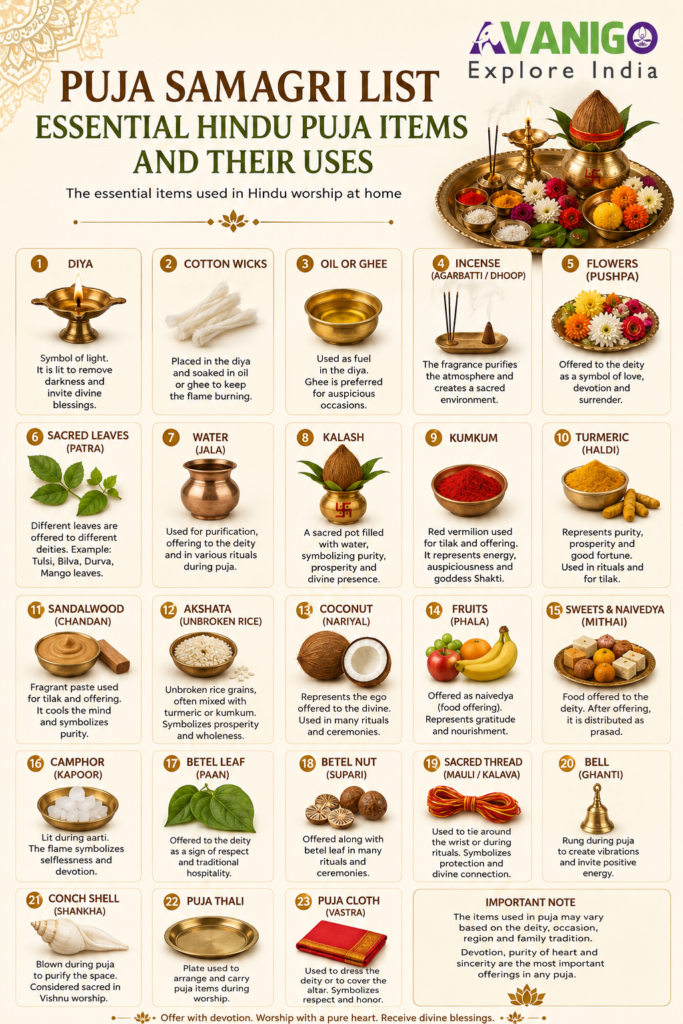
The diya, or traditional oil lamp, is one of the most recognisable objects in Hindu worship.
It is generally lit at the beginning of puja and may also be used during aarti.
The flame represents light and the removal of darkness, making it a central element of many forms of Hindu worship.
A diya may be made from clay, brass, silver or other materials. The fuel can vary according to household and ritual tradition, with oil and ghee among the commonly used options.
2. Cotton Wicks
Cotton wicks, traditionally called batti, are placed inside the diya and soaked in oil or ghee.
Different traditions use different types and numbers of wicks depending on the occasion.
For an ordinary daily puja, a simple cotton wick is sufficient.
3. Oil or Ghee
Oil or ghee provides the fuel for the diya.
Ghee lamps are particularly common in devotional practices, while different oils may be used according to family tradition or the particular ritual.
There is no need to assume that one fuel is universally prescribed for every Hindu puja.
4. Flowers
Flowers, known as pushpa, are among the most common offerings in Hindu worship.
Fresh flowers may be placed before the deity, offered individually or arranged into a garland.
The flowers used can also vary according to the deity and regional tradition.
For example, lotus flowers have strong associations with Lakshmi, while particular flowers and leaves have specific significance in the worship of other deities.
The important principle is that offerings are made with devotion rather than simply for decoration.
5. Sacred Leaves
Leaves are another important category of puja offerings.
Some of the best-known include:
- Tulsi for Vishnu and Krishna traditions
- Bilva leaves in Shiva worship
- Durva grass in Ganesh worship
- Mango leaves in certain auspicious ceremonies
The appropriate leaf therefore depends on the deity and ritual.
AvaniGo already has related material discussing the cultural significance of mango leaves in Hindu rituals.
6. Water
Water is used throughout Hindu worship.
It may be offered to the deity, used for purification, placed in a kalash or used during ritual bathing.
Water is one of the simplest and most fundamental offerings in puja. Traditional descriptions of Hindu worship include several forms of water offering as part of the ritual sequence.
7. Kalash
A kalash is a vessel traditionally filled with water and often decorated with mango leaves and a coconut.
It has an important place in many Hindu ceremonies and auspicious rituals.
The precise arrangement and symbolism can vary by tradition, but the kalash is broadly associated with auspiciousness, abundance and sacred presence.
8. Kumkum
Kumkum is a red powder traditionally used for tilak and various Hindu rituals.
It may be applied during worship or offered to a deity.
AvaniGo already has a dedicated article on the importance of kumkum in Hinduism.
Related reading: Importance of Kumkum in Hinduism
9. Turmeric
Haldi, or turmeric, is widely associated with auspiciousness in Hindu traditions.
It is used in various rituals, including puja and ceremonies associated with marriage and other important occasions.
Turmeric may be used on its own or together with kumkum.
10. Sandalwood Paste
Chandan, or sandalwood paste, is used as a fragrant offering and may also be applied as a tilak.
Its cooling fragrance and traditional association with purity make sandalwood an established part of many forms of Hindu worship.
11. Akshata
Akshata refers to unbroken rice grains, often prepared or mixed with turmeric or kumkum depending on the ritual.
Rice is associated with abundance and auspiciousness and is used in various Hindu ceremonies.
Because the grains remain whole, akshata is distinct from ordinary cooked rice.
12. Coconut
The coconut, or nariyal, is widely used in Hindu rituals.
It may be placed on a kalash, offered during puja or used during ceremonies marking an auspicious beginning.
The use of coconut varies between rituals and regions, so it should not be treated as compulsory for every daily puja.
13. Fruits
Fresh fruit is commonly used as naivedya, or food offered during worship.
The fruit is presented to the deity before it is distributed or consumed as prasad.
Common offerings include bananas, apples, oranges, coconut and seasonal fruits.
The exact choice is generally influenced by availability, tradition and the particular occasion.
14. Sweets and Other Naivedya
Food offered to a deity is known as naivedya.
It can include fruits, sweets, cooked food, milk preparations or other foods appropriate to the particular tradition.
After being offered, food may be distributed as prasad.
Traditional descriptions of puja commonly include food, fruit and sweets among the offerings made to the deity.
15. Incense
Agarbatti and dhoop are used as fragrant offerings during puja.
Incense is often lit before or during worship, creating a distinct sensory atmosphere around the prayer space.
Dhoop and incense sticks are not necessarily identical. Dhoop generally refers to thicker or differently prepared forms of incense.
16. Camphor
Kapoor, or camphor, is commonly associated with aarti.
A small quantity is lit and moved before the deity as part of the ritual.
Camphor is therefore especially associated with the concluding or prominent light-offering portion of many pujas.
17. Betel Leaves and Betel Nut
Paan, or betel leaf, and supari, or areca nut, appear as offerings in many traditional rituals.
They are particularly associated with more elaborate puja procedures and ceremonial hospitality.
They are not required for every simple daily household puja.
18. Mauli or Kalava
A mauli, also called kalava in many parts of India, is a sacred thread used in Hindu rituals.
It may be tied around the wrist or used as part of a particular ceremony.
The way it is used can vary according to region and ritual tradition.
19. Bell
The ghanti, or ritual bell, is commonly used during puja and aarti.
It marks the worship and creates a distinctive ritual sound.
Some households keep a bell permanently near the shrine, while others use it only during particular forms of worship.
20. Conch Shell
The shankha, or conch shell, has a prominent place in many Hindu traditions, particularly Vaishnava worship.
It may be blown during worship and can also be used as a ritual vessel in some traditions.
Its use is not universal across every household or every form of puja.
21. Puja Thali
A puja thali is the plate or tray used to organise the materials needed during worship.
A simple thali might contain:
- Diya
- Cotton wicks
- Kumkum
- Turmeric
- Akshata
- Flowers
- Incense
- Camphor
- Small vessels for water
- Other items appropriate to the ritual
Puja thalis can be made from steel, brass, silver and other materials. Their size and contents vary according to the occasion.
Basic Puja Samagri for Daily Home Puja
If you are performing a simple daily puja at home, you do not necessarily need the entire list above.
A practical basic set can include:
Essential
- Diya
- Cotton wick
- Oil or ghee
- Incense
- Flowers or appropriate leaves
- Water
- Kumkum
- Turmeric
- Akshata
- Fruit or another simple naivedya
- Puja thali
Optional depending on tradition
- Sandalwood paste
- Camphor
- Bell
- Conch
- Coconut
- Betel leaf
- Betel nut
- Sacred thread
This distinction is important because a simple home puja does not need to imitate an elaborate temple ritual. Hindu worship traditions allow considerable variation in the number and type of offerings.
Puja Samagri for Different Hindu Deities
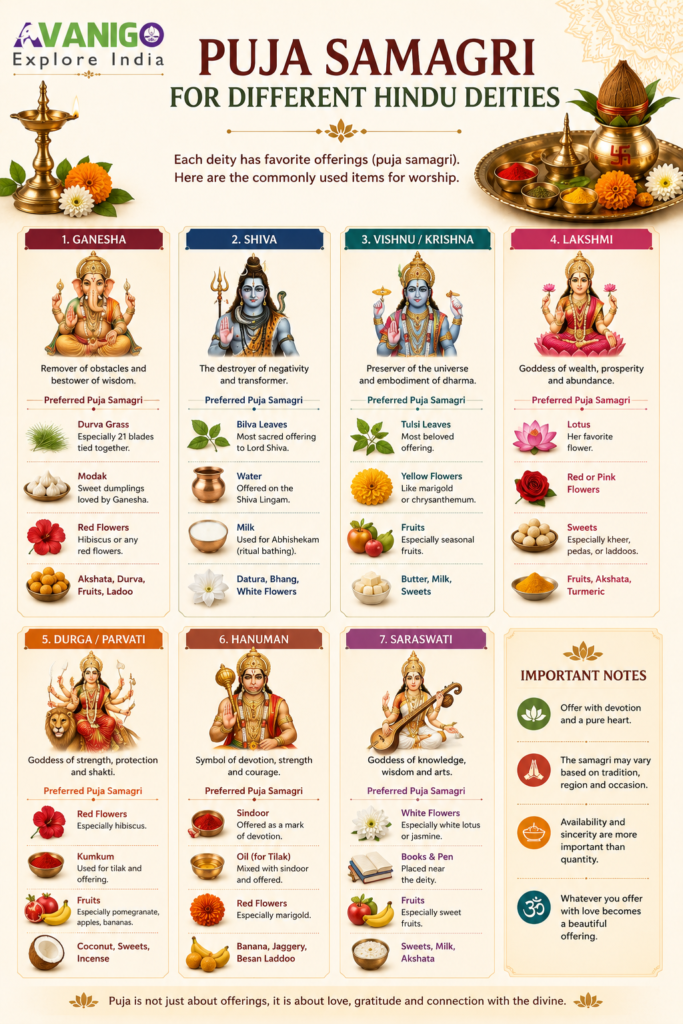
The basic items may remain similar, but certain offerings are traditionally associated with particular deities.
| Deity | Commonly associated offerings |
|---|---|
| Ganesha | Durva grass, flowers, modak |
| Shiva | Bilva leaves, water, milk |
| Vishnu / Krishna | Tulsi leaves, flowers, fruits |
| Lakshmi | Lotus, flowers, fruits, sweets |
| Durga | Flowers, kumkum, fruits, sweets |
| Hanuman | Sindoor, flowers, fruits |
| Saraswati | Flowers, fruits, books or learning-related offerings |
These associations are tradition-specific rather than universal rules. Offerings can differ significantly across regions, sampradayas and family practices.
What Is the Difference Between Puja Samagri and Puja Thali?
The two terms are often confused.
Puja samagri refers to the collection of materials used during the worship.
Puja thali is the tray used to arrange and carry some of those materials.
So the thali is one part of the puja setup, while samagri refers to the broader collection of ritual items.
Does Every Hindu Puja Require All These Items?
No.
This is perhaps the most important point when preparing a puja samagri list.
A simple household puja can be much shorter than a formal Shodashopachara, or sixteen-offering, puja.
Traditional Hindu worship has multiple forms, and the materials can change depending on:
- The deity being worshipped
- The occasion
- The region
- Family tradition
- Sampradaya
- Type of puja
- Whether a priest is conducting the ritual
- Whether the worship is daily or ceremonial
Even the most elaborate traditional lists should therefore be treated as guides rather than a universal checklist.
Final Thoughts
A puja does not become meaningful because the worship space contains the largest number of ritual objects.
At its simplest, Hindu puja involves approaching the divine with attention, reverence and an offering.
Water, flowers, light, fragrance and food are some of the most familiar ways in which that offering is expressed.
The samagri may change from one household to another, but the underlying practice remains remarkably consistent: to create a sacred space, offer with devotion and turn one’s attention towards the divine.
So if you are preparing for a simple puja at home, start with the essentials rather than worrying about collecting every possible item.
The right puja samagri is ultimately the one appropriate to the particular worship you intend to perform and the tradition you follow.