
Quick Navigation
Indian Brassware: Traditional Uses, Crafts and Cultural Significance
There is something immediately recognisable about Indian brass.
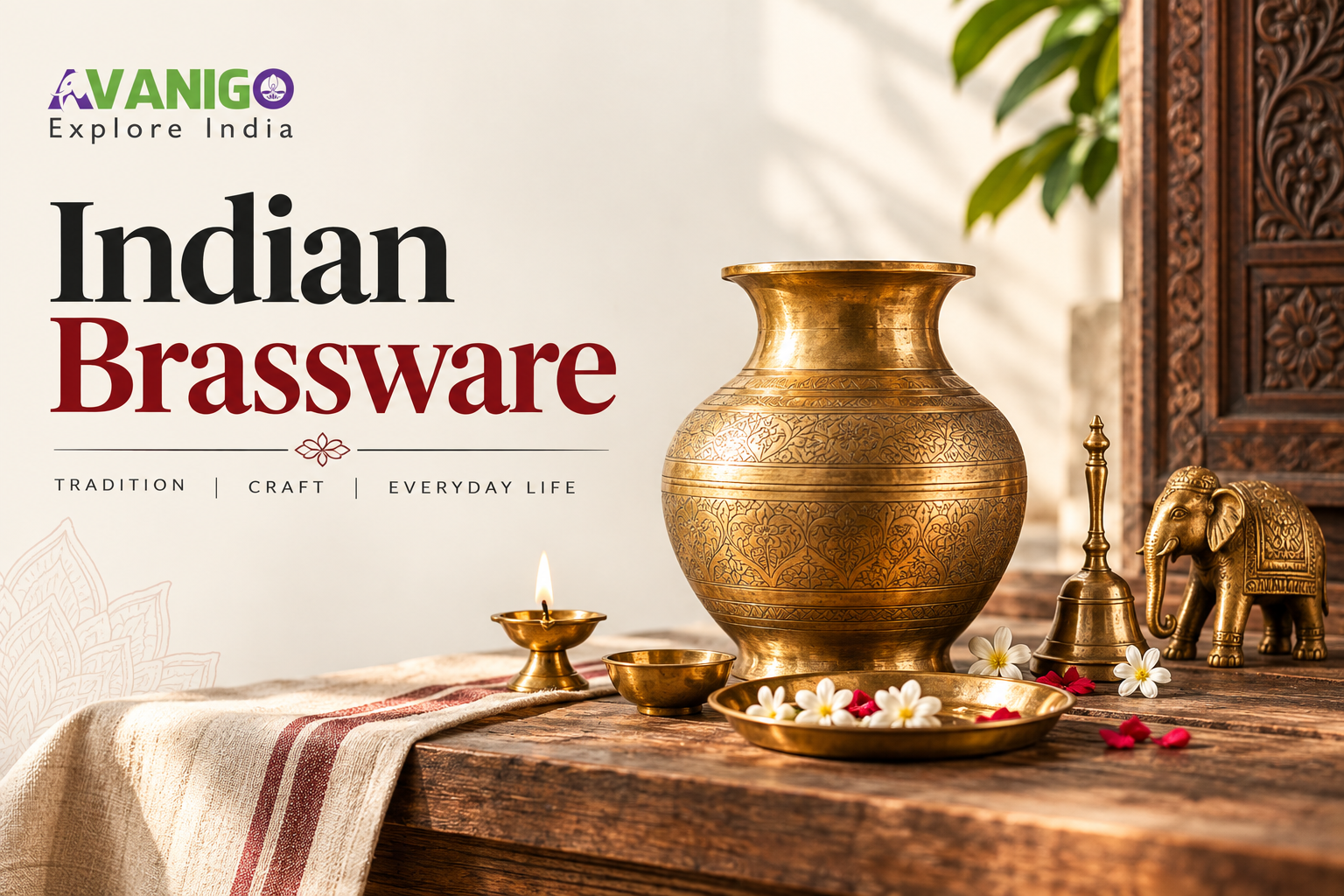
The warm golden surface of a pital diya, the weight of an old lota, the sound of a brass bell, the rounded form of a traditional cooking vessel or the quiet shine of a brass urli can make an ordinary room feel unmistakably Indian.
But brassware in India was never simply decorative.
It occupied the space between utility, ritual and craftsmanship.
Brass vessels were used in households, temples and ceremonial settings. Artisans turned the same material into lamps, bells, water vessels, serving ware, religious objects and decorative pieces. In different regions, brass acquired different forms, techniques and visual languages.
And the material has not disappeared with modernisation.
Quite the opposite.
Brass is finding its way back into contemporary Indian homes as people look for objects that are durable, repairable, handcrafted and connected to place and tradition. Current market data also reflects the continuing strength of Indian craft production. In FY2024-25, India’s handicraft exports excluding hand-knotted carpets reached ₹33,122.79 crore, with art metalware accounting for ₹4,386 crore.
So why has brass remained relevant for so long?
The answer lies partly in the material itself, and partly in what generations of Indian craftspeople learned to do with it.
What Is Brass?
Brass is an alloy primarily made from copper and zinc.
Its characteristic yellow-gold appearance, malleability and durability made it useful for both functional and decorative objects. India’s handicrafts portal describes brass as a longstanding material in the country’s artistic and functional heritage, used for utensils, lamps, musical instruments and religious artefacts.
It is important, however, not to confuse every traditional Indian yellow-metal vessel with brass.
Indian material culture includes brass, bronze, bell metal, copper and other alloys, and historical terminology does not always map neatly onto modern metallurgical categories.
That distinction becomes particularly important when discussing ancient texts.
How Old Is Brassware in India?
The history is more interesting than the familiar claim that “brass has been used in India for thousands of years.”
The evidence needs some qualification.
Ancient Indian literature clearly documents the use of metal vessels and utensils, but the materials mentioned include copper, bronze or bell metal, iron, gold and other alloys. The specific history of brass, as a copper-zinc alloy, is more complicated.
A study of ancient Indian economic history records kāṃsya, a copper-tin alloy, in the Chandogya Upanishad and in the Ramayana. It also records pittala, or brass, in the Maitrayana tradition and a reference to pittala in the Ramayana.
The Arthashastra also lists arakuta, generally identified as brass, among metals.
That gives us a more credible historical picture:
Metal vessels are unquestionably ancient in India. Brass itself also has an old textual history, but it should not be casually projected backwards into every Vedic reference to metal.
That distinction makes the story more interesting, not less.
Brass in the Ramayana
The Ramayana provides several references to metal vessels and materials.
One historical study of the epic notes the use of bell-metal vessels for milking in the account of Dasharatha’s gifts following the marriage ceremonies of his sons. The same study identifies a reference to pittala, brass, in the epic.
This is useful because it tells us something about the material culture surrounding ancient Indian households and ceremonial life.
But we should not conclude that every vessel mentioned in the Ramayana was brass.
Ancient Indian texts use several material terms, and translating them all as “brass” creates a false sense of certainty.
Brass, Bronze and Bell Metal Are Not the Same
This is one of the most useful distinctions for anyone buying traditional Indian metalware today.
Brass: Primarily copper and zinc.
Bronze: Traditionally associated with copper and tin.
Bell metal: A copper-based alloy traditionally used for vessels, bells and other objects, with regional compositions and traditions.
Copper: A metal in its own right, rather than an alloy.
The differences matter because they affect colour, hardness, sound, reactivity, casting behaviour and appropriate use.
This is also why a good brassware article should not treat every traditional “pital” or “kansa” object as interchangeable.
Why Was Brass So Useful in Indian Homes?
Brass offered a useful combination of properties.
It is relatively durable, can be shaped and worked into detailed forms, has a distinctive appearance and does not rust in the way iron does.
That made it suitable for objects that were expected to last.
A brass vessel could move from one generation to another.
A lamp could remain part of a household’s daily puja.
A bell could remain in a temple for decades.
A decorative vessel could eventually become an heirloom.
That longevity is one reason traditional metalware fits naturally into today’s conversation around slow consumption and durable home products.
Brass in Hindu Rituals
The connection between brass and Hindu worship is particularly strong.
Brass is commonly used for:
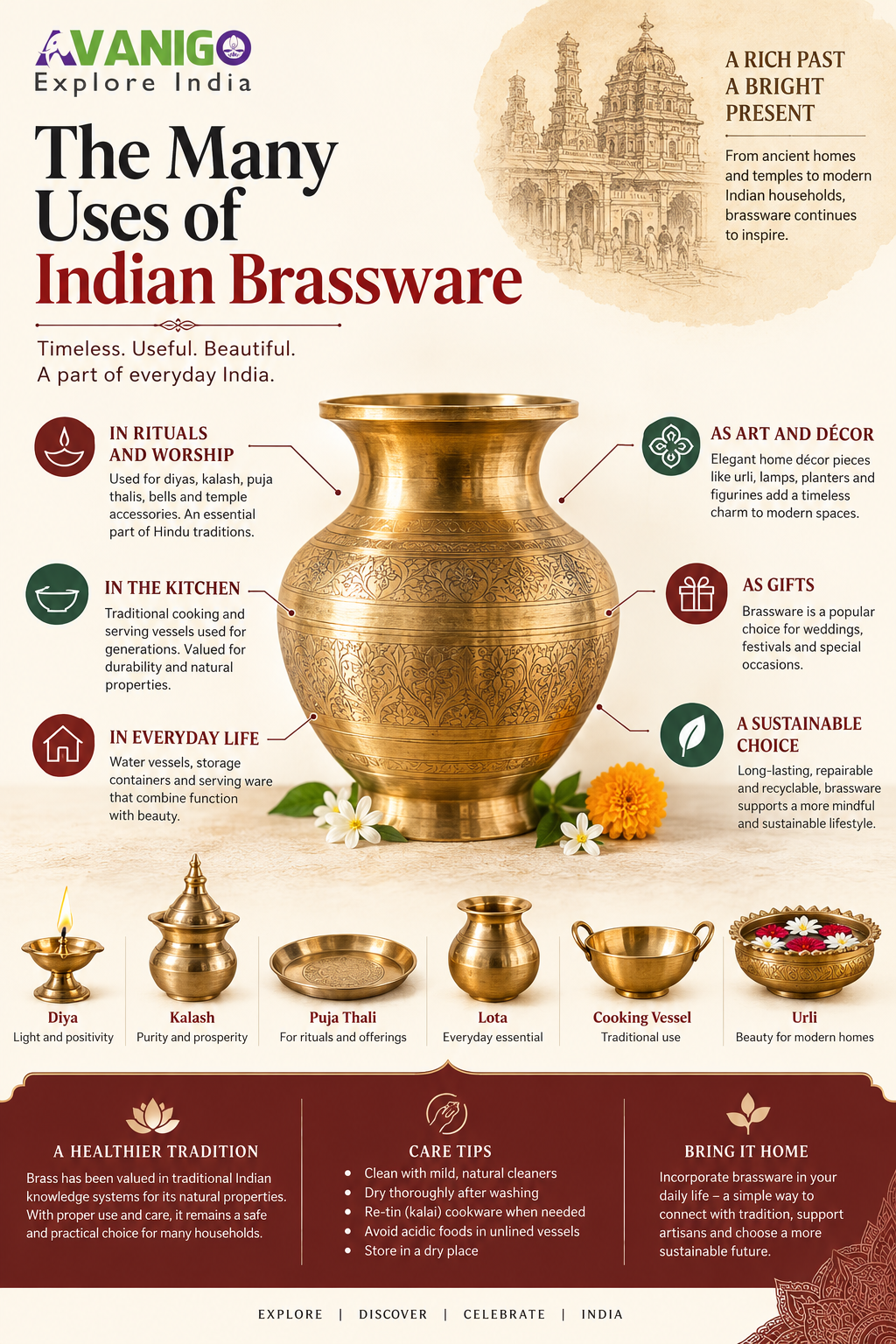
- Diyas
- Aarti lamps
- Bells
- Kalash
- Puja thalis
- Incense holders
- Deepam stands
- Small vessels
- Temple accessories
- Deity ornaments and decorative objects
The appeal is not merely visual.
A brass diya or bell has a tactile quality that mass-produced plastic or lightweight metal objects cannot reproduce.
The object itself becomes part of the ritual environment.
This is one reason brass continues to have a place in contemporary Indian homes even where traditional household practices have otherwise become more compact.
From Household Vessel to Temple Object
Indian brassware has always occupied several worlds at once.
The same broad material tradition produced objects for:
the kitchen → the puja room → the temple → the living room → ceremonial gifting.
That overlap is important.
It explains why brass remains particularly visible in Indian weddings, religious ceremonies, festive gifting and traditional home décor.
A brass diya can be both a functional lamp and a decorative object.
A brass urli can be both a ceremonial vessel and a contemporary centrepiece.
A brass bell can be both a religious object and an example of metal craftsmanship.
Moradabad: India’s Brassware Capital
When discussing Indian brassware today, Moradabad in Uttar Pradesh is impossible to ignore.
Known as Pital Nagri, or the Brass City, Moradabad has developed into one of India’s best-known metal craft centres.
The Government of India’s Incredible India platform notes the city’s long metalworking tradition and its wide range of products, including bells, lamps, incense holders, handles, decorative objects, bowls and planters.
The craft is particularly interesting because it is not a single technique.
Moradabad artisans work with processes such as:
- Casting
- Engraving
- Repoussé
- Cutwork
- Polishing
- Embossing
Historical craft documentation describes Moradabad’s modern brass industry as developing strongly in the nineteenth century, while its broader metalworking traditions have earlier roots.
The city’s craft economy also demonstrates something important about Indian handicrafts: a finished object can represent the work of several specialised hands rather than one artisan performing every stage.
Beyond Moradabad: India’s Regional Brass Traditions
Indian brassware is not a Moradabad-only story.
Craft traditions involving brass and related alloys occur across the country.
Among the recognised craft traditions are:
- Bastar Dhokra, Chhattisgarh
- Sarthebari bell metal, Assam
- Budithi brass and bell-metal craft, Andhra Pradesh
- Bakhira brassware, Uttar Pradesh
- Mhow-style metalware
- Regional brass utensil traditions in several parts of northern and southern India
Bastar Dhokra is particularly distinctive because it uses the lost-wax casting technique. The Government’s handicrafts portal describes the tradition as centuries old and notes the use of brass, clay, rice husk and other locally available materials in its production process.
The result is not polished uniformity.
It is the slightly irregular surface, hand-shaped detail and individual variation that tells you the object was made rather than stamped.
The Lost-Wax Tradition
Lost-wax casting, known in various Indian craft traditions as Dhokra, is one of the most fascinating techniques in Indian metalcraft.
An artisan first creates a form in wax and then builds a mould around it.
The wax is subsequently removed during firing, leaving a cavity into which molten metal is poured.
The mould is then broken to reveal the finished object.
That last step matters.
A traditional lost-wax object is not simply taken out of a reusable industrial mould. The mould itself is part of the making process.
Each casting can therefore carry small differences.
That is one reason handmade brass and bell-metal objects have a visual quality that is difficult to reproduce through mass manufacturing.
Is Brass Healthy?
This is where we need to separate traditional knowledge from modern medical evidence.
There are legitimate reasons to be interested in brass as a material, but claims that eating from brass vessels automatically improves digestion, immunity, heart health or longevity are not adequately established.
Research has demonstrated antimicrobial behaviour in copper-rich alloys, including brass, under certain experimental conditions. One study found significant reductions in Salmonella Enteritidis biofilm formation on brass surfaces compared with stainless steel controls.
That is interesting from a materials-science perspective.
But it does not mean that eating food from a brass plate provides a medical benefit.
Traditional Indian knowledge systems also recognised particular properties and uses of brass. A review of Pittala in the traditional Indian knowledge system notes brass-related instruments in Ayurvedic texts such as the Charaka Samhita and Sushruta Samhita.
Those historical references are valuable cultural evidence. They should not automatically be presented as modern clinical evidence.
Brass and Food Safety: The Part Modern Buyers Need to Know
This is more useful than making vague “health benefits” claims.
Brass is not appropriate for every type of food contact.
Brass contains copper, and copper can react with acidic or salty foods.
The Food Safety and Standards Authority of India advises against using aluminium or copper metals for serving sour or acidic food.
Traditional Indian kitchens developed a practical response to this problem: kalai, or tin lining.
A properly lined brass cooking vessel creates a barrier between the food and the underlying brass.
If the lining is damaged or worn, the vessel should not simply be treated as though it were still food-safe.
For acidic foods such as tamarind-heavy preparations, tomato-rich dishes or foods containing substantial vinegar or citrus, modern food-safety guidance should take precedence over nostalgia.
This is precisely where an old material deserves modern understanding rather than blind revival.
How to Clean Brass Utensils
Brass does not need to remain mirror-bright to be authentic.
A little patina is part of its character.
For routine cleaning:
- Wash with mild soap and water.
- Dry thoroughly.
- Avoid leaving water standing on the surface.
- Use a soft cloth rather than abrasive steel wool.
- For tarnish, use an appropriate brass cleaner or a mild traditional cleaning method.
- Test any acidic cleaning paste on a small area first.
- Do not aggressively polish engraved or antique pieces.
Traditional households have used ingredients such as tamarind, lemon and flour-based mixtures to clean metalware, although acidic cleaners should not be left on the metal for long periods.
The objective is to clean the brass, not grind away its surface.
How to Maintain Brass Cookware
For brass cookware, maintenance goes beyond polishing.
Check the inner lining.
If the vessel was originally tinned and the silver-coloured layer is worn through, it may need re-kalai before it returns to cooking use.
This is one of the most useful traditional skills to revive.
A vessel that can be repaired is a fundamentally different proposition from a disposable object.
Why Brass Fits the Sustainability Conversation
Sustainability is often reduced to the phrase “eco-friendly.”
Brass deserves a more nuanced discussion.
A well-made brass object can remain useful for decades.
It can be:
- Maintained
- Polished
- Repaired
- Re-tinned
- Reused
- Passed down
- Recycled as metal
Indian craft production also supports decentralised artisan economies. Government data identifies handicrafts as an important source of rural and semi-urban livelihoods, while recent government programmes such as One District One Product continue to promote local craft clusters and market access.
That does not make every brass product automatically sustainable.
Mining, alloy production, transport and energy use still have environmental costs.
But a durable, repairable object used for decades has a very different consumption pattern from a cheap decorative item bought and discarded after a season.
Why Brass Is Returning to Modern Indian Homes
The modern revival is not necessarily about recreating a nineteenth-century kitchen.
It is about selective continuity.
A contemporary home might use:
- One brass diya instead of several decorative objects
- A brass urli as a restrained centrepiece
- A brass lamp in an entryway
- Brass serving bowls for festive meals
- A traditional bell in the puja space
- Brass planters or vessels as accents
- A hand-crafted brass object alongside modern furniture
This works particularly well with contemporary Indian interiors because brass adds warmth without requiring an entire room to look traditional.
Current design coverage also points towards a broader movement of bringing brass, Indian textiles and traditional craft objects into otherwise modern interiors.
How to Buy Good Indian Brassware
When buying traditional brassware, look beyond shine.
Ask:
- What is it made from?
- Is it solid brass or plated?
- Where was it made?
- Which craft technique was used?
- Is the piece handmade or machine-produced?
- If it is cookware, does it have a food-safe lining?
- Can it be repaired?
- Does the seller know the artisan or craft cluster behind it?
The more specific the answer, the more likely you are buying an object with an actual material and craft story behind it.
Brass in the Indian Home: An Old Material With a New Role
The future of Indian brassware may not lie in trying to recreate the past exactly.
It may lie in choosing fewer, better objects.
A brass lamp that is lit every evening is more meaningful than ten decorative brass pieces gathering dust.
A well-made serving vessel used every festival can become part of a family’s material memory.
A repaired cooking vessel tells a better sustainability story than a replacement.
And a handcrafted object purchased directly from a known craft tradition keeps more than a material alive. It keeps skill, vocabulary, technique and memory in circulation.
That is why Indian brassware still matters.
Not because everything old is automatically better.
But because some old materials have qualities that remain remarkably relevant.