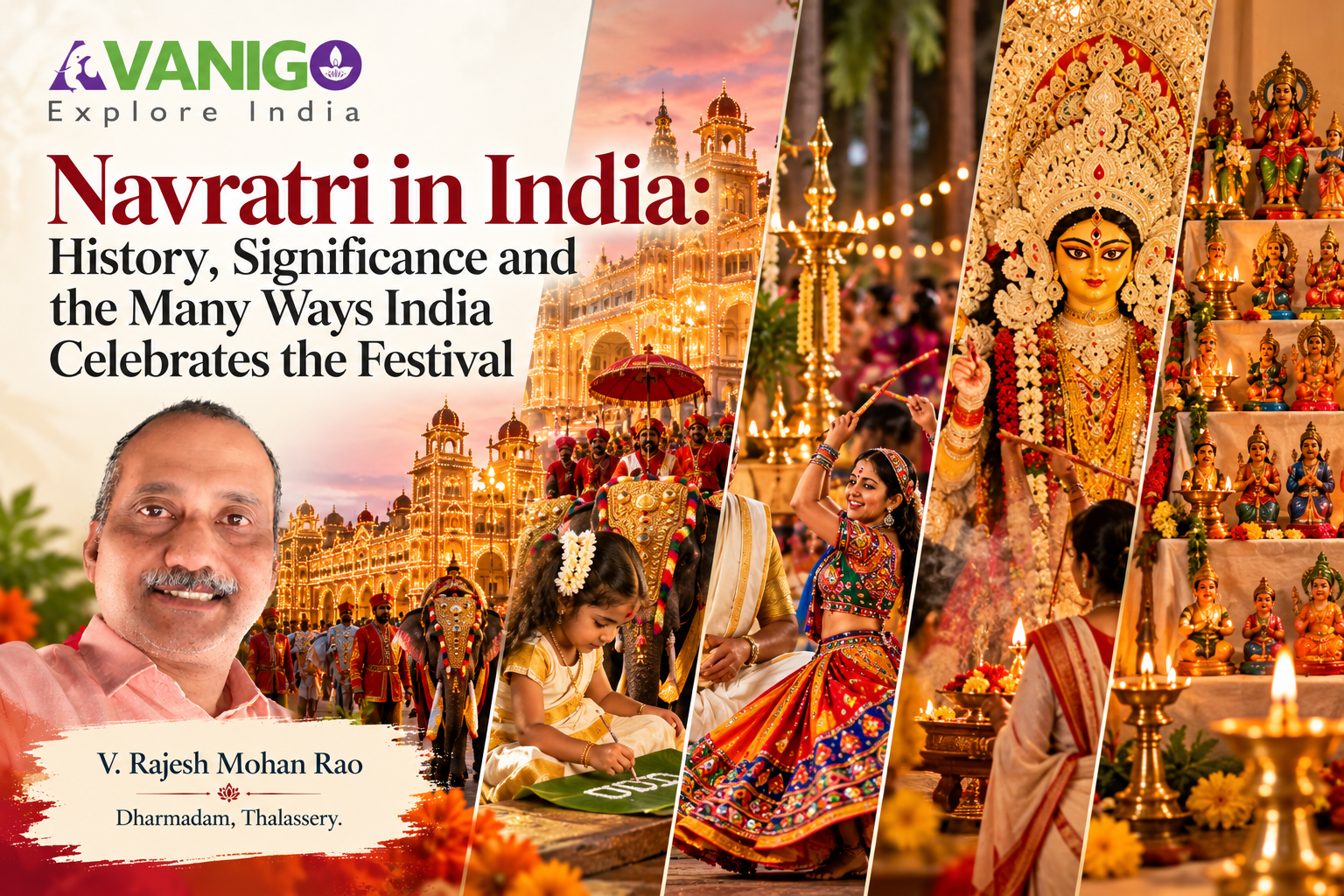
Navratri is one of the most widely celebrated festivals in India. The word Navratri means “nine nights”, and the festival is associated with the worship of the Divine Mother in different forms. Yet Navratri in India is much more than a religious festival. Across India, it brings together traditions of worship, music, dance, food, family gatherings, art, education and community life.
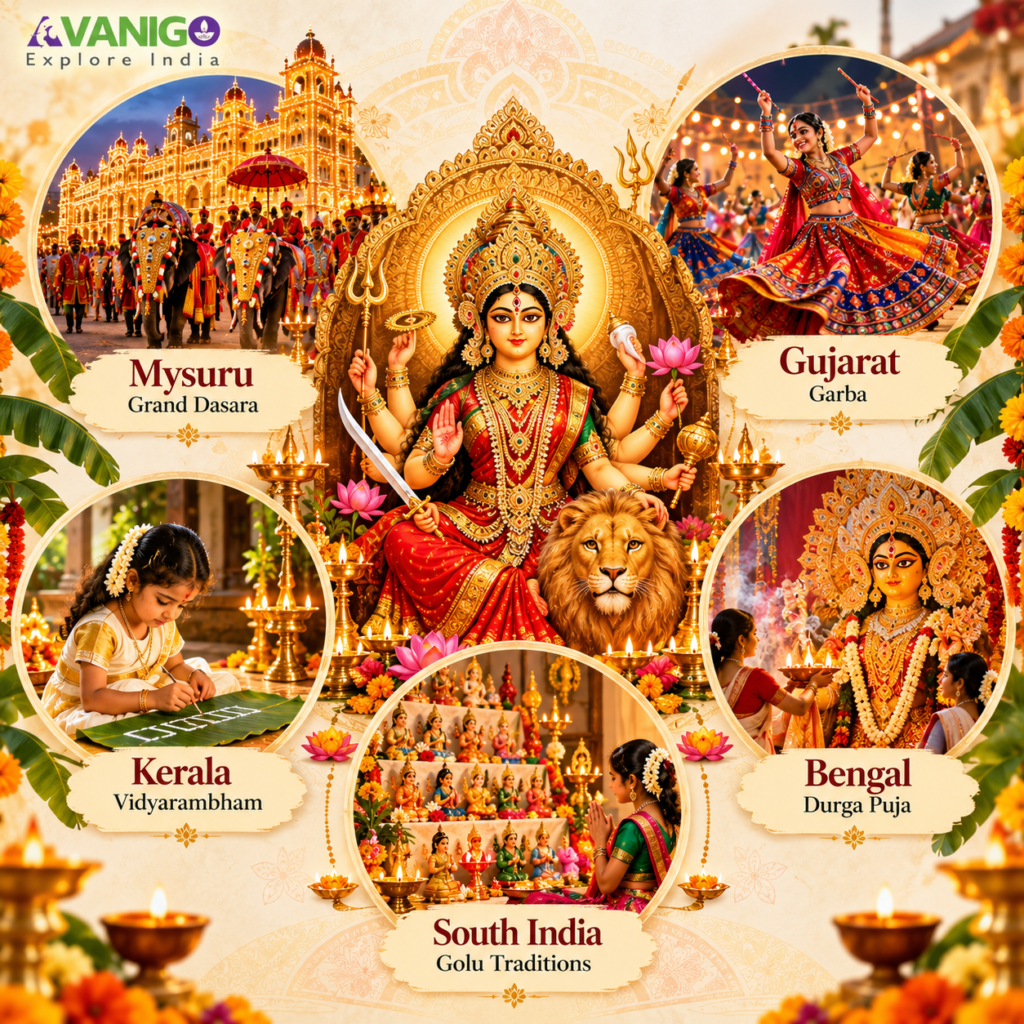
What makes Navratri particularly interesting is the way its celebrations change from one region to another. The same festival may appear as Durga Puja in Bengal, Garba and Dandiya in Gujarat, Mysuru Dasara in Karnataka, Bommai Golu in Tamil Nadu and Saraswati Puja and Vidyarambham in Kerala. These traditions are different in appearance, but they are connected by a common cultural idea: the celebration of goodness, knowledge, strength and the victory of dharma over evil.
Quick Navigation
What Is Navratri?
Navratri is traditionally observed for nine nights and ten days. Devotees worship different manifestations of Shakti, the divine feminine power.
In many traditions, the festival is associated with Goddess Durga and her victory over Mahishasura. The story represents the triumph of good over evil and is understood not only as a mythological event but also as a symbolic reminder that courage, discipline and righteousness can overcome destructive forces.
The tenth day is celebrated as Vijayadashami or Dussehra. It is considered an auspicious day for new beginnings in many parts of India.
However, Navratri is not celebrated in exactly the same way everywhere. Regional customs, family traditions and local history have given the festival many different forms.
The Nine Nights and the Idea of Shakti
The central idea of Navratri is Shakti, or divine energy. Goddess Durga is worshipped in different forms, representing qualities such as strength, wisdom, prosperity, compassion and protection.
For many families, the nine days are also a period of discipline. Some devotees observe fasting, while others follow particular dietary practices. Prayer, meditation, temple visits, bhajans and other forms of worship are common.
At the same time, Navratri is a social festival. Families meet, homes are decorated and communities organise cultural programmes.
This combination of spirituality and community life is one of the reasons why Navratri continues to remain relevant even in modern India.
Mysuru Dasara: Karnataka’s Grand Navratri Tradition
Karnataka has one of India’s most famous Dasara celebrations in Mysuru.
Mysuru Dasara has developed into a major cultural celebration, with the city decorated for the festival and a range of traditional and public events taking place. The festival is closely associated with the Wadiyar royal tradition and the cultural history of Mysuru.
The famous Dasara procession is an important attraction. Traditional music, decorated elephants, cultural performances and the ceremonial atmosphere make Mysuru Dasara a distinctive expression of Karnataka’s heritage.
For visitors, it is not simply a religious celebration. It is also an opportunity to experience the history, architecture, music and cultural traditions of Mysuru.
Navratri in Kerala: Worship, Learning and Vidyarambham
Kerala has its own distinctive way of observing the Navratri period.
The final days of Navratri are especially associated with Saraswati, the goddess of knowledge and learning. Books and learning materials are traditionally placed for worship, and children participate in Vidyarambham, the ceremonial beginning of learning.
Vijayadashami is particularly important for students, teachers and families. Children may begin their formal learning on this auspicious day, and the ceremony has become an important cultural tradition in Kerala.
The atmosphere around temples and cultural centres during this period reflects Kerala’s long connection between education, music, literature and spiritual traditions.
The Kerala tradition demonstrates that Navratri is not only about power and victory. It can also be a celebration of knowledge.
Navratri in Gujarat: Garba and Dandiya
In Gujarat, Navratri is closely associated with Garba and Dandiya Raas.
During the festival, people gather in large numbers in the evening to dance around a central lamp or an image representing the divine feminine. Traditional and contemporary music bring people together, and colourful clothing adds to the festive atmosphere.
Garba has become internationally recognised as one of India’s distinctive cultural dance traditions.
What began as a community and devotional tradition has also developed into a major cultural event in cities across India and among Indian communities abroad.
Durga Puja and Navratri in Eastern India
In West Bengal and several other parts of eastern India, the Navratri period is closely connected with Durga Puja.
Elaborate images of Goddess Durga are created, temporary structures known as pandals are decorated and communities come together for worship and cultural activities.
Durga Puja is also an important example of how a religious festival becomes part of a region’s artistic and social life. Sculpture, decoration, music, food and community participation all become part of the celebration.
The festival therefore represents both devotion and living cultural heritage.
Golu in South India
Tamil Nadu, Karnataka and parts of Andhra Pradesh and Telangana have traditions of arranging dolls and figurines during Navratri.
Known as Golu or Bommai Golu in Tamil Nadu, these displays can include representations of gods and goddesses, scenes from everyday life, traditional figures and artistic arrangements.
Families invite relatives and friends to see the display, exchange traditional gifts and share food.
This tradition gives Navratri a strong family and artistic dimension. Children also participate, making it an effective way of passing cultural traditions from one generation to another.
Food and Fasting During Navratri
Food is another important part of Navratri traditions.
Fasting practices differ considerably between communities. Some people avoid grains, some eat fruits and selected foods, while others observe a complete fast according to their personal or family tradition.
There is no single food rule that applies to every Hindu household during Navratri.
In many parts of India, special dishes are prepared during the festival. Fruits, milk, vegetables, traditional sweets and regional fasting foods are commonly associated with the period.
The diversity of Navratri food traditions also reflects India’s wider culinary diversity.
Navratri as a Festival of Family and Community
One of the most lasting features of Navratri is its ability to bring people together.
Families return to their ancestral homes, children meet grandparents and relatives, and neighbours participate in celebrations. Temples and community organisations conduct cultural programmes, music events and religious ceremonies.
In many places, the festival also creates opportunities for local artists, musicians, craftsmen, flower sellers, food vendors and small businesses.
Thus, Navratri is connected not only with religious belief but also with the social and economic life of communities.
The Cultural Meaning of Vijayadashami
The tenth day, Vijayadashami, carries a special meaning in many parts of India.
It is associated with victory and auspicious beginnings. In some regions, it commemorates the victory of Goddess Durga over Mahishasura. In other traditions, it is connected with Lord Rama’s victory over Ravana.
In Kerala, it is strongly associated with learning and Vidyarambham. In Karnataka, the Dasara celebrations have a distinctive historical and royal character.
These different traditions show how Indian culture can preserve multiple interpretations of the same festival without losing its broader identity.
Navratri in Modern India
Modern Navratri celebrations have changed in many ways.
Social media, television and digital platforms have taken the festival to audiences far beyond the communities where particular traditions originated. Garba is now performed in many Indian cities, Mysuru Dasara attracts visitors from different parts of the country, and Durga Puja has become an important cultural event in several metropolitan cities.
At the same time, many families continue to maintain older practices at home.
This balance between tradition and modernity is one of the interesting aspects of Indian festivals. Traditions do not always remain unchanged, but they can continue by adapting to new circumstances.
Preserving the Spirit of Navratri
The real value of Navratri lies not only in large celebrations or elaborate decorations.
It also survives in simple practices: a family lighting a lamp at home, grandparents explaining a traditional story to children, students beginning their education on Vijayadashami, women preparing traditional food, communities organising cultural programmes and people visiting temples together.
Such practices keep cultural memory alive.
India’s strength has always been its ability to preserve diversity while allowing traditions to evolve. Navratri is a good example of this cultural continuity.
Conclusion
Navratri is not one single festival with one single form of celebration. It is a collection of regional traditions connected by a common cultural idea of Shakti, devotion, knowledge, courage and the victory of good over evil.
From Mysuru’s grand Dasara to Kerala’s Vidyarambham, Gujarat’s Garba, Bengal’s Durga Puja and South India’s Golu traditions, the festival takes different forms while remaining deeply connected to Indian culture.
For the modern generation, Navratri offers more than an opportunity to celebrate. It provides a chance to understand India’s history, regional diversity, family traditions and living cultural heritage.
Perhaps that is why, after centuries of change, the nine nights of Navratri continue to find a place in homes, temples, schools, public spaces and communities across India.
About The Author
Rajesh Mohan Rao, Dharmadam, Thalassery.
The author is a higher secondary school teacher teaching commerce subjects and Member of Konkani language working committee Kerala.He is also the President of Dharmadam Chandrakala Mohan Rao Cultural Forum which serves the community.